Data center opposition continues to mount in Aurora, Colorado, as city leaders get ready to grapple with the controversial facilities once again
Published in News & Features
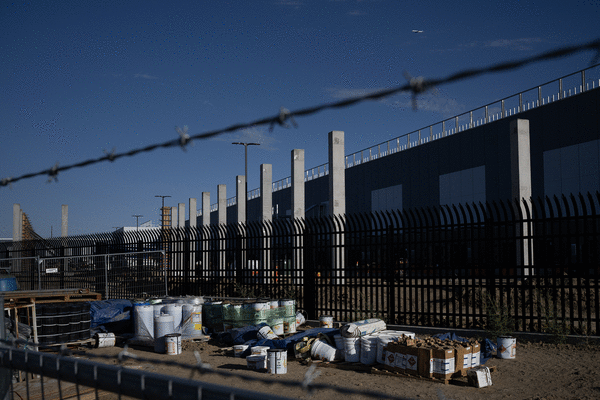
DENVER — The group gathered alongside the southern fence of the massive QTS data center in Aurora on Friday was small — but their demands were clear.
“Data centers kill — communities pay the bill,” the half-dozen protesters shouted at crews laying ground for a third building on the Virginia-based company’s campus at the southeast corner of Interstate 70 and E-470. “Hey hey, ho ho, these data centers have got to go.”
Friday’s protest could be seen as a warm-up for what is expected to be a long and contentious public hearing on data centers at Aurora City Hall on Monday night, as the facilities stuffed with computers, servers and other equipment that power today’s digital world raise hackles over their environmental impacts and their central role in spawning the artificial intelligence revolution.
“We know that the demand for these data centers is from AI, which we can agree doesn’t do us any good,” James Wooldridge, director of Climate Defiance, said on East 10th Avenue Friday as cement trucks and semi trucks rolled by behind him. “No one thinks this is a good idea.”
On Monday, data centers will once again be front and center at the Aurora City Council business meeting, with three measures teed up to rein in the fast-growing facilities.
The first proposes council’s “strong support and encouragement” of the relocation of Vantage Data Centers’ proposed Trident project, which has generated strong backlash from residents in neighborhoods near where the facility is slated to be built on a 108-acre site just inside the E-470 beltway at East 48th Avenue.
The Trident project, which would be Colorado's largest data center, would require 500 megawatts of power. A megawatt of power can power approximately 1,100 homes, according to Xcel Energy.
Aurora Mayor Mike Coffman has vehemently come out against the project at its current location, saying it "must be stopped."
“I don’t want to be the data center capital of the state,” he told The Denver Post earlier this month.
But the mayor's efforts to impose a data center moratorium, as has happened in an increasing number of surrounding communities — including Denver, Thornton and Brighton — have come up short in Aurora.
The City Council narrowly rejected a timeout on issuing new data center permits this past summer, instead opting to craft regulations for the facilities to address water use and proximity to neighborhoods.
But as opposition grew in the following weeks, the issue of a moratorium came back to council last month, where it was narrowly rejected. On Monday, the council will consider a measure to once again impose a moratorium on new data center applications, but the temporary ban would apply only to the city's urban core rather than its largely uninhabited eastern expanses.
“I don’t want other data center applications coming in under the existing rules because they are just too weak,” Coffman said.
The third item under consideration would be a halt to tax incentives to lure data centers to the city.
Aurora in 2023 gave QTS a tax break worth up to $19 million over 12 years if it creates and maintains 15 jobs with minimum salary requirements. Vantage in 2025 inked a deal worth up to $39 million over 10 years, as long as the company creates 50 jobs with minimum salary requirements.
Karen Cohen, a QTS spokeswoman, said many of the accusations leveled at hyperscale facilities like the one in Aurora are not accurate. QTS, she said, uses a closed-loop cooling system "that does not consume water for cooling once operational."
"This technology helps conserve local water resources while meeting the needs of a growing digital economy," she said. "After construction is complete, municipal water use is generally limited to standard building operations similar to those of other commercial facilities."
"We pay for the energy costs of our data centers so they do not increase local utility bills," Cohen said. "We create good jobs in communities in which we operate."
She said the company contributed more than $11.6 million in state and local taxes from its Aurora operations in 2025, and expects to contribute more than $13.8 million this year.
"With the campus still under construction, these contributions are expected to grow significantly, with current projections estimating more than $350 million in state and local tax revenue over the next 15 years," she said.
Back at the protest, Wooldridge pointed to hundreds of homes and a school in a neighborhood a few hundred feet south of the QTS campus. He worries about what the noise effects could be of a giant data center complex running around the clock, backed up with diesel generators when the power goes out.
"They're going to have to deal with that droning noise that doesn't stop," he said.
_____
©2026 MediaNews Group, Inc. Visit at denverpost.com. Distributed by Tribune Content Agency, LLC.






Comments