WA movie theaters must offer open caption screenings, per new law
Published in Entertainment News
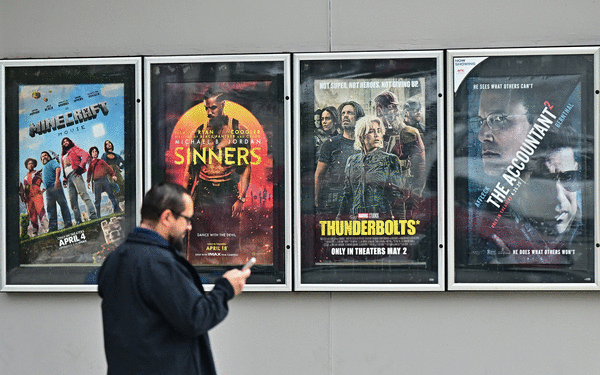
SEATTLE — The new year brings good news for those who love movies but are deaf or hard of hearing: Enacted Jan. 1, a new state law will increase the number of movie screenings using open captions, and require theaters to clearly identify those screenings in their advertising.
Open captions, as the name implies, are viewable by everyone, differing from closed captions in that they don’t require an individual device (which movie theaters have been required by law to offer for some years, but which are notorious for not always working properly). The captions will simply show up on the movie screen, readable by all audience members — similar to subtitles used on foreign-language films, but also including information like ambient noise and nonverbal sounds.
Elizabeth Ralston, a Seattle-based accessibility consultant who is deaf, called the new law “a huge win for the deaf and HOH communities.” In an email, she wrote, “Even though there are personal closed captioned devices available at theaters, having open captions benefits those who prefer to see the captions directly on the big screen. Offering multiple ways to enjoy a movie makes it accessible to an even larger number of people — there is quite a lot of diversity in communication preferences within the deaf community.”
She acknowledged that many movie theaters were already offering such screenings, but most of them on an irregular basis, and without predictability it can be hard to plan a movie outing. Many people, she said, may not know about the option of open captions; the new requirements will go a long way in raising awareness and accessibility.
The new law has been known as the John Waldo Act, named for the attorney and disability rights advocate who died in 2023. Waldo co-founded the Washington State Communication Access Project, which compelled numerous public spaces — transportation, live theaters, moviehouses, courtrooms, sports arenas — to offer captioning for the hard of hearing.
Under the bill, if a movie is available with open captioning (most major-studio releases are, though some older films may not have the option) and has at least five scheduled screenings, companies with five or more theaters in the state must offer two open captioned screenings a week in the first two weeks of release, among other requirements.
Of the major film chains in Washington, AMC and Cinemark already offer selected screenings with open captions, as well as on request, though the new law will require them to offer more. Regal, according to its website, appears to currently offer open captions only on request for groups of 10 or more.
Representatives for all three national chains did not respond to requests for information last week.
Jeff Brein, managing partner of Far Away Entertainment (which owns six moviehouses in the state), said in an email that his theaters have long offered open caption screenings on Tuesdays and upon patron request with 24-hour notice, though requests are infrequent. He said the chain would comply with the new law and begin offering the required twice-weekly open caption screenings of new films.
Individual moviehouses, or chains with four or fewer theaters, have the option of either following the same requirement or providing an open caption screening within eight days of a patron request. SIFF, with its three theaters, already offers open captions on all screens on Tuesdays and Sundays, as does the Grand Cinema in Tacoma on Wednesdays and Sundays. Jesse Plack, manager of the three-screen Majestic Bay in Ballard, said that while his theater doesn’t currently offer regularly scheduled open caption screenings, patrons looking for that format should contact the theater and will be happily accommodated.
Washington is not the first state to require open caption accessibility in movie theaters; Hawaiʻi and Maryland, as well as Washington, D.C., and New York City, have already passed such laws, and other states (including North Carolina and Michigan) have bills in progress.
———
© 2026 The Seattle Times. Visit www.seattletimes.com. Distributed by Tribune Content Agency, LLC.









Comments