'The Fugitive': 16 filming locations to visit around Chicago
Published in Entertainment News
CHICAGO — “This is Kimble’s house.”
That’s what Norbert Gleicher remembers actor Harrison Ford telling director Andrew Davis after Ford toured the contemporary home at 336 W. Wisconsin St. in early 1993.
The Chicago-born Davis and his team — at the time desperate to firm up plans for the film which was set to shoot around the city — were still working on the thriller’s script.
“This is a movie where I was handed the most beautiful ingredients and no recipe,” Davis told the Tribune’s Michael Phillips in 2023. “The studio had an idea of what kind of meal they wanted, but no recipe. So I had to figure out how to run the kitchen and make it work.”
A chance encounter over Italian food provided the locale for the movie’s opening murder scene. Gleicher, an infertility specialist now based in New York, and his young family were eating dinner at Bice when his daughter Anja wandered away from their table.
“The place was unusually empty. They knew us there, so we let our three-year-old daughter run around,” Gleicher recalled in a phone interview this week. “Suddenly the manager said there were some people in the other room who wanted to talk to me.”
Gleicher found Anja entertaining a table of cast and crew members, which included one of his patients. He invited them all back to Lincoln Park for drinks, and soon, filming equipment was moved in and out of his family’s home for the next few weeks. Ford’s “Fugitive” character Richard Kimble even adopted some of Gleicher’s mannerisms, including a bushy beard and a flashy Mercedes.
Or did Ford get the bushy beard idea from a surgeon? Ford shadowed Bruce Gewertz, the chairman of surgery at the University of Chicago Medical Center, before filming began.
Gewertz, who consulted with screenwriter Jeb Stuart on medical terms used in the script, brought Ford into his fold. Scenes were shot at his hospital and at Cook County Hospital.
“He was an incredible observer, and he was able to take over my role in an operating room and make it seem realistic,” Gewertz said about Ford.
The interaction even influenced Kimble’s specialty. “I argued for changing the protagonist from a neurosurgeon to a vascular surgeon,” Gewertz said. “And they bought.”
Gewertz appeared for about a minute in a role credited as “Dr. Bruce.”
“The Fugitive,” which was based on a popular TV series from the 1960s, became a box-office success. Tribune critic Gene Siskel called it “a delicious story as the hunted becomes the investigator, and the investigator is, at first, the hated.”
By incorporating actual footage from the city’s Chicago River dyeing and St. Patrick’s Day Parade, “The Fugitive” is now also considered the quintessential film for March 17.
Here’s a look at 16 different filming locations around the city — from Lincoln Park to Pullman — that gave the film its Chicago savvy, including one that’s the forever home for a real one-armed man.
1. Richard Kimble’s home
336 W. Wisconsin St. (Lincoln Park)
In the film: Richard Kimble’s wife, played by Sela Ward, was bludgeoned, then shot to death in an upstairs bedroom by a mysterious man, who escaped after a struggle with Kimble. The surgeon noticed one distinction about the man — he had a prosthetic arm. (The Tribune erroneously wrote in September 1992 that Ford would play the one-armed man.) Kimble, however, was arrested for the crime as reporters — including WBBM-TV’s John “Bulldog” Drummond — watched.
In reality: The house was a construction zone when Gleicher bought it in the early 1980s, he told the Tribune, complete with a large hole in the ground floor where a swimming pool had been dug by the previous owner but not completed. He had no choice but to live there, as Donald Rumsfeld moved into the Gold Coast condo formerly owned by the in-vitro fertilization expert.
Gleicher expanded the house before the movie was shot, tacking on several more bedrooms, two floors and an elevator.
To prevent damage to Gleicher’s extensive art collection, a replica of the home was constructed on a nearby sound stage.
2. Bus loading
1119 E. 46th St. (Kenwood)
In the film: Kimble was interrogated by Detective Kelly (played by Ron Dean who, in reality, killed a police officer and served time in prison) and Detective Rosetti (played by former Chicago police Sgt. Joseph Kosala).
Following his conviction, Kimble and a handful of others walked outside the brick building to be loaded on a bus bound for Menard Correctional Center. (The train crash, hospital and dam scenes were filmed in North Carolina.)
In reality: The address is a parking lot entrance for Ariel Community Academy and North Kenwood Oakland Charter School (formerly Shakespeare Public School).
3. Airport
1521 S. Linn White Drive (Near South Side)
In the film: Samuel Gerard (played by Tommy Lee Jones, who received an Academy Award for Best Supporting Actor for the role) and his crew of U.S. marshals boarded a plane bound for Chicago.
In reality: It was Meigs Field, the city’s lakefront airstrip. After Mayor Richard M. Daley ordered it destroyed in March 2003, the area was converted into a 40-acre nature preserve.
The former terminal building — which was also the site of “Scranton” airport in “Home Alone” — remains.
4. Stockyards Truck Stop
4512 S. Halsted St. (New City)
In the film: Kimble stopped here to alter his appearance before he hitchhiked to Chicago.
In reality: The diner didn’t receive high marks in a June 1980 story headlined, “Where the cops and caddies go to eat.”
“I’d do almost anywhere, though than eat the freaking slop in here,” truck driver George Dennison told the Tribune. “It’s getting worse. I wouldn’t ever come here, but my company’s got an office here. I wouldn’t say all truck stops are bad, though. They’re not, except this one.”
Today it’s a vacant lot.
5. House raided by Gerard’s team
8942 S. Green Bay Ave. (South Chicago)
In the film: Gerard’s team acted on a tip that an escaped convict — potentially Kimble — was staying at the residence.
In reality: Buildings on the street were demolished, which is now the site of a 15-acre recreation area — Clara D. Schafer Park. Nearby are Calumet Fisheries and a one-person cemetery for one-armed Battle of Waterloo veteran Andreas von Zirngibl.
6. Kimble’s call
Northeast corner of Wells Street and Wacker Drive (Loop)
In the film: Kimble called his attorney from an Illinois Bell (now part of AT&T) public telephone, who encouraged Kimble to turn himself in to the police. Though Kimble told his lawyer he was in St. Louis, Gerard’s gang knew he was in Chicago due to the sound of the “L” car and bridge house bell.
In reality: Each bridge house along the Chicago River — including this one near the Merchandise Mart and Chicago Riverwalk — is equipped with a bell. It is rung as a warning before and while gates close the bridge to traffic during bridge lift season. According to the McCormick Bridgehouse & Chicago River Museum, the city’s bridges open about 40 times per year from April to November to accommodate tall ships trying to get to/from Lake Michigan. The 2026 season will begin April 22, according to chicagoloopbridges.com.
7. U.S. Marshals headquarters
401 N. Michigan Ave. (Near North Side)
In the film: The iconic clock of the Wrigley Building was the view from the marshals’ office as they worked to find Kimble — and avoided answering questions from Pam Zekman, another WBBM-TV reporter.
In reality: The office tower formerly known as the Equitable Building sits next to Tribune Tower in Pioneer Plaza. The Chicago headquarters for the marshals is at the Dirksen U.S. Courthouse.
8. North Bank Club
405 N. Rush St. (Near North Side)
In the film: Kimble’s colleague Charles Nichols (played by Jeroen Krabbé) left his tennis match at the North Bank Club in his BMW. Kimble asked him for money on Lower Water Street — just across from Tribune Tower.
In reality: There’s no tennis to be found on this lower part of the Wrigley Building. But those walking to the Wendella tour boats dock will walk right past it.
9. Kimble’s apartment
9000 S. Houston Ave. (South Chicago)
In the film: With little money available, Kimble paid cash for this basement apartment.
In reality: The multi-family home is near the National Shrine of St. Jude, the patron saint of desperate situations.
10. Cook County Hospital
1825 W. Harrison St. (Near West Side)
In the film: Kimble returned incognito to do research on potential one-armed suspects. He was helped by physician Kathy Wahlund (Jane Lynch), but hindered by Anne Eastman (Julianne Moore) after he diagnosed an injured boy.
In reality: Cook County Hospital was designed in the Classic Revival style by Paul Gerhardt, a German American architect who also planned Lane Tech College Prep. The migrants and the poor were treated inside the two-block-long structure nicknamed Chicago’s Ellis Island, which also was the site of the first blood bank in the United States, founded by immigrant Hungarian doctor Bernard Fantus.
A multiphase $1 billion redevelopment — that included two hotels, a food hall, day care center and medical offices — reopened on the site in 2020.
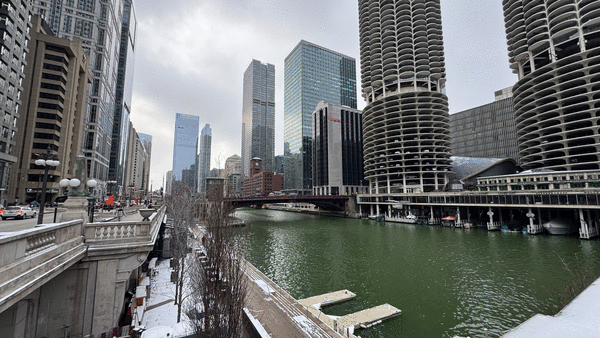
11. Chicago River dyeing
On State Street Bridge looking west toward Dearborn Street
In the film: Men in a small boat appear in a freshly dyed Chicago River.
In reality: The annual dyeing takes place the Saturday before every St. Patrick’s Day in Chicago. It’s a tradition that debuted in 1962. Now, however, sightseeing boats are used to blast an orange powder that turns slime green when it touches water.
12. ‘Jail’
121 N. LaSalle St. (Loop)
In the film: Attempting to cross potential one-armed suspects off his own list, Kimble visited a jail to meet with one of them. It’s also where Gerard begins to chase the doctor.
In reality: It’s really the Chicago City Hall-County Building, and there’s no jail inside. It’s across the street from Daley Plaza.
13. St. Patrick’s Day Parade
Dearborn Street at Washington
In the film: To evade Gerard, Kimble donned a green hat and joined a group of plumbers who marched in the St. Patrick’s Day Parade.
In reality: The scene was shot live during the 38th edition of the parade on March 17, 1993. WGN-TV reporter Robert Jordan interviewed Jones for a short segment of the live broadcast.
But “The Fugitive” wasn’t the only movie shot during the parade. “Blink,” starring Aidan Quinn and Madeleine Stowe, was the other.
14. Hotel: Men Only
426 S. Clark St. (Loop)
In the film: After his basement apartment was raided, Kimble checked into a single-occupancy, men-only hotel.
In reality: As of 2021, the Ewing Annex Hotel was the last of it kind in the city, according to New Republic. Across the street is Metropolitan Correctional Center where convicted bank robbers Joseph “Jose” Banks and Kenneth Conley scaled down some 15 stories of the sheer wall in 2012 using a rope fashioned from knotted bedsheets. It was the first jailbreak at the facility in nearly 30 years.
Banks hid in a predictable spot less than five miles from the South Loop jail and was betrayed by someone who had spoken with the fugitive and was able to give authorities his exact location, a law enforcement source said. When he was captured, Banks had no cash, weapon or cellphone, and he was wearing some of the same clothes he had on when he escaped three days earlier, the source said.
Conley remained on the loose for 18 days until he was found sleeping in a basement furnace room at a Palos Hills apartment complex.
15. One-armed man’s house
11217 S. Saint Lawrence Ave. (Pullman)
In the film: Kimble broke into the home to find evidence that connected one-armed man Fredrick Sykes (Andreas Katsulas), a former police officer, to the murder of Kimble’s wife. He also uncovered Sykes’ connection to one of Kimble’s murdered colleagues.
In reality: The historic home is next door to Greenstone Church, which, except for exterior improvements, has remained largely unchanged since the 1880s. Pullman National Monument — the first National Park Service unit in Chicago — was designated by President Barack Obama in 2015, then became Pullman National Historic Park in 2022.
16. Chicago Hilton and Towers
720 S. Michigan Ave. (Loop)
In the film: Kimble confronted his former friend Nichols about his sabotage of a pharmaceutical drug as it was unveiled at the International Association of Cardiologists meeting. A struggle ensued — yadda, yadda — and Kimble finally convinced Gerard of his innocence. Nichols was led away in handcuffs.
In reality: Hilton Chicago was the largest hotel in the world when it opened under the name Stevens Hotel on Michigan Ave. in 1927. The $30 million, 28-story towers contained 3,000 rooms, an 18-hole rooftop miniature golf course complete with sand traps and its own hospital. It was, according to its own press clippings, “the greatest hotel of all times.”
Famous guests have included Charles Lindbergh, Queen Elizabeth II, Elizabeth Taylor, seven U.S. presidents and dozens of other personalities.
The hotel also has had starring roles in numerous films, including “The Fugitive” and its sequel, “U.S. Marshals,” “My Best Friend’s Wedding” and “Home Alone II.”
Several name changes and renovations later, the Hilton Chicago now has about half as many rooms.
©2026 Chicago Tribune. Visit chicagotribune.com. Distributed by Tribune Content Agency, LLC.


Comments