How a Hollywood star helped save Eugene O'Neill's Bay Area home 50 years ago
Published in Entertainment News
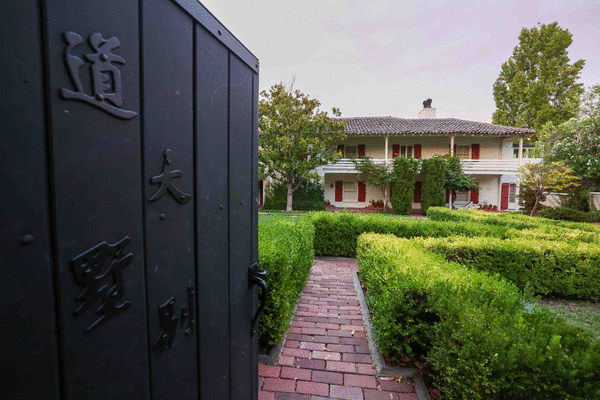
SAN JOSE, Calif. — Fifty years ago, in the fall of 1976, a presidential signature transformed Tao House, the secluded Danville home where playwright Eugene O’Neill wrote his final masterpieces, into a national historic site.
The signature was the final act in a yearslong, community-led campaign to prevent the gracious, white-brick hilltop mansion — O’Neill’s home from 1937 to 1944 — from disappearing beneath a proposed 1,500-home development.
The campaign received major Hollywood help from Jason Robards Jr., the Oscar-winning star of “All the President’s Men.” Robards always said he owed his career to the Nobel Prize-winning playwright whose searing dramas about human beings pushed to their limit revolutionized American theater. The actor also became a leading O’Neill interpreter after he performed in historic, back-to-back productions of “The Iceman Cometh” and “Long Day’s Journey Into Night” — two of the plays O’Neill wrote at Tao House.
Several years after Tao House was restored and opened to the public in 1985, Robards paid a visit, including to the second-floor study where O’Neill felt ready to excavate his difficult past and write plays that his contemporary fans say have enduring power. After Robards toured the home, he said a “tremendous serenity came over me; it threw me and carried me through.” As an artist, Robards said about O’Neill: “I can tell you he gave me life.”
This year, local O’Neill fans are celebrating the effort that made his home a unique Bay Area treasure — a 15-acre national park in a tranquil setting that’s devoted to a great American writer. More than 14,000 people visited the site in 2025, taking in its views of Mount Diablo and the adjacent Las Trampas Regional Preserve. Visitors can also learn about a playwright who may no longer be a household name but who was portrayed onscreen by Jack Nicholson as a romantic, tortured artist and whose works have inspired generations of other artists, from Katharine Hepburn to Sam Shepard and Denzel Washington.
The park’s 50th anniversary also gives O’Neill fans a chance to make a case for why Robert Falls, the former longtime artistic director at Chicago’s Goodman Theatre, called him “America’s Shakespeare.”
“Just as you can find a song in Taylor Swift’s catalog to match any mood or any moment, I think you can do the same with O’Neill,” said Beth Wynstra, a Walnut Creek-reared O’Neill scholar and associate professor at Babson College in Massachusetts. “If you want to look at the ills of capitalism, I would recommend ‘The Hairy Ape.’ You want to think about a post-#MeToo moment, ‘Anna Christie’ is your play, right?”
Every September, the public also can see an O’Neill play performed in the white barn on the property, which figures into the setting for “A Moon for the Misbegotten,” another Tao House masterpiece. For this year’s 50th anniversary, the annual Eugene O’Neill Festival from Sept. 12-26 will feature “Ah! Wilderness,” the playwright’s only full-length comedy, as well as a new work, “Teddy,” by a playwright from Ireland, O’Neill’s ancestral homeland.
For many living near that hill or in the rest of the Bay Area, a Tao House visit may be their first experience with O’Neill. Wynstra acknowledged that he’s not taught in high schools, and his nearly 60 plays are not regularly performed, in part because some have the reputation for being long, dark and difficult.
“He had this massive body of plays, and I think you can keep going back to that well and find one that speaks to the here and now,” Wynstra said. In teaching O’Neill to 18- to 21-year-old undergraduates, she sees them finding connections to their own lives. “They love to write about them. They love to talk about them.”
O’Neill was one of the first American playwrights to “put real people and real stories” onstage, including stories about the poor and marginalized, Wynstra said. He employed beautiful language and experimented with a range of styles, including expressionism, Greek tragedy and realism, to create dramas about class, race, women’s role in society, addiction, mental illness, murder, marriage, family dysfunction and disillusionment with the American dream. In a notable example of a director making O’Neill relevant to recent events, a COVID-19-era revival of “Long Day’s Journey” in Greenwich Village had the fractured Tyrone family confronting one another during lockdown, Wynstra said.
O’Neill was born in 1888, the son of famed Irish immigrant actor James and his wife, Ella O’Neill, whose struggles with opioid addiction also play out in “Long Day’s Journey.” After an unstable childhood, he went to sea, then lived on the streets of lower Manhattan, battling alcoholism and depression. Following a 1912 suicide attempt and surviving tuberculosis, O’Neill began writing plays.
O’Neill won the first of four Pulitzers for drama in 1920 and became internationally famous. But his personal life was marred by more drinking and tragic relationships with most everyone he cared about. As he struggled with mounting health problems, he moved west to write. In 1936, the year he won the Nobel Prize, he and his devoted third wife, San Francisco-born actress Carlotta Monterey, visited the Bay Area and toured land for sale — 158 isolated acres on a hill overlooking the then-rural San Ramon Valley.
With Monterey’s help, O’Neill found a refuge in the East Bay where he could stop drinking and “confront my dead at last.” Monterey oversaw the simple design of Tao House, infusing it with Asian touches and making sure each room opened onto the courtyard or veranda. When O’Neill wasn’t furiously turning out his last great plays and three other works, the couple gardened or shared walks on the grassy slopes with their Dalmatian, Blemie. “Here/Is home/Is peace/Is quiet/Here/Is love,” O’Neill wrote in a 1940 poem to his wife.
But their Danville sojourn soon ended. A Parkinson’s-like illness forced O’Neill to stop writing, and he and Monterey had difficulty retaining staff during World War II. They sold Tao House to a local rancher in 1944, and O’Neill died in 1953 in a Boston hotel.
Twelve years later, the playwright’s former property became the target for a possible subdivision development. Several local women, Thalia Brewer, Darlene Blair and Lois Sizoo, launched fundraising and legislative lobbying efforts to save the house. Local parks activists and politicians came on board, as did UC Berkeley professor and O’Neill scholar Travis Bogard. On the importance of saving the house, Bogard wrote: “I guess it’s true that where an artist has created something intensely, something remains.”
With the newly formed Eugene O’Neill Foundation, Bogard enlisted Robards’ help. For a 1975 fundraiser, Robards performed one of the Tao House plays, “Hughie,” at Berkeley’s Zellerbach Auditorium. The following year, he joined Blair in testifying before a U.S. Senate committee hearing — during reshoots for “All the President’s Men.” In October 1976, President Gerald Ford signed the bill giving the home national historic site status. It is one of nearly 40 National Park Service sites, along with John Muir’s home in Martinez, that are devoted to American writers.
Although many theaters don’t routinely tackle O’Neill, a major revival in New York or London becomes a splashy, star-studded event. Wynstra has noticed a resurgence of such productions in recent years, with Ruth Wilson and Michael Shannon co-starring in a 2025 West End production of “A Moon for the Misbegotten” and Michelle Williams playing sex worker Anna Christie earlier this year in Brooklyn.
For a veteran actor or an up-and-comer, O’Neill presents the ultimate challenge. Washington recalled his first leading role was in a college production of “Emperor Jones.” He hailed the playwright as one of “the greats of all time” while playing Hickey — the role that first made Robards famous — in a 2018 Broadway revival of “The Iceman Cometh.” That production co-starred Austin Butler in his Broadway debut.
Hickey is the charismatic traveling salesman who preaches a distorted vision of salvation to the social misfits and leftist radicals in a dive bar in lower Manhattan, modeled on the denizens of a favorite O’Neill hangout. Both Robards and a young Robert Redford also turned up in a 1960 live-television adaptation of “The Iceman Cometh,” directed by Sidney Lumet and streamable on YouTube.
For the park’s 50th anniversary, Robards’ actor son, Sam Robards, will attend the festival and visit Tao House for the first time. In an interview with this news organization, the TV and film actor recalled how his movie star mother, Lauren Bacall, was riveted seeing both the 1956 production of “The Iceman Cometh,” as well as his father’s performance. This was before Bacall ever met Robards and the year before her first husband, Humphrey Bogart, died. “She talked about how the production was so deeply affecting, and everybody felt like they were in this bar and they couldn’t get out of it,” Sam Robards said.
Sam Robards said he’s determined to carry on his father’s legacy in supporting the Tao House’s mission. He said, “I don’t have the same relationship to O’Neill that my father did, but I will spread the word of Eugene O’Neill, because everything is in there.”
If you go
The Eugene O’Neill National Historic Site is free and open to the public, 10 a.m. to 2 p.m. Wednesdays-Sundays. To tour the house, reservations are required, and visitors must catch a National Park Service shuttle ride into the park. The shuttle departs at listed pickup times from the Museum of the San Ramon Valley, 205 Railroad Ave., Danville; nps.gov/euon. Visitors can also hike into the park to enjoy the grounds via trails in the Las Trampas Wilderness Regional Preserve.
The annual Eugene O’Neill Festival runs from Sept. 12-26, though the Tao House performances of Sheila Forsey’s “Teddy” and O’Neill’s “Ah, Wilderness!” are sold out. Tickets are still available for the 1:30 p.m. Sept. 26 performance of “Ah, Wilderness!” at Danville’s Village Theatre. Tickets are $60; eugeneoneill.org.
©2026 MediaNews Group, Inc. Visit at mercurynews.com. Distributed by Tribune Content Agency, LLC.









Comments