Movie review: 'Verity' cracks the code of adapting Colleen Hoover's work
Published in Entertainment News
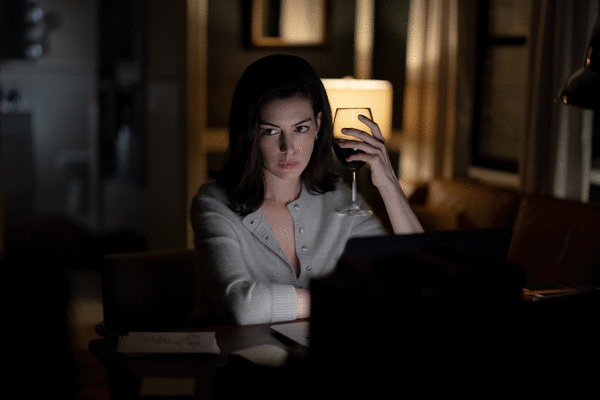
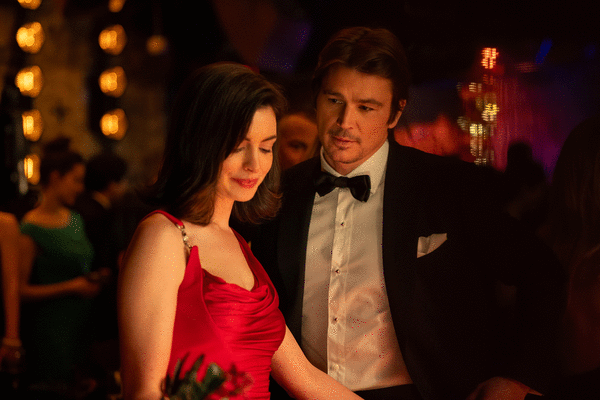
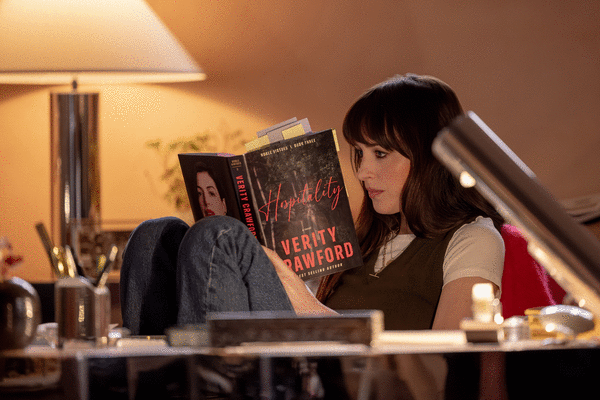



Did director Michael Showalter just nail the Colleen Hoover adaptation? The third major movie version of the blockbuster author’s work hits the big screen with “Verity,” and things are starting to lock into place. Much darker and more twisty than the weepy trauma dumps “It Ends With Us” or “Reminders of Him,” “Verity” is high camp with a wink, a hair toss and just enough bite to draw blood.
The screenplay is adapted by Nick Antosca, known for his tawdry television melodramas like “The Act” and “Cape Fear.” His script is remarkably faithful to the book, just condensed for efficiency. It helps that Hoover’s novel, with shades of “Jane Eyre” and “Rebecca,” is full of wild turns and insane details, and really only needs a movie star makeover to work as a film: a few nips, tucks and a flashy exterior.
Showalter and Antosca take the bones and juicy bits of Hoover’s book and make it more elegant, refined and contemporary, but keep all the craziness that viewers crave. The film opens with a graphic car accident that results in struggling writer Lowen Ashleigh (Dakota Johnson) covered in gore. When a stranger comes to her aid, one man’s death becomes another couple’s portentous meet-cute, as Lowen encounters Jeremy Crawford (Josh Hartnett) for the first time.
The pair are about to find themselves in a complex psychosexual throuple with Jeremy’s wife Verity Crawford (Anne Hathaway), a mega-successful novelist and genuine celebrity. Verity can’t finish her book series for mysterious reasons, so Jeremy hires Lowen to do so. When she arrives at their imposing Vermont mansion to go through Verity’s notes, Lowen discovers that Verity’s a vegetable, completely physically and mentally indisposed after a car accident. Still, she looms large in Lowen’s imagination, especially when she finds a secret autobiography in which Verity reveals her darkest secrets.
The guileless Lowen gobbles it up, spinning an elaborate fantasy about the woman Verity was before the accident. In Lowen’s overactive imagination, Hathaway plays a Hitchcockian femme fatale always wearing her signature color, red. This juicy role as a female psychopath-bad mommy-sex kitten-genius is almost too easy for the Oscar winner.
Showalter and Antosca draw out the “Persona”-esque qualities of the story, as Lowen, while finding herself drawn to Jeremy, becomes absolutely obsessed with Verity — or the idea of her. Does she want to be Verity or sleep with her? She definitely wants to inhabit Verity’s luxe life, moving into her office, wearing her clothes, mothering her son, seducing her husband. But there are also haunting clues that the catatonic wife down the hall isn’t as helpless as she looks.
Showalter has assembled the perfect trio of prestige actors for the material, because all three have a knowingness about the way they play the duality of their characters. Hathaway is arch and expressive, doing subtle things with her eyes and voice that no one else can. Her more “actress-y” qualities juxtapose Johnson’s dry, sardonic demeanor, which she alternates with whispery seduction. Hartnett plays the hapless man well, but his naive exterior could be concealing something more sinister, as in the M. Night Shyamalan thriller “Trap.” All three are able to pivot easily between likable and not, which is key for the shifting alliances in “Verity.”
It’s sumptuous to look at, from the movie star faces to the weird but fascinating interiors of the Vermont mansion, all warm wood and stone accents. The plot exists on twists, but if there’s anything missing from “Verity,” it’s the character backstory that might inform Verity’s calculated machinations, or Lowen’s striving to fill her personal void.
One wouldn’t expect Showalter, who has roots in comedy as a founding member of “The State,” to be working in the realm of campy Sirkian melodrama, but he’s become a versatile director over the years, and no doubt his working relationship with Hathaway from the romance adaptation “The Idea of You” (2024) helped. Comedy directors (see also Paul Feig, “The Housemaid”) tend to do well in this genre, because they can nail the target on the intentionally comedic bits. Everyone here is in on the joke — but Showalter could have pushed it even further.
Still, of the Colleen Hoover adaptations so far, “Verity” is easily the best and most stylish of them all. It plays with more sophisticated themes of writing, truth and trust, the complicated nature of the versions of ourselves we put on the page. The unmoored truth is never resolved here, leaving us with the lesson that the only thing certain is uncertainty, and the only person we can’t trust is ourselves. Verity? Hardly.
———
'VERITY'
3 stars (out of 4)
MPA rating: 1:54
Running time: R (for sexual content, some nudity, language, violence and bloody images)
How to watch: In theaters Oct. 2
———
©2026 Tribune Content Agency, LLC










Comments