How Jimmy Eat World will celebrate 25 years of 'Bleed American' at Hollywood Bowl
Published in Entertainment News
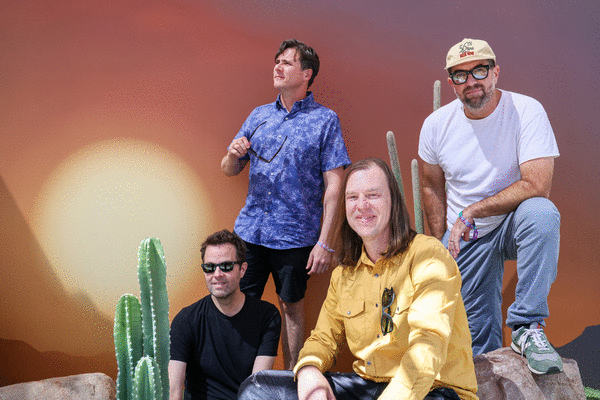
ANAHEIM, Calif. — By the middle of 2000, Jimmy Eat World was adrift. Capitol Records had dropped them from the label after a pair of albums. The band had left its management. They were on their own.
Then, in October 2000, the alternative rock band from Mesa, Arizona, entered Cherokee Studios in Hollywood to try something new, drummer Zach Lind and bassist Rob Burch say in a recent video interview from their homes in the Phoenix area.
“When we made ‘Clarity’ [the band’s 1999 third album], it was very much a studio album,” Lind says. “We tried to use the studio as an instrument. We kind of threw the kitchen sink at all the different songs.
“There’s more of maybe a musical orchestral approach to songs on ‘Clarity,’ [so] that when [on]‘Bleed American,’ the next album, we kind of self-corrected back to a different sort of approach.”
Why make a new album that sounds like the previous record when you can do something new? Lind says.
“A lot of that is just boredom,” he continues. “You don’t make the same album over again, and going into an album with a different mindset is a bit more creatively conducive.
“There was just sort of this natural bounce back to more simple arrangements. Like classic rock arrangements on songs that up into that we, up into that point, didn’t really mess around with a lot. We were always looking for ways to make it more interesting or more in your face or more abrupt.”
Then too, that kind of streamlined approach to songwriting and recording was also a practical decision for Jimmy Eat World, given that it no longer had a major label writing checks for recording sessions.
“We were making the record with our own money that we had saved from touring,” Lind says. “We went to Cherokee to track the drums, but then our plan was to go back on tour and make more money and then come back and track the rest of it.
“And that’s basically what happened,” he says.
“It was touring and any income, anything that we could scrape together on the road from T-shirts and gigs,” Burch says. “We didn’t touch it. We set that aside. That’s for recording.
“And we all still maintained our day jobs,” he says. “We paid our rent and kept ourselves fed, barely, by doing the jobs that we had at the time.”
Burch worked in restaurants and was a delivery driver. He and guitarist Tom Linton worked through a temp agency setting up pop-up events during baseball’s spring training. Lind also worked as a delivery driver for a printing company. Singer Jim Adkins sold art supplies.
“We’re both delivery driving when we’re not on tour,” Burch says. “And what are you doing when you’re on tour? You’re driving across North America. I’m curious about how many miles we’ve got under our belts. It’s got to be a lot.”
“Bleed American,” the album their savings made, was released on July 24, 2001, by DreamWorks Records. With pop-punk or power pop radio hits such as “The Middle,” “Sweetness,” and the title track, and relentless touring through the rest of 2001 and most of 2002, it made them stars of the alternative rock scene.
In July, Jimmy Eat World took “Bleed American” on the road for its 25th anniversary, playing the album in full at stops as they crisscrossed the United States on the Warped Tour and their own headlining dates.
On Saturday, Nov. 7, Jimmy Eat World headlines the Hollywood Bowl for the first time, playing “Bleed American” and other favorites from across its catalog for the Southern California fans that have always embraced them. The Format will open the show.
In an interview edited for length and clarity, Burch and Lind talked about that Bowl date, the struggles and successes of the fourth album they’re celebrating a quarter-century later, and why they think its songs remain so popular with fans old and new.
Q: What’s it like looking forward to headlining the Hollywood Bowl for the first time?
Zach Lind: We opened up for Incubus a while back –
Rick Burch: – it was quite a rush to perform there. It’s one of those unique venues that are massive but they’re also very intimate. Having seen gigs there, I know how special the room is.
Lind: Yeah, I think with shows like that, it goes by so quickly, especially when you’re opening. It feels obviously exciting to play in venues like the Hollywood Bowl because they’re so iconic. There’s an extra level of nervousness that I think everyone feels, right? When you’re playing these sort of venues, you feel as a performer like you want to show up in your best version.
Q: You’ve probably played most other venues around here by now, given how strongly Southern California has supported Jimmy Eat World over the years.
Burch: Definitely. Southern California is so near to where we are; it was one of the first places that we got out of our own little bubble and were able to do a gig. So it’s always been like a second home for us. And you’re right, we’ve been all up and down the coast there and played many, many tiny places. It’s always good.
We’ve developed a lot of relationships and have a lot of friends and people we work with, and it’s always great to catch up. It’s like a homecoming every time.
Q: You talked about the directness of the music and Jim’s lyrics for “Bleed American.” The big hit, “The Middle,” is like that. Did it stand out early on that it had potential?
Lind: I think with “Sweetness” that was absolutely the case, because we were playing it at our shows before [“Bleed American”] came out. “Sweetness” was one of those songs that people could hear for the first time and by the end of the song, they’re singing along. So we got this feeling playing it live, like, Wow. We got a direct response from the crowd on that song, which is strange because the song wasn’t officially out.
With “The Middle,” it was a little different, just because we never really played it a lot until the record came out. But I remember personally feeling, when I heard Jim’s demo of “The Middle,” it stood out to me.
And when I played our demo version for friends or whatever, it would get a response from people. They would be like, “Oh, that’s a really great song.” You never really know for sure. Like typically when we make albums there’s songs we think, “This is going to be a hit,” and then it doesn’t even get chosen as a single. We’re like, “Oh [bleep], we have a bad track record at guessing that kind of stuff.
Burch: To add to what Zach has said, “The Middle” came together really quickly. We didn’t labor over it. Jim had the demo. We kind of put it through the band process, and it was like, “All right, that’s great. Cool, let’s move on to the next thing.” It just kind of always existed. We were always proud of it. We always felt it was a strong song, and we were very happy with what happened there.
But we had no idea the strength of it once it got into other people’s hands, meaning when other people listened to it. It’s a song that people have brought into their lives and made their own, which is the biggest honor and compliment of any artist to have their work be accepted in such a deep way.
Q: How soon after the release of “Bleed American” did you start getting positive feedback on the new album and songs?
Lind: I think for us it felt like when “The Middle” started really cooking on radio and we started getting for the first time, like real commercial success and positive response on a song on radio play.
The thing we noticed more than anything else was just more people showing up at the shows. Like when we started carrying our own PA and bringing full production on tour, I was like, “Oh, I guess more people are coming to the shows.”
We were so busy touring and it was kind of a bit of a whirlwind. Our A&R guy would say, “Oh man, the spins are going up, and things are going well.” But I think it’s just hard to really understand what that all means, especially at that age. We kind of were just a little bit green when it came to what radio play meant or how it impacted you.
Burch: We’re in our own bubble, like we’re just out on the road playing gigs, so we didn’t have a good read. It was only through these messages from our colleagues saying, “Hey, things are good this week.” So we’re like, “All right, well, awesome. We’ve got a gig tonight. We’re going to shred it.”
Q: You’d have probably started playing larger venues in Southern California, moving up from the Glass House, Chain Reaction, and other small clubs.
Burch: Yeah, it was like Chain Reaction, and then the El Rey was definitely like, “Whoa, this is an awesome theater. Wow, this is huge.” [He laughs]
Lind: I’m trying to think of the biggest show we did in L.A. when it came to “Bleed American.” It might be the Wiltern. I don’t remember; maybe the Wiltern came later.
Burch: It might have.
Lind: Definitely the first show we did for the “Bleed American” cycle was at the Roxy. That was before the album came out. [In 2001, when “Bleed American” arrived, Jimmy Eat World played the Roxy, a pair of shows at the Glass House, the El Rey, and the Long Beach Arena.]
I think a bunch of our bigger shows in the “Bleed American” era in L.A. were more like KROQ shows. That was the first time we were like, “Oh, we’re playing with all these insane bands.” So that was different. That was really kind of scary and intimidating. Like Almost Acoustic Christmas at Universal Amphitheatre, the Weenie Roast out in Irvine. Playing those shows were like, “Whoa.”
Burch: We owe a massive amount of gratitude to the L.A. radio stations for their support and being a big part of promoting us over the years. This wouldn’t have been what it became without the L.A. radio stations.
Q: Zach, you mentioned something about people taking these songs into their lives. How have you come to see why this album and these songs mean so much to people?
Lind: The way we understand that is just from fans telling us songs like “The Middle” and “Hear You Me” are songs that have struck a chord emotionally with people. Whether it’s that they’ve lost a loved one — “Hear You Me” we hear that all the time about that song.
“The Middle” is sort of like a song that’s a soothing voice to hear when you’re maybe experiencing all kinds of different things that feel bad or negative. People have talked to us about “The Middle” in terms of it helping them through cancer treatment or being bullied at school or something like that. Maybe just struggling with self-image issues.
So on the one hand, that’s what we hear from people. On the other hand, I don’t know if it’s really necessary for us to be fully understanding and in touch with the impact of the songs. “The Middle,” and I would say the same thing for “Hear You Me,” those songs kind of have their own center of gravity.
Like they’ve hit people in a way that we could have never anticipated or, I think, truly understand. It’s like we’re the people who made it, and you don’t sit around and think, “Oh man, these songs are really helping people out.” You don’t really think of it that way.
But from what we hear, “Bleed American,” especially those two songs, have really found their own life in the lives of other people in a way that’s really cool, really humbling, and it feels great.
Those songs just kind of happen and they’re just like a little something, you know, something comes together and it just hits people the right way. It’s hard to really understand it, and that’s OK.
©2026 MediaNews Group, Inc. Visit ocregister.com. Distributed by Tribune Content Agency, LLC.




Comments