Zero-dollar premiums sticking point in Senate health talks
Published in Health & Fitness
WASHINGTON — A bipartisan group of Senate deal-makers labored toward an agreement Wednesday on reviving expired health care tax credits but are still managing sticking points as the House prepares to vote on a largely symbolic measure backed by Democrats to extend the subsidies for three years.
In a procedural step, the House voted 221-205 Wednesday evening to consider the rule for Democrats’ tax credit extension. Nine Republicans joined Democrats in voting “yes” to discharge the rule from committee, including the four Republicans who signed on to the discharge petition to meet the threshold for forcing a vote. A vote on the underlying bill is expected before the end of the week.
At issue are the enhanced tax credits for Affordable Care Act plans that Democrats succeeded in passing in 2021, which were extended until Dec. 31 of last year.
The Senate already rejected a three-year extension of those credits when a measure was blocked in a procedural step in that chamber.
The latest Senate compromise, which is expected to be finalized in the coming days, is facing pushback within the group of negotiators, as some Democrats think Republicans’ requests for new guardrails go too far.
The rough outlines of a potential deal are similar to a proposal Sens. Susan Collins, R-Maine, and Bernie Moreno, R-Ohio, floated in December that would temporarily extend the enhanced Affordable Care Act tax credits while capping income eligibility and eliminating zero-premium plans.
But Democrats who are engaged in the negotiations have concerns with some of those provisions, arguing it would hurt people, depending on their locale.
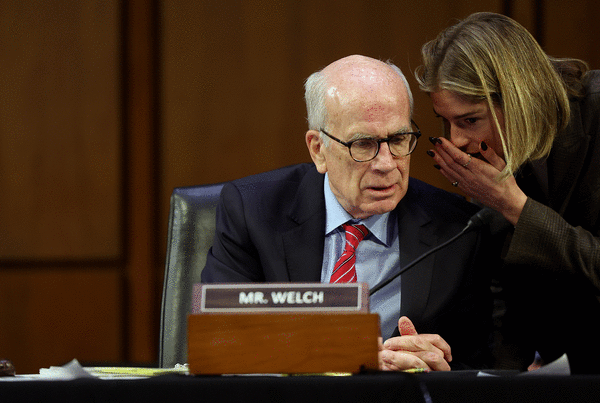
“All of us prefer not to have that,” said Sen. Peter Welch, D-Vt., referring to Democrats’ views on a proposed ban on zero-dollar premium plans. “For most states like Vermont, it won’t have a detrimental impact. In Georgia, it might, and that’s a concern for us, so we’re trying to figure out how to address that.”
Under the enhanced tax credits first passed by Congress in 2021, people making between $15,650 and $23,475 a year paid nothing toward their premiums for certain ACA plans. Eliminating these zero-dollar premiums could especially impact people in states that didn’t expand Medicaid to cover more low-income adults, such as Georgia.
Sen. Jeanne Shaheen, D-N.H., said she had heard concerns as well about changing the zero-premium policy on the lowest-income marketplace enrollees.
“The data shows that you lose a lot of people at the lowest income levels when you do that,” Shaheen said.
Senate Finance ranking member Ron Wyden, D-Ore., whose committee has jurisdiction over the ACA, said he has been talking to lawmakers on both sides about how implementing minimum premiums would institute rate hikes for people who have already signed up for coverage.
“It’s an example that the No. 1 issue today is affordability, and nobody has really walked through what it’s going to mean for those 8 million people,” Wyden said, referring to an early estimate of how many people have signed up for ACA coverage for 2026 so far.
Both sides have also expressed concerns about including compromise Hyde amendment language in the deal, which President Donald Trump floated during a policy retreat Tuesday. The Hyde language prohibits federal funding of abortion in most cases.
“What President Trump was saying yesterday was Republicans, and frankly Democrats, too, need to show a little bit more flexibility so we can actually get something done with respect to the issue of health care,” said White House press secretary Karoline Leavitt during a briefing Wednesday. “He wants to see Congress get something done with respect to health care and that was the point he was trying to make.”
Shaheen on Wednesday said there was “no need to come to a compromise” given the contours of the current law.
Wyden concurred. “I mean, people who are looking at Hyde are playing with fire. There is not support in this country for throwing Hyde in the trash can or rolling it back,” he said.
Senate Majority Leader John Thune, R-S.D., has blessed the bipartisan talks but stressed that any deal would need to meet three requirements to pass the Senate, including a ban on zero-dollar premiums, transitioning the extended credits into health savings accounts, and securing explicit Hyde protections.
He told reporters Wednesday that while productive conversations continue there are still some “issues they have to resolve.”
“The conversations are constructive. But at this point, there’s nothing that I’m aware of that we’ll be voting on soon,” Thune said.
Open enrollment for 2026 ends Jan. 15 in most states, and insurers have indicated that reopening insurance sign-ups after the enrollment period would be challenging.
“I hope it does light the fire,” Sen Josh Hawley, R-Mo., said of the Jan. 15 deadline. “But I’m not seeing a lot of evidence.”
_____
(Jacob Fulton contributed to this report.)
_____
©2026 CQ-Roll Call, Inc. Visit at rollcall.com. Distributed by Tribune Content Agency, LLC.









Comments