California files another lawsuit against Trump administration over offshore wind
Published in Science & Technology News
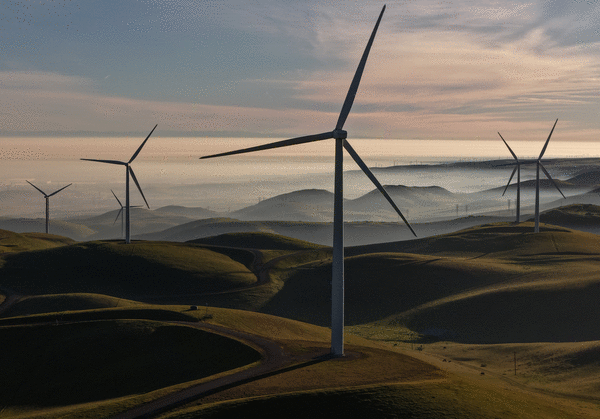
Another round in the legal battle between California and the Trump administration over offshore wind projects has commenced.
California Attorney General Rob Bonta and the California Energy Commission filed a 54-page lawsuit in federal court Tuesday, disputing what they claim was an unlawful buyout that took a major offshore floating wind project in Morro Bay off the table.
The filing marks the second legal complaint the Attorney General’s Office and the energy commission has filed against the Trump administration — and another lawsuit is looming.
Tuesday’s lawsuit challenges a $765 million buyback of four wind leases in locations across the country held by Invenergy, a Chicago-based international power generation company. Announced in June, the deal included the $111 million Even Keel Wind project that had lease rights covering more than 80,000 acres off the Central California coast.
“California is challenging these reckless and illegal backroom deals and holding the companies that participate in them accountable,” David Hochschild, chair of the California Energy Commission, said in a statement.
As of 2:30 p.m., neither the U.S. Department of the Interior nor Invenergy had responded to emails from the Union-Tribune asking for comment on the lawsuit.
When the withdrawals were announced two months ago, Secretary of the Interior Doug Burgum said, “The offshore wind leases were sold under the assumptions that taxpayers would indefinitely subsidize costly, unreliable projects and that no national security concerns were implicated — both assumptions have since been proven false.”
Under the terms of the deal, Invenergy will redirect the money to other energy projects that include developing natural gas power plants in Indiana, Wisconsin, Iowa, Kansas and Missouri, plus geothermal projects in the West.
An Invenergy executive at the time said the company “is focused on delivering reliable, affordable energy for our customers and supporting disciplined investment at scale.”
This is the second lawsuit California has filed in federal court.
The state attorney general and the energy commission submitted a similar complaint last month, accusing Interior and other agencies of making an “unconstitutional and unlawful” deal in April that saw another company — Golden State Wind LLC — back out of its lease to build a floating offshore wind farm, also in Morro Bay.
Instead, Golden State Wind will be eligible to recover the company’s $120 million investment by spending an equal amount on U.S. oil and gas assets, energy infrastructure or liquefied natural gas projects on the Gulf Coast.
In yet another buyback, German energy multinational RWE in August announced relinquishing offshore wind leases in New York, Louisiana and California as part of a $1.22 billion settlement with the Department of the Interior. One of those projects is the Canopy Offshore Wind Farm in Northern California’s Humboldt County.
Earlier this month, the California Attorney General’s Office sent a “notice of intent to sue” to officials at Interior and other federal agencies, as well as executives at RWE.
With the Invenergy, Golden State Wind and Canopy Offshore Wind Farm projects no longer on the drawing board, there are just two floating offshore lease projects left in California — one in Humboldt Bay and one in Morro Bay.
The nascent offshore wind industry is a cornerstone of California’s efforts to derive 100% of its electricity from carbon-free sources by 2045, if not sooner.
Within 20 years, state policymakers intend to develop 25 gigawatts of offshore wind power — enough to power roughly 25 million homes and provide about 13% of the state’s electricity supply.
“The lease buyout reduces the options available to California to meet its clean energy and climate policies,” Tuesday’s lawsuit said, adding that the state has made $100 million in investments in offshore wind and attendant projects. The complaint also included a long list of alleged violations of federal statutes.
The attorneys general of New York, Connecticut, Delaware, Maine, Massachusetts, New Jersey, Rhode Island and Vermont also filed two joint lawsuits on Tuesday that challenged other lease buyouts in their respective states.
Offshore wind projects in California are different than facilities in other parts of the country. Unlike the East Coast, where turbines can be bolted into the seabed, the continental shelf off the Pacific coast plunges steeply.
That means offshore wind farms in California must float on the water’s surface, tethered or moored by cables to the ocean floor. Electricity generated by turbines will be transmitted to a floating substation and carried to a power plant onshore via buried cables.
California has yet to put “steel in water,” and the state is expected to be the first region in the U.S. to use floating wind turbines.
There are no plans to develop offshore wind projects in San Diego and Southern California. That’s in large part due to discussions years ago between military officials and the Bureau of Ocean Energy Management that ultimately designated
Southern California a “wind exclusion” area because of concerns that offshore wind facilities would interfere with training missions.
Besides, wind speeds in the south are not as steady and strong as those in Central and Northern California. As a result, efforts to build floating offshore wind projects have focused on Morro Bay and Humboldt County.
_____
©2026 The San Diego Union-Tribune. Visit sandiegouniontribune.com. Distributed by Tribune Content Agency, LLC.






Comments