Virginia oyster farm loses entire harvest in harmful algal bloom
Published in Science & Technology News
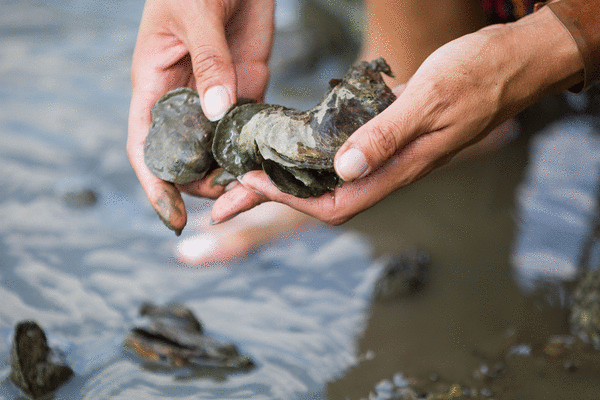
NORTHAMPTON COUNTY — Oyster grower Alex Lambert had one day’s notice that an algal bloom was heading toward his 4,000-basket farm. It could be years before scientists know why.
A local grower messaged Lambert on Sept. 17, telling him discolored water was spotted in nearby creeks with suspicion it could be harmful to sea life like his oysters.
Lambert tried not to panic. He’d learned from other farmers that larger oysters tend to survive the type of bloom. But the next morning, on Lambert’s birthday, an intense smell ruminated from the Lambert Shellfish farm. The water was still, thick and brown, and dead fish floated along the shore.
The crew spent the day in defense, maneuvering baskets onto their dock, and moving about 500,000 smaller oysters by the shore. The smaller ones were closed up, a sign of good health, but Lambert knew they would have to check on the oysters the following day.
The next day, the small oysters were “popping,” or fully gaping open like a pistachio, Lambert said. Around 250,0000 1-2 inch oysters, which he thought would fare fine, were all dead. The next day, all of the larger oysters were popping as well.
“It became clear that we were going to lose just about everything,” Lambert said. “It was day by day, seeing the next size up die.”
In the past few weeks, Lambert has been going over his estimates for basket and oyster loss. Besides a 10% salvaged basket, the farm faced a 100% mortality, estimated at $400,000 worth of oysters.
Lambert heard from nearby growers up Hungars Creek that their farms survived. His oyster farm had never faced such widespread loss before.
“Without it moving, and it being so thick and highly concentrated, it was a lethal dose of poison,” Lambert said. “I’m curious what the folks in charge determined to be the source of this, or if it was all weather related.”
What the science says
Finding the cause of this specific bloom on the Eastern Shore could take decades, said Margaret Mulholland, professor at Old Dominion University’s Department of Ocean & Earth Sciences.
“It’s been linked to nutrient over-enrichment, the usual things like nutrient pollution,” Mulholland said. “We certainly know it only happens when the water temperatures are warm, but we don’t know the exact trigger that causes the bloom to initiate.”
Since late July, Mulholland has been tracking a normal algal bloom species called Margalefidinium polykrikoides, or “Marge,” which has no known toxin attributed to it. The bloom began in the Lafayette and York rivers around the same time, and populations popped up near Tangier Island in early September.
By Sept. 12, scientists believe the algal bloom species had transitioned into Alexandrium monilatum, or “Alex,” as bioluminescence was reported near Tangier, a characteristic of the harmful species. While “Marge” can impact shellfish, “Alex” creates a toxin that directly harms shellfish and fish, and is known to have disastrous effects specifically for oysters.
But an unusual event, which scientists are still trying to identify, must have shoved the bloom to the Eastern Shore on Sept. 17, Mulholland said. That level of water transport in the bay is uncommon. Researchers believe the push onshore was caused by a meteorological phenomenon.
While most algae blooms are known to annually occur, “Alex” does not, said Hamish Small, assistant research professor at William & Mary’s Batten School of Coastal and Marine Sciences and the Virginia Institute of Marine Science.
By his estimates, the last large bloom of it in the Chesapeake Bay was 2017, and it has never traveled to where it hit Lambert’s farm.
“We’ve never seen the blooms of this organism mid-bay or on the Eastern Shore,” Small said. “So this is sort of new to us.”
As of now, researchers think the bloom has dissipated as a result of last month’s nor’easter. But the concern is that “Alex” has settled into the sediment, forming cysts, which have the potential to later disperse.
“We hope that the cysts don’t take hold in those creeks because that could cause it to be more of a regular occurrence,” Mulholland said.
Lambert Shellfish rebuilds
Lambert Shellfish has about a month and a half to get as much oyster seed in the water before growth ends for the winter. A friend of Lambert’s family set up a fundraiser to support the company.
Last week, Lambert Shellfish put a liter of test seed out in the farm’s waters, assessing the survival through the weekend. It held up, and the crew began seeding this week.
Lambert said the algal bloom event has shown him there are some gaps in the Virginia industry. He said if he had heard about the bloom early, he would have had time to get his oysters out of the water before it hit.
“We need to have a protocol. We can improve the communication, and it doesn’t need to be definitive knowledge. Just to let folks know that there’s a risk out there,” Lambert said. “We could have saved all of our seed if we had been given two days.”
________
©2026 The Virginian-Pilot. Visit at pilotonline.com. Distributed by Tribune Content Agency, LLC.






Comments