How Thom Tillis and allies maneuvered past 137 years of obstacles to aid Lumbee Tribe
Published in Political News
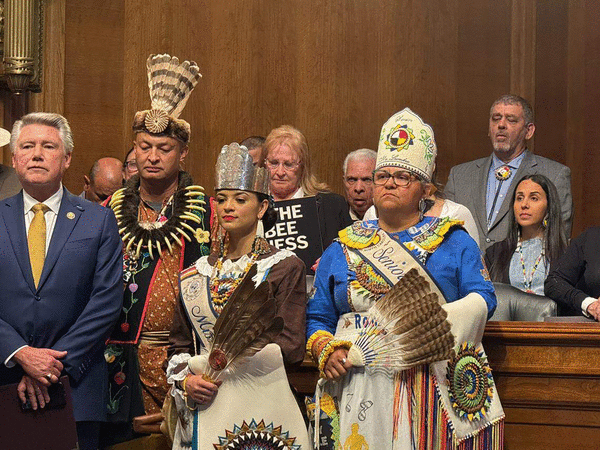
WASHINGTON — An unusually large group of onlookers in the Senate gallery caught Alabama Sen. Katie Britt’s attention. She turned toward the group, sitting in an area of the gallery normally reserved for friends and family of her colleagues.
More than 80 members of the Lumbee Tribe of North Carolina were in the balcony staring down at senators as they cast their votes on whether to give the tribe federal recognition, something they’ve fought for for 137 years.
Britt smiled after being told it was the tribe and then glanced back up.
“It’s a very surreal moment,” Lumbee chairman and North Carolina state Rep. John Lowery told McClatchy before the vote. “We’ve been working towards this for a long time, and I’m glad that we’re here.”
For years, it had seemed as if legislation for the Lumbee Tribe would never reach the Senate floor. The late North Carolina Sen. Kay Hagan, a Democrat from Greensboro, and former Sen. Richard Burr, a Republican from Winston-Salem, both tried before.
But it was Sen. Thom Tillis, a Republican from Huntersville, who made it his personal mission to ensure it did. He was not going to retire without the Lumbee Tribe of North Carolina being federally recognized and given full benefits.
But it was going to take a village to make that happen.
Who are the Lumbee?
The Lumbee Tribe of North Carolina is made up of more than 60,000 members, the largest tribe east of the Mississippi River. It is located in Robeson, Hoke, Cumberland and Scotland counties.
Members of the Lumbee tribe began asking Congress for federal recognition in 1888, in order to get funding to educate children. But Congress didn’t acknowledge the tribe until 1956. And in a move Tillis said was unprecedented, lawmakers specified that acknowledgment wouldn’t come with federal benefits.
Federal recognition opens up a host of benefits from the government for the tribe, including assistance on anything from health care to education to economic development to agriculture.
The Lumbee believed it would take another act of Congress to undo the 1956 law.
But getting a reversal became a battle with other tribes, who employed high-powered lobbyists to act on their behalf and argue that the Lumbee tribe should go through the Bureau of Indian Affairs for recognition. That includes the Eastern Band of Cherokee, which also argues against the legitimacy of the Lumbee’s racial, cultural and historic claims.
“It is important that lawmakers fully understand the implications,” said Michell Hicks, principal chief of the Eastern Band, after it passed the House. “Once recognition is granted without an evidentiary review, the standing of all federally acknowledged tribal nations becomes more vulnerable to political shifts rather than being anchored in history and law. We are asking Congress to scrutinize this and to ensure that decisions of this magnitude remain grounded in documentation and established policy.”
Despite the Cherokee’s lobbying efforts, the Lumbee garnered support from President Donald Trump, former President Joe Biden and former Vice President Kamala Harris.
And Tillis was resolute that the Lumbee deserved recognition.
“The Lumbee tribe has a very well-documented history, and the Eastern Band of the Cherokee, the Choctaw Indians of Mississippi and other tribes were trying to protect their interests,” Tillis said in a news conference Wednesday. “They would use all kinds of fake narratives, saying that the Lumbee were fake Indians, or that it would cost too much money. There was always something that at the end of the day, either prevented the House or Senate from getting it done, and we’ve worked hard to educate members about the history of the Lumbee.”
Meeting the Lumbee
Sen. Ted Budd, a Republican from Davie County, told McClatchy he learned about the tribe while still representing portions of the Triad in the U.S. House.
The Lumbee did not live in Budd’s district, but as he ran for Senate in 2022, they reached out seeking his support.
“I didn’t immediately jump on, because I wanted to know what this is about,” Budd said. “Is this about dollars? Is this about recognition? Is this about casinos? I really think these folks are after this for the right reasons.”
“I got to know them. I got to love them. I got to build great relationships,” Budd said.
So he partnered with Tillis, who took the lead, in getting Lumbee recognition passed.
“It’s just a great community, and they haven’t gotten what they’ve deserved, and this has been a worthy fight,” Budd said.
He added that Tillis laid out a strategy and his office joined in.
“It’s almost as if he’s carrying the ball, and I’m pushing on the line and pushing him on this one,” Budd said. “That’s how this works, so I just want to give him great credit for his efforts on this.”
National Defense Authorization Act
Tillis told McClatchy Tuesday that he knew it would take just one senator to block the Lumbee Recognition Act from getting a floor vote.
But he also knew that if he slipped it into another must-pass bill, he could get it over the line.
Rep. David Rouzer, a Republican from Wilmington, added an amendment to the House version of the National Defense Authorization Act that would offer the tribe federal recognition with benefits.
The Senate passed its own version of the NDAA, and while Tillis’ amendment to place the measure into the bill wasn’t taken up, having two versions of the same bill meant that lawmakers would have to take the two bills and consolidate them into something both chambers could agree on.
Budd sat on the Senate committee that had jurisdiction over the bill.
Winning Wicker
Sen. Roger Wicker, the committee’s chairman and a Republican from Mississippi, had concerns about the measure because of his relationship with the Choctaw tribe, Budd told McClatchy.
Tillis and Budd played good cop, bad cop, if you will.
“I had a conciliatory tone, working with the chairman, Roger Wicker,” Budd said.
He added that the two senators’ staffs have great relationships, so they got to work talking about the importance of the measure.
“As we would find bumps along the road, speed bumps, we would deal with that,” Budd said.
On the other side, Tillis was taking advantage of Senate practices that allow a single senator to hold up legislation, using those hold tactics against senators who got in the Lumbee’s way.
“He had a hard-nosed tactic,” Budd said. “Not that he was damaging relationships, but he was really obstructing other people’s agendas, for the sake of the Lumbees, and he was much more free to do so because of his announcement of retirement.”
In July, after getting into a disagreement with Trump — that played out in a public social media dispute — over health care in North Carolina, Tillis announced he would end his 2026 reelection campaign and retire from Congress at the end of his term.
“It was perfect timing for him to go both barrels and support the Lumbees on this, while I would work inside committee on NDAA,” Budd said.
Tillis has repeatedly, through the years, blocked Indian Affairs legislation to get support for the tribe.
Last year, Tillis blocked South Dakota Sen. Mike Rounds’ Wounded Knee Massacre Memorial and Sacred Site Act to get Rounds’ support.
Last month, Tillis blocked the nominations of several federal judicial officials out of Mississippi trying to get Wicker to the negotiating table.
It paid off.
Tillis, Wicker and Oklahoma Sen. Markwayne Mullin, a member of the Senate Committee on Indian Affairs, and of the Cherokee tribe, who is supportive of Lumbee recognition, met to create an edited version of the Lumbee Recognition Act that they could mutually support.
Making changes to the bill
Among those changes were specifics about the tribal boundary, ensuring that new claims of tribal land would need an act of Congress and that the benefits the Lumbee Tribe receives will not be available for three years, but are also set to begin no later than at that point.
The White House was also involved in tweaking the language.
Trump factor
One of Trump’s first official acts in his second term was to order a report to find a method for the Lumbee tribe to be federally recognized with full benefits.
“I love the Lumbee tribe,” he said, in January, as he signed the order in the Oval Office.
It was a campaign promise he had made in 2024.
“Our opponents have put in a lot of money,” Lowery told McClatchy. “They’ve got tentacles all across this government, and so having the White House firmly on our side — not just telling us, ‘Hey, if it gets my desk I’ll sign it’ — actually making having this as a priority of the president, we can never underestimate that. And we can never overstate it enough, to let people know that it took that type of political might to overcome the money that I know has been spent against us.”
The report to Trump was never made public, and a Freedom of Information Act request filed by McClatchy seeking the report went unfulfilled. But many believe that the report indicated that a congressional act was the best option available to the tribe.
All but two of North Carolina’s members of Congress — Reps. Chuck Edwards and Virginia Foxx — support federal recognition for the Lumbee tribe. Foxx and Edwards represent areas of North Carolina that are home to the Eastern Band of Cherokee.
But Foxx oversees the House Committee on Rules, which determines what bills make it to the House floor.
“I know that the president — his team — had a lot to do with it being included in the House version,” Lowery told McClatchy. “We know that the Rules Committee in the House had to vote on it, had to approve it, and from what I understand, took a lot of pressure from the Trump White House to get it done.”
House approval
On Dec. 10, the NDAA, with Lumbee recognition, passed the House 312-112. Rep. Valerie Foushee, a Democrat from Orange County, was the only member of North Carolina’s congressional delegation to vote against the bill.
Foushee put out a statement saying she voted against the bill “because it falls short of what our service members and the American military truly deserve.”
But she added that she is “thankful the NDAA includes long-overdue federal recognition for the Lumbee Tribe of North Carolina,” and that she supports the provision.
“While I voted against the passage of this legislation in order to uphold fairness and support for our service members,” Foushee said in her statement, “I am pleased that the over 60,000 Lumbee Tribe members in our state will finally be able to access the federal benefits and resources they rightly deserve.”
Anticipation by the tribe
The tribe was in Washington Tuesday believing the bill could go to the Senate floor within hours.
Tillis made sure to dress head-to-toe in ways that highlighted the tribe, from pins, to shirts, to a UNC Pembroke tie. The Lumbee tribe has a long history of association with the university.
“I’m excited,” Tillis told McClatchy. “After 137 years on their part, about 40 years on Senate members’ part, it’s going to get done.”
Tillis rounded a corner toward his office near the Capitol and came upon the waiting tribal members, who cheered when they saw him.
They gathered around him asking for photographs.
“I just want to say thank you to everybody who has supported us over the years and continue to support us and continue to stand with us,” Lowery said.
But the Lumbee hit one more hurdle.
Senators, ready to go home for the holidays, were trying to speed up the process of passing the NDAA by throwing out the rules on how long they had to wait to bring the bill to the floor.
Sen. Ted Cruz, a Republican from Texas, was not happy the bill didn’t include a provision on helicopter safety around Washington airspace and wouldn’t consent. So the Lumbee had to come back Wednesday.
Final passage of recognition bill
This time, Tillis was dressed in a bolo tie. It was the same one he was seen wearing on the Senate floor when he announced his frustration with a health care provision in July that led to his retirement.
Tillis escorted the 80 members of the tribe into the Senate gallery, before offering his vote.
He went back up to address them briefly while they watched senators vote.
The process — a 15-minute vote — took more than an hour, which is typical of the chamber.
Rep. Addison McDowell, a Republican from Davie County, sat on the chamber floor taking in the moment.
Occasionally, a lawmaker would walk into the Senate chamber and wave at the Lumbee, who would offer thumbs up back to them.
And then, after 137 years, the bill passed.
“I’m glad that we’re finally at this moment,” Lowery said, “and I’m thankful for everybody who helped us get here.”
_____
©2025 The News & Observer. Visit at newsobserver.com. Distributed at Tribune Content Agency, LLC.

















































Comments