Supreme Court likely to uphold state bans on trans athletes competing in girls' sports
Published in Political News
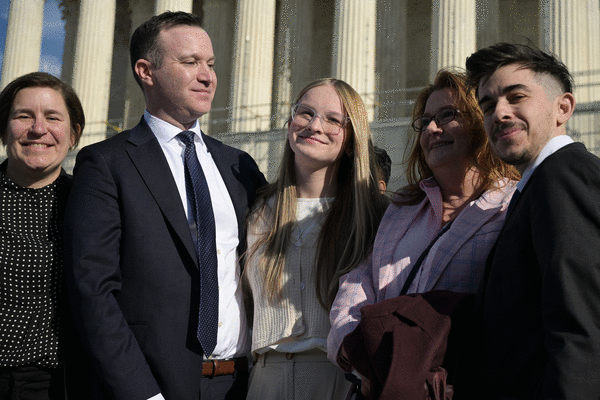
WASHINGTON — The Supreme Court sounded ready Tuesday to uphold conservative state laws that forbid transgender athletes to compete on school sports teams for girls.
But the ruling may not directly affect California and the liberal-leaning states, at least for now.
Idaho, West Virginia and 25 other Republican-led states say a student’s biological sex at birth should determine who can play on the girls’ or boys’ teams. They say it is unfair to girls to permit biological males to compete against them in sports such as track and field or swimming.
“Biological males are, on average, bigger, stronger and faster than biological females,” West Virginia’s state lawyers said.
Trans rights advocates sued and won rulings that these laws discriminate under the Constitution and violate Title IX, the 1972 education law credited with bolstering sports for girls and women nationwide.
During three hours of argument, the court’s conservative majority sounded ready to reverse these decisions and to uphold the state laws — but in a limited way.
Justice Brett M. Kavanaugh, a sports enthusiast who coaches girls’ basketball, said he favored a step-by-step approach.
“Given that half the states are allowing transgender girls and women to participate, about half are not, why would we at this point just jump in and try to constitutionalize a rule for the whole country?” he asked.
If so, a ruling in favor of West Virginia and Idaho will not directly change the law in California and the more than a dozen other Democratic-led states that forbid discrimination based on gender identity.
The law in California is essentially the opposite of those in the two states being challenged in the Supreme Court. Sports participation in the state’s K-12 public schools is entirely based on gender identity rather than gender assignment at birth.
The pioneering law signed by Gov. Jerry Brown in 2013 granted transgender students the right to participate in athletic teams and use facilities consistent with their gender identity.
But there were two signs of trouble ahead for California and the other Democratic-led states.
Chief Justice John G. Roberts Jr. and Justice Samuel A. Alito Jr. said the court must define what is sex discrimination under the federal Title IX law. “How can a court determine whether there’s discrimination on the basis of sex without knowing what sex means,” Alito asked.
Picking up on that point, Kavanaugh said California and the blue states will face a problem if Title IX law separates athletes based on their “biological sex,” not their gender identity.
The other factor is President Trump, who has vowed to protect women’s sports from transgender athletes. In the fall, the Trump administration joined the transgender sports cases on the side of West Virginia and Idaho.
But its lawyers argued only that the Constitution permits states to exclude transgender girls from girls’ teams. It does not require that they do so, their lawyers said.
Even a West Virginia lawyer agreed.
“There is enough room for California to make a different interpretation,” state solicitor Michael R. Williams told the court.
Deputy Solicitor Gen. Hashim Mooppan said these Democratic states “are violating Title IX,” the education law that allows separate sports teams for girls and boys. But he said the court should not rule on that question now.
Last year, in response to the court’s ruling on gender-affirming care, Trump cut off federal funds to hospitals and medical facilities that provided such care.
A ruling upholding restrictions on transgender athletes could spur the Trump administration to cut off education funds to Democratic-leaning states.
In June, the U.S. Department of Justice notified all California school districts that they were not to comply with state law allowing athletes to compete in sports based on gender identity. State Supt. of Public Instruction Tony Thurmond immediately countered that California public schools would continue to follow state law despite the warning.
The standoff is being litigated between state officials and the Trump administration, which has threatened to cut off federal funding to California schools — both locally and statewide.
The California Interscholastic Federation, which governs high school sports, made pragmatic compromises last year related to competitions in individual sports, such as track and field. For individual competitions, a trans athlete will not be allowed to bump a biological female from qualifying for a competition. In such a situation, the number of qualifying competitors would be expanded.
Such a solution is manageable because the number of trans athletes is exceedingly small. A similar approach applies to winners of individual competitions. For example, if a trans athlete finished first in a competition over a biological female, then the biological female also would be accorded a first-place finish.
Last year, a similar dispute came before the court.
Then, the conservative justices ruled Tennessee and other red states may prohibit gender-affirming drugs and medical treatments for teenagers who suffer from gender dysphoria.
The 6-3 majority said this was not unconstitutional discrimination based on the teenagers’ transgender status. But that ruling did not strike down the conflicting law in California.
It did, however, spur the cutoff of federal funds to hospitals and medical clinics that provided gender-affirming care.
The sole plaintiff before the court Tuesday was Becky Pepper-Jackson. Now 15, she has carried on a lonely legal fight to compete on her school’s track team in Bridgeport, W. Va.
Designated male at birth, she says she is the only transgender girl competing in her state and has been the target of complaints and protests.
In middle school, Becky participated in cross-country as a sixth-grader and described herself as slow. She “routinely placed near the back of the pack,” her attorneys told the court.
But upon reaching high school, she has been winning.
In 2024, she “placed in the top three in every track event in which B.P.J. competed, winning most,” the state’s attorneys said. In the spring of 2025, “focusing on strength events, B.P.J. bumped female competitors out of the state tournament, then placed third in the state in discus and eighth in shot put while competing against much older female athletes,” they told the court.
Her attorney, Joshua Block of the American Civil Liberties Union, said she has been winning in the shot put and discus “through hard work and practice.”
He said she “received puberty-delaying medication and gender-affirming estrogen that allowed her to undergo a hormonal puberty typical of a girl.”
He urged the court to rule for Becky because she does not have a physical advantage due to her biology.
But the conservative justices did not sound inclined to rule on the issue of puberty blockers.
WASHINGTON — The Supreme Court justices sounded ready Tuesday to uphold state laws that forbid transgender athletes from competing on school sports teams for girls.
Idaho, West Virginia and 25 other Republican-led states say a student's biological sex at birth should determine who can play on the girls' or boys' teams.
They say it is unfair to girls to permit biological males to compete against them in sports like track and field or swimming. "Biological males are, on average, bigger, stronger and faster than biological females," West Virginia's state lawyers said.
While the court's conservative majority court is likely to rule for these states, the justices said they prefer a narrow decision limited to these laws.
If so, such a ruling for the red states will not directly change the law in California and the more than a dozen other Democratic-led states that forbid discrimination based on gender identity. Those laws protect rights of transgender girls to compete on a girls' team.
A similar dispute came before the court last year.
Then, the conservative justices ruled Tennessee and other red states may prohibit gender-affirming drugs and medical treatments for teenagers who suffer from gender dysphoria.
The 6-3 majority said this was not unconstitutional discrimination based on the teenagers' transgender status. But that ruling did not strike down the conflicting law in California.
In recent months, the Trump administration joined the transgender sports cases on the side of West Virginia and Idaho.
But its lawyers argued only that the Constitution permits states to exclude transgender girls from girls' teams. It does not require that they do so, their lawyers said.
Even a West Virginia lawyer agreed. "There is enough room for California to make a different interpretation," state solicitor Michael R. Williams told the court.
Deputy Solicitor General Hashim Mooppan said these Democratic states "are violating Title IX," the education law that allows separate sports teams for girls and boys. But he said the court should not rule on that question now.
Last year, in response to the court's ruling on gender-affirming care, President Donald Trump cut off federal funds to hospitals and medical facilities that provided such care.
A ruling upholding restrictions on transgender athletes could spur the Trump administration to threaten Democratic states with a loss of federal education funds.
Becky Pepper-Jackson, now 15, has carried on a lonely legal fight to compete on her school's track team in Bridgeport, West Virginia.
Designated male at birth, she says she is the only transgender girl competing in her state and has been the target of complaints and protests.
In middle school, Becky participated in cross-country as a sixth-grader and described herself as slow. She "routinely placed near the back of the pack," her attorneys told the court.
But upon reaching high school, she has been winning.
In 2024, she "placed in the top three in every track event in which B.P.J. competed, winning most," the state's attorneys said. Last spring "focusing on strength events, B.P.J. bumped female competitors out of the state tournament, then placed third in the state in discus and eighth in shot put while competing against much older female athletes," they told the court.
Her attorney, Joshua Block of the American Civil Liberties Union, said she has been winning in the shot put and discus "through hard work and practice."
He said she "received puberty-delaying medication and gender-affirming estrogen that allowed her to undergo a hormonal puberty typical of a girl."
He urged the court to rule for Becky because she does not have a physical advantage due to her biology.
But the justices did not sound inclined to rule on the issue of puberty blockers.
_____
©2026 Los Angeles Times. Visit at latimes.com. Distributed by Tribune Content Agency, LLC. ©2026 Los Angeles Times. Visit latimes.com. Distributed by Tribune Content Agency, LLC.



















































Comments