Trump moves to make data centers pay for surging power costs
Published in Political News
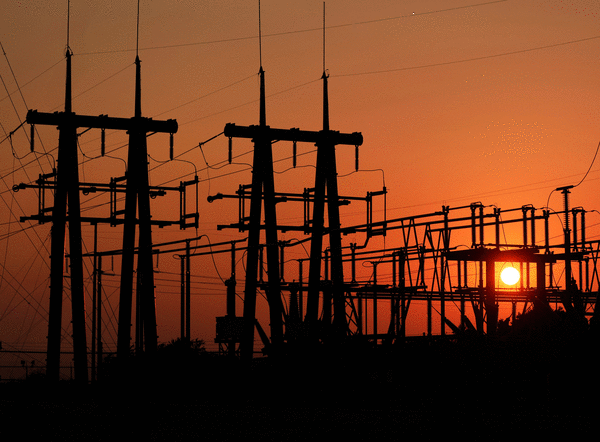
President Donald Trump and U.S. Northeast governors will direct the nation’s largest grid operator to hold an emergency power auction that would force technology giants to pay for the construction of a fleet of new plants.
The unprecedented move, set to come Friday, aims to quell concerns about data centers driving up energy costs.
Under the initiative, the administration and governors whose states are supplied by PJM Interconnection LLC will direct the grid operator to hold a reliability power auction in which tech companies would bid on 15-year contracts for new electricity generation. If PJM goes along with the plan, it could be mammoth in scale, delivering contracts that would support the construction of some $15 billion worth of new power plants, said a White House official granted anonymity to detail the approach.
The push — which will come in the form of a “statement of principles” signed by Trump’s National Energy Dominance Council and the governors of Pennsylvania, Ohio, Virginia and other states — responds to growing worry about power demand far outpacing supply in the region managed by PJM, which serves more than 67 million people from the Mid-Atlantic to the Midwest.
And it seeks to address building tension over how the nation can supply electricity to power-hungry data centers seen as necessary to help win a global competition to dominate artificial intelligence without simultaneously hiking utility bills for American consumers.
Trump has repeatedly described power plants being built alongside data centers, and on Monday, he doubled down on the idea, insisting in a social media post that the big technology companies that build data centers must “pay their own way.”
“I never want Americans to pay higher Electricity bills because of Data Centers,” Trump said.
Cost-of-living concerns are already weighing heavily on Republicans’ bid to maintain control of the House and Senate in this November’s elections. While Trump has stressed the plummeting cost of oil and gasoline since he took office last January, electricity prices have climbed due to rising demand — and there’s a building backlash against data centers that are fueling the surge.
The average U.S. retail price for electricity gained 7.4% in September to a record 18.07 cents per kilowatt-hour, the biggest gain since December 2023. Residential prices have jumped even higher, rising by 10.5% between January and August 2025, marking one of the largest increases in more than a decade, according to the National Energy Assistance Directors Association.
The action Friday is being cast as a one-time emergency intervention into the PJM market, necessary because of the rapid rise in electricity prices in the Mid-Atlantic. The Trump administration and governors will urge the grid operator to return to market fundamentals after the acute problem is addressed, the White House official said.
Yet representatives of PJM will not be in attendance when the plan is laid out Friday. “We don’t have a lot to say on this,” PJM spokesman Jeffrey Shields said by email. “We were not invited to the event they are apparently having tomorrow and we will not be there.”
The White House did not immediately respond to requests for comment about its interaction with the grid operator.
The administration’s prescription for PJM is what’s known as a reliability backstop auction — something the grid operator already envisioned in the wake of repeated failed sales. But the administration and governors’ plan would mean holding the emergency auction right away after one clear failure – with unusual terms meant to foster a wave of rapid, new construction and the only bidders being data center owners and operators.
While PJM currently holds auctions procuring electricity supplies for a 12-month period, the sale encouraged by Trump and governors would involve 15-year contracts, with start-up times for the new power plants likely staggered. The White House and governors are urging PJM to hold the special one-time auction by the end of September. Tech giants would pay for the prices locked in for the duration whether they use the power or not. This auction sets payouts to generators, which would also get paid for real-time electricity that they produce.
“It sounds like a significant improvement and a logical extension of bring-your-own new generation,” Joe Bowring, president of PJM’ s independent watchdog Monitoring Analytics LLC, said in a telephone interview.
The approach would provide secure revenues for years in a market notoriously known for price volatility and generator bankruptcies.
“While a ‘statement of principles’ doesn’t appear to include a legal mandate for PJM to act, pressure from the Trump administration and a bipartisan coalition of PJM states is very likely to motivate a considerable response” from the grid operator, said Timothy Fox, with the research firm ClearView Energy Partners.
This plan also could fast track the development of natural gas generation and potentially nuclear plants by guaranteeing revenues – and profits – specifically to support data campuses needed to deploy artificial intelligence. PJM is already home to the world’s biggest concentration of data centers, in northern Virginia, and is expecting peak demand across the 13-state eastern U.S. system to jump 17% by 2030 from this year’s high.
The approach could benefit larger tech companies at the expense of smaller firms.
Amazon.com Inc., Alphabet Inc.’s Google and Microsoft Corp. are less exposed to electricity price fluctuations since they can pass those costs on to customers, said Gil Luria, analyst at DA Davidson & Co. However, dozens of smaller companies, including Nebius and CoreWeave that offer artificial intelligence infrastructure to cloud-computing companies on multi-year contracts, could be more exposed to big price swings since they are on the hook to absorb higher electricity costs, he said.
“If they have to pay more for electricity, their margins will get squeezed,” Luria said.
The effort had the potential to help PJM tackle a significant roadblock: improving the accuracy of its forecasts for demand growth. With tech giants paying for the power plants they need, the approach could weed out speculative projects that have skewed demand growth projections.
The involvement of governors – including at least one Democrat, Pennsylvania’s Josh Shapiro – is seen by the Trump administration as helping to anchor the effort, since state policies have driven recent changes in the power mix, including the retirement of coal and gas plants. The initiative is also seen aiding hyperscalers by ensuring reliable power supply, and it could be a model for other parts of the country, the White House official said.
Governors are committing to implement and assign these costs to the data centers, ensuring the price of these new power plants doesn’t land on the average household, the White House official said.
The AI boom, in many ways, is taking place at the best and worst time for America’s aging power infrastructure. Soaring demand is straining grids already taxed by extreme storms and an overhaul of how power is flowing to homes. The data-center buildout now threatens to drive up household power bills that were already at record levels.
It isn’t just a PJM problem. Almost all U.S. power grids will lack spare capacity by 2030, while consumers saw an average inflation of 9% in their utility bills over the previous two years, according to Goldman Sachs Group Inc.
PJM’s auctions have emerged as a political flashpoint in the national debate about affordability after prices reached record levels in 2024. Although Pennsylvania’s Shapiro struck a deal with PJM to cap prices in future auctions, costs hit new highs in two subsequent sales.
The most recent auction, in December, also fell 6.6 gigawatts short of supplies, which PJM blamed on the frenzy to build massive data centers.
PJM is now being asked to extend the price cap through this year, the White House official said.
While the statement of principles being signed Friday isn’t a binding legal document, administration officials have discussed the plan with a host of stakeholders, from PJM executives and state officials, to utilities, power-plant developers, Wall Street and the hyperscalers building these data centers, the official said.
The action comes just before a Monday deadline for PJM to respond to the Federal Energy Regulatory Commission about its plan going forward. And the expectation is that the auction plan will be included in PJM’s reply to FERC. The bipartisan agency would need to approve the measures.
(With assistance from Spencer Soper.)
©2026 Bloomberg L.P. Visit bloomberg.com. Distributed by Tribune Content Agency, LLC.





















































Comments