Analysis: Compared with other presidents, Trump 2.0 is one of a kind
Published in Political News
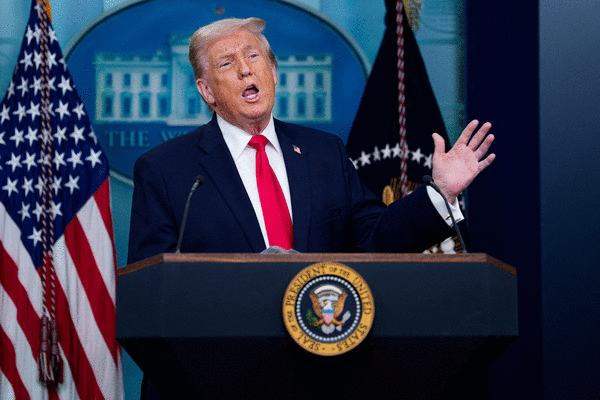
WASHINGTON — When matching up the first year of Donald Trump’s second term with other presidencies, there really is no comparison.
Trump’s breakneck pace since returning to office does not draw clean parallels with any single former president, historians say, though certain actions have mirrored those of several predecessors, including Grover Cleveland, Franklin D. Roosevelt, William McKinley and Richard Nixon.
But there were still differences in those presidents’ moves in terms of how they carried them out, especially when it came to working with Congress.
As Trump on Tuesday celebrated one full year back in White House, the first 365 days have offered a new and unprecedented blueprint for carrying out the duties of the highest office in the land.
“I don’t think there’s been a term like it,” Trump told reporters Sunday night in Florida after attending the College Football Playoff National Championship game in Miami. He cast his first year back as a “success,” though congressional Democrats vehemently disagree.
“During his campaign and his presidency, President Trump promised ‘retribution’ against his enemies. He has made good on his promise, using the justice system as a shield for his cronies and a sword to attack his opponents,” Senate Judiciary ranking member Richard J. Durbin, D-Ill., said in a Tuesday statement.
Presidential historians highlighted Trump 2.0’s habit of trying to bypass or weaken Congress, noting that other presidents typically tried working with Congress and securing major — even contentious — policy changes via legislation.
“In addition to the Supreme Court — despite having four of his appointees — ruling against Richard Nixon in the Pentagon Papers and tapes cases, a Democratic Congress checked Nixon through the War Powers Act of 1973, which he vetoed and it overrode,” Barbara Perry, a professor at the University of Virginia’s Miller Center, said in an email. “And even his own party’s congressional leaders convinced him to resign under certainty of impeachment and conviction, for which they would vote ‘yes.’”
“This GOP Congress has bowed to President Trump, except on the Epstein files law, which he has now violated by not releasing all the documents by last month,” Perry added.
During a Tuesday appearance at a White House briefing, Trump mocked critics who said he’d need legislation to pare down the number of undocumented individuals illegally entering the United States.
Another historian argued that comparisons between Trump and Nixon had their limits.
“Most of Nixon’s aggressive policy initiatives were in his first term,” Edward Lengel, a former chief historian for the White House Historical Association. “After reelection, he became secretive and isolated even from his own supporters and was soon embroiled in Watergate, which undercut his presidency.”
“Nixon also had to deal from the beginning with a heavily Democratic Congress that stymied him,” he added.
Trump and his top lieutenants often boast about how they have shaken up Washington by elevating the executive branch — and fundamentally altering the balance of power between the three branches of government. Roosevelt did the same — but in different ways, experts said.
“In short and as always, the 47th presidency is, in total, unprecedented in his unlawful and unconstitutional actions. One could argue that FDR reshaped the American regime, and he did via the New Deal and in World War II,” Perry said. “But he was not attempting to line his own pockets with financial gain. Rather, he alleviated the worst of the Great Depression’s ravages and saved the world from fascism.”
“Roosevelt did so in the former instance, despite a conservative SCOTUS ruling against him in the first term and having to placate southern Democrats in Congress,” she added.
Since returning to power, Trump has not attempted to placate any Democratic factions.
There’s also Cleveland, the only other president to have won election to two nonconsecutive terms. Again, even the similarities reveal differences.
“There are some parallels with Cleveland, especially as regards the Monroe Doctrine, even including Venezuela,” Lengel said, referring to the 19th-century credo Trump has cited to defend his administration’s recent military actions in the South American nation. “However, Cleveland was anti-tariff and also largely anti-imperialist in a highly imperialist era.”
Trump, on the other hand, has been heavily involved in global affairs in his second term. This year alone, he ordered the ouster and capture of Venezuelan President Nicolás Maudro, did not rule out military strikes on Iran and threatened to take Greenland from Denmark.
“I don’t think they’re gonna push back too much,” Trump said Sunday of European leaders ahead of his upcoming visit to the World Economic Forum in Davos, Switzerland. “Look, we have to have (Greenland). … Because a boat went there 500 years ago and then left, that doesn’t give you title to property.”
“Let’s put it this way,” the president added. “It’s going to be a very interesting Davos.”
‘Contravening norms’
Perry pointed to other differences in the comparisons between Trump and Cleveland.
For instance, Cleveland opposed annexing Hawaii, while Trump has mused about making Canada the 51st state, in addition to gaining control of Greenland. Unlike the 22nd and 24th president, Trump returned to power with an eye on “territorial expansion,” Perry said.
Still, as Trump has deployed National Guard and federal law enforcement within a number of Democratic-run cities, Perry noted that Cleveland, a Democrat, sent troops to Chicago in 1894 in response to the Pullman Strike by railroad workers. And in his second term, Trump has worked closely with corporate America, again evoking Cleveland.
On trade, Trump has frequently been compared with McKinley, a fellow Republican believer in tariffs. The 47th president himself has boasted about this similarity.
“Trump is consciously trying to emulate William McKinley, for example on foreign policy and tariffs,” Lengel said. “But this applies mainly to McKinley’s first term, since he was assassinated shortly into his second.”
And then there’s Andrew Jackson, the two-term president from Tennessee known as “Old Hickory.” Like Trump, the seventh president was keen on expanding the power of the office and aggressively battled his political foes and sought to settle scores.
“Seeing his reelection as a national mandate, Jackson carried on his heavy-handed war against the Bank of the United States to remake the American banking system, looked to expand executive power, and focused on nation-by-nation deal-making abroad regarding trade and fiscal issues,” Lengel said. “His attitude in pushing his policies by contravening norms and standards generated intense partisan hatred. He had an adversarial relationship with Congress.”
There’s another administration with whom Trump 2.0 differs on a number of matters: Trump 1.0.
This time around, the president has spoken on camera more than twice as much as he did during the first year of his first term, according to data compiled by Roll Call’s Factba.se. That extends to social media as well, with Trump firing off more than 6,500 posts over his first 365 days, compared with more than 2,600 eight years ago.
Trump visited 31 states in the first year after his 2017 swearing-in, while his latest term has seen him head to 18 states, according to the Factba.se data. (He visited 14 countries in each of his first years.)
Trump’s second term has also drastically outpaced the first on executive orders within the first 12 months (228 versus 58), as well as on deportations (777,590 versus 387,350), the Factba.se analysis found. Trump has played golf more often over the past year more than he did over the same time period eight years ago (100 days on the links versus 73), spent more time at one of his private properties (100 versus 73) and attended more sporting events (seven versus two).
_____
©2026 CQ-Roll Call, Inc., All Rights Reserved. Visit cqrollcall.com. Distributed by Tribune Content Agency, LLC.





































Comments