What the Supreme Court's decision to strike down tariffs means for LA's trade-dependent economy
Published in Political News
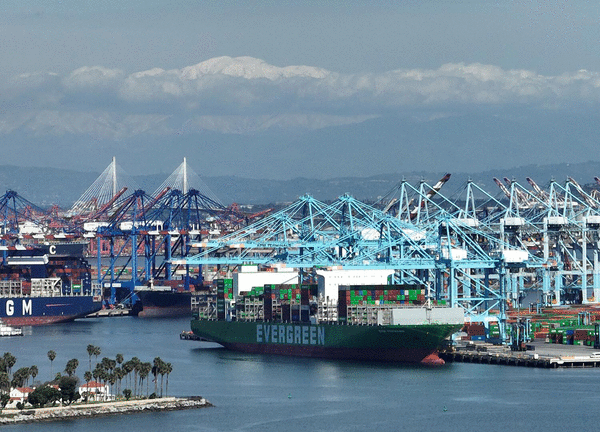
LOS ANGELES — The Supreme Court's decision Friday to strike down the majority of tariffs imposed by President Donald Trump could provide some relief to L.A.'s trade-reliant economy — but only if they are not reimposed again through other means.
The court's 6-3 ruling that Trump didn't have the authority to impose tariffs under the International Emergency Economic Powers Act rolled back levies that have upended international trade.
"We've seen that the tariffs have a significant impact on our supply chain, on our manufacturers and especially on our port logistics and trade sector," said Stephen Cheung, chief executive of the nonprofit Los Angeles County Economic Development Corp.
"I think this decision will have a significant impact on the Los Angeles economy. However, it's going to take a long time to unravel, so we'll see specifically how everything is going to pan out," he said.
The tariffs dealt a blow to a large swath of businesses in Southern California and across the state, including farmers, automakers, home builders, tech companies and apparel retailers.
MGA Entertainment, the Chatsworth maker of Bratz dolls, said a little more than half of its products are made in China, while hardware and lumber seller Anawalt in Malibu said the majority of its lumber comes from Canada and nearly all of its steel products are made in China.
During a news conference Friday following the decision, Trump said that under other legal authorities he would impose a 10% global tariff and pursue additional levies, including a possible 30% tariff on foreign cars. Later in the day he signed an order imposing the 10% tax, which takes effect Tuesday, Feb. 24.
"The Supreme Court's ruling on tariffs is deeply disappointing, and I'm ashamed of certain members of the court — absolutely ashamed," Trump said. "They're very unpatriotic and disloyal to our Constitution."
Friday's court decision affects up to $170 billion in tariffs collected under the International Emergency Economic Powers Act of 1977, including 10% to 50% duties and penalties on China, Canada and Mexico.
Whether importers who paid the tax can seek refunds was left to a lower court to decide. It's estimated $100 billion in tariffs were not affected by the decision.
The ports of Los Angeles and Long Beach — which handle nearly a third of the nation's containerized cargo and are the primary trade gateway to Asia — saw a surge of traffic the first half of last year as importers sought to get ahead of the tariffs, largely imposed in April.
However, traffic tailed off the second half of the year, with the L.A. port expecting a single-digit decline in volume this year before Friday's decision.
The twin facilities form the largest ports complex in North America, supporting more than 200,000 jobs and contributing $28 billion to the regional economy in 2022, according to a California Center for Jobs & the Economy report.
The uncertainty surrounding the tariffs derives from the complexity of the tariffs themselves — as well as the other legal options Trump has to impose them again.
Mike Jacob, president of the Pacific Merchant Shipping Association, which represents ocean carriers, marine terminal operators and others in the industry, said the tendency is to think of the tariffs as uniform.
"It was different rates for different countries. That was compounded by different rates for different commodities. And there's a lot of changes that have occurred with specific commodities," he said. "So it's almost impossible to take a broad brush and say, here's what we expect to happen — except to say that it's still a pretty unsettled space."
In imposing a 10% global tariff, Trump would be relying on a provision of the Trade Act of 1974, while his ability to pursue additional levies would rely on other law.
Economist Jock O'Connell, international trade adviser at L.A.'s Beacon Economics, said that Trump may have authority to impose the 10% global tariffs, but additional levies would involve trade authorities.
"That would be a cumbersome process. The tariffs have to be more specifically framed and the subject of an investigation," he said.
Also complicating the process are trade deals the U.S. has been negotiating with foreign countries based on the tariffs. O'Connell expects they will seek to renegotiate them.
"They're likely to come back to the table and say, 'Well, you don't have the authority to impose these,'" he said.
Gene Seroka, executive director of the Port of Los Angeles, said importers are facing tough decisions right now, given that any ocean carrier leaving an Asian port today would not be subject to the tariffs that were struck down.
"That executive is asking: 'Are my commodities now exempt from this tariff?' If the answer is yes, 'Can I buy more of that product and get it shipped while there are no tariffs?'" he said.
Those decisions would revolve around such factors as the availability of space on the vessel and local warehouses, as well as trucking services, he said.
Mark Zandi, chief economist at Moody's Analytics, said the decision should be good news for the larger U.S. economy and businesses on the "front line" of the trade wars, such as transportation, distribution, agriculture and retail.
"If the president lets the Supreme Court decision stand and doesn't try to replace the tariffs, that's a plus for the economy — but that's not what's going to happen," he said.
©2026 Los Angeles Times. Visit latimes.com. Distributed by Tribune Content Agency, LLC.













































Comments