KY Republican Congressional candidates agree with Trump, each other in debate
Published in Political News
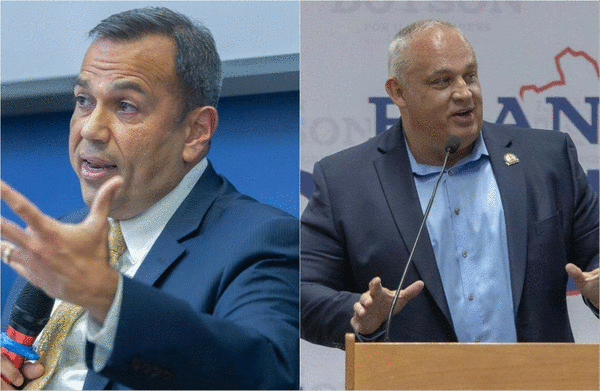
LEXINGTON, Ky. – Two Republicans running to replace Rep. Andy Barr left little daylight between themselves in the first televised debate of Kentucky’s 2026 election cycle.
Rep. Ryan Dotson, R-Winchester, and former state senator Ralph Alvarado largely agreed with each other on matters of health care, immigration, tariffs, term limits and President Donald Trump in a debate hosted by Spectrum News on Thursday night for GOP candidates in Kentucky’s 6th Congressional District.
Alvarado flexed his policy chops on a wide range of topics, including health care and immigration, as well as his ties to Trump — Alvarado was an earlier supporter of Trump’s, speaking at the Republican National Convention in 2016.
“I’m an ally for the President. The president knows me. I’m looking forward to serving with him and making sure that he has an ally when it comes to defending his vision of America first and making America great again,” Alvarado said.
Dotson framed himself as an effective outsider, touting both his agreement with Trump on policy issues, but also his penchant to shake things up and home in on socially conservative issues like transgender rights.
“I’m definitely an outsider to the respect that I just don’t go with the flow, and I have this mentality: Any dead fish can float downstream,” Dotson said.
The pair was the only two of the five Republican candidates to meet Spectrum News’ threshold for the debate stage. Other candidates are Adam Perez Arquette, Steve Shannon and Greg Plucinski.
Plucinski is running a professional campaign, but he did not meet Spectum News’ threshold for the debate stage because candidates were required to have raised at least $100,000 from outside sources. Plucinski, a former pharmaceutical executive from Nicholasville whose company was recently acquired, has largely been a self-funder. In the final months of 2025, he loaned his campaign more than $300,000.
In a statement, a campaign spokesperson wrote that Plucinski would make his case for the nomination “without relying on failing legacy media.”
“Media outlets don’t decide elections in Kentucky. And Kentucky wants results — and two career politicians debating their lackluster records is the last thing people want to hear. Greg Plucinski has invested millions of dollars and created hundred of high-paying jobs in Lexington. He’s done more for the economy in this district than either of these politicians,” the spokesperson wrote.
The issues
Spectrum News host Mario Anderson, who moderated the debate, touched on several different topics important to Republican voters in Kentucky throughout the hourlong debate.
Their emphases differed a bit.
Alvarado brought up his direct ties to Trump multiple times during the debate, and focused on his background as a doctor in answering questions about health care and vaccines.
Dotson emphasized his outsider status and his work championing the bill that made it illegal for transgender girls to play girls sports in Kentucky — though there was only one known instance of a transgender girl doing so.
“As a junior legislator, I went to Frankfort and I got ‘save women’s sports’ passed… For the last four years, there has not been one biological male playing in a girls’ sport. And I led the charge in the house when it came to stopping gender reassignments on minors, stopping boys from using girls’ bathrooms and locker rooms,” Dotson said.
Their praise for Trump was largely effusive — but not totally uncomplicated.
Both candidates said they agreed overall with Trump’s strategy on tariffs — many of which were recently struck down by the U.S. Supreme Court due to the method in which they were levied — but acknowledged the pain felt by the bourbon industry. They also both said long-term taxation strategy should remain a congressional power.
Alvarado acknowledged an adverse effect on both bourbon distillers and farmers, who have also complained about the effect of exports due to the tariffs. He said the bourbon business was “concerned about their sales overseas” and younger generations drinking less alcohol. However, he expressed hope that Trump could use continued tariffs as leverage and forge a trade deal with India, the world’s most populous country, that would benefit Kentucky bourbon.
Dotson said there’s been “a little hiccup in the bourbon market,” but said he has faith in the Trump administration.
“Any reset that we do is going to affect us. There’s going to be some temporary pain, but I believe there’s going to be a long-term gain from this,” Dotson said.
He also explicitly disagreed with the supreme court’s ruling on the tariffs.
Vaccines was one area where the candidates differed. Alvarado, a physician, said patients get the final say, but he said he recommended certain vaccines as a doctor.
“I recommend the pediatric vaccines. We’ve got 80 years of data behind them and the safety,” Alvarado said.
Dotson spoke negatively on the topic, saying that those who didn’t want to take the COVID-19 vaccines “were treated as second-class citizens.”
“I don’t think it ever should be mandated that anybody should take a vaccine of any kind,” Dotson said.
Alvarado and Dotson both praised Trump’s foreign policy, agreed on supporting the Second Amendment, endorsing term limits — Dotson said six in the U.S. House and two terms in the Senate, while Alvarado didn’t pin down an exact number — and more.
When asked if they would ever oppose a Trump-backed policy if it hurt Central Kentucky, both said yes in theory. Anderson prompted both men to comment on the “biggest weakness” in each other’s campaigns, but neither went very negative.
Alvarado didn’t directly reference Dotson, instead highlighting his own closeness to the Trump team and his ability to pass bills when Democrats held some power in the legislature.
Dotson said he and Alvarado probably agreed on 90% of the issues. Still, he made quick reference to Alvarado leaving his state senate post to run Tennessee’s health department — a post he left just before declaring his run for Congress last year.
“To see any type of weakness in him is the fact he did leave Kentucky for a season, and then he came back,” Dotson said.
Dotson closed by framing himself as a man of action who won’t just be a “button pusher” in Congress.
“Every man’s record speaks for itself. I have a longstanding record in Frankfort, and in my community, of being a staunch conservative fighter. ... Sure, we can go to Frankfort or go to Washington, D.C. and be a button pusher, but I choose not to.”
In response to Dotson’s comment, Alvarado emphasized that he “never left Kentucky,” maintaining his medical practice in the Winchester area during his time in Tennessee.
Aside from that comment, Alvarado’s closing statement was all Trump.
“Fifteen months ago, this country elected President Trump back into the White House. I don’t know what this country would be if they hadn’t elected President Trump,” Alvarado said.
©2026 Lexington Herald-Leader. Visit at kentucky.com. Distributed by Tribune Content Agency, LLC.

Comments