Commentary: 3 questions linger after Trump's State of the Union speech
Published in Political News
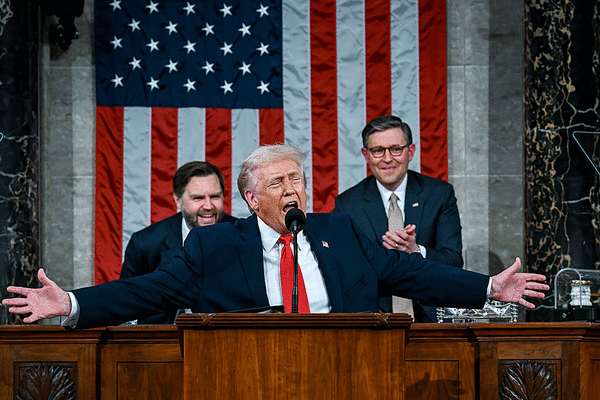
Anyone tuning into the State of the Union expecting responsible governance was sorely disappointed. What they got instead was pure Trumpian spectacle.
All the familiar elements were there: extended applause lines, culture-war provocation, even self-congratulation, praising the U.S. hockey team and folding its victory into a broader narrative of national resurgence. The whole thing was show business, crafted for reaction rather than reflection, for clips rather than consensus.
It was a relief when Virginia Gov. Abigail Spanberger delivered the Democratic response and shifted the conversation from overheated rhetoric to three simple questions.
She asked: Is the president working to make life more affordable for you and your family? Is the president working to keep Americans safe, both at home and abroad? Is the president working for you?
The administration can try to spin them, but lived experience tells a different story. The answers are not in the chamber but in daily life: at the grocery store, at the gas pump, on a credit card statement, in the safety of our communities, and at the kitchen table.
Affordability
Start with affordability.
Inflation has cooled from its post-pandemic highs, and the White House is quick to note it. Unemployment remains low and, on paper, the indicators look stable.
But affordability is not a chart; it is a daily reality that asks whether wages keep pace with rent and insurance premiums, whether retirement savings feel secure, and whether families believe next year will bring more stability than the last.
Confidence, however, is eroding. Consumer sentiment has fallen for four consecutive months, reaching its lowest level since 2020. Americans’ outlook on income, business conditions, and jobs has dropped to a 12-year low, and credit card delinquencies more than 90 days past due have climbed to a 13-year high.
For many middle-class families, the markers of the American Dream feel increasingly distant. Mortgage rates have doubled from pandemic lows, pushing first-time homeownership out of reach, while rents have outpaced wages in many cities. Childcare rivals college tuition in some states. Health insurance premiums and deductibles keep rising. Student loan payments have resumed, tightening already strained budgets.
The result is persistent anxiety as families delay buying homes, young couples postpone having children, and retirement contributions shrink to cover short-term expenses. While certain parts of the economy may be growing, family confidence is not.
These are not partisan numbers. They are economic stress signals that raise a harder question: Is the administration calming uncertainty, or amplifying it?
Security
The second question follows: Are we safe?
At the State of the Union, the language of safety was everywhere: border security, military strength, law and order. The president cited deportations, renewed border barriers, and rebuilding the armed forces as proof that America was regaining control. The imagery was calculated; strength projected from the podium was meant to reassure a jittery nation. Yet reassuring words carry little weight when daily life tells another story. Security, like affordability, rests not on rhetoric but on durable governance.
By the end of the week, the administration launched military strikes against Iran, a war of choice that risks destabilizing the Middle East and drawing the United States into another prolonged conflict. The question is not whether strength should ever be used, but whether its use makes Americans safer or merely signals resolve.
True security in a constitutional republic is measured not by how quickly a president acts alone, but by whether policy withstands scrutiny, commands legislative backing, and strengthens institutions rather than bypassing them.
In recent months, the administration has leaned heavily on executive orders and emergency authorities to reshape immigration enforcement and national security posture. Executive action is swift but also reversible; what one president builds by decree, the next can erase with a signature. That cycle may project decisiveness, but it does not build stability.
Alliances require consistency. Deterrence requires credibility. Border policy requires coordination with Congress, courts, and states. When governance turns unilateral, security becomes personality-driven rather than system-driven.
Personality is not a strategy.
Is the president working for you?
The third question cuts deeper: Is the president working for you?
In a constitutional system, that question is answered not by rally size or executive speed, but by whether power flows through institutions designed to represent the public. Congress controls the purse and should be consulted before taking the country to war. Courts review executive action. Agencies implement laws shaped through deliberation and compromise. When those structures function, citizens may disagree with outcomes yet still recognize the process as legitimate.
When they weaken, the shift is subtle but significant. Budgets are deferred through continuing resolutions. Policy moves through executive orders rather than legislation. Loyalty begins to outweigh expertise in the civil service. The visible story is decisive leadership; the deeper reality is institutional erosion.
A president working for the public strengthens the mechanisms that translate disagreement into policy and works through them, even when it is slower and less dramatic.
The State of the Union was performative, the applause loud and partisan, the imagery vivid, but the real test is quieter: whether families feel more secure, whether the nation is safer in ways that endure, and whether the institutions that bind us are stronger, not thinner. When the chamber empties, the lights dim, and the clips circulate, the serious questions remain.
____
Robert Cropf is a Professor of Political Science at Saint Louis University.
_____
©2026 The Fulcrum. Visit at thefulcrum.us. Distributed by Tribune Content Agency, LLC.















































Comments