Aviation safety bill passes US House after jet and helicopter collision
Published in Political News
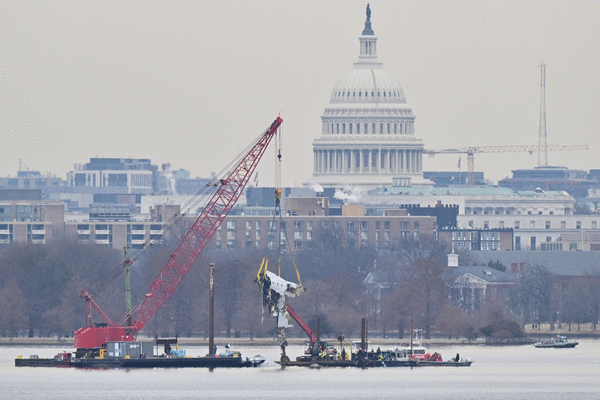
The U.S. House of Representatives on Tuesday passed a bill that would require upgraded collision detection and helicopter route design enhancements to make aviation systems safer.
The bill comes after a Black Hawk helicopter and an American Airlines flight fatally collided last year near the Ronald Reagan Washington National Airport in Washington, D.C. Capt. Rebecca Lobach, a Durham native, was piloting the helicopter and died in the collision.
A total of 67 people, which included all passengers and crew members on both aircraft, died in the collision.
H.R. 7613 is known as the ALERT Act, which stands for the Airspace Location and Enhanced Risk Transparency Act of 2026. The bill would work to make aviation systems safer by requiring upgraded collision detection technology by 2031.
It would also permanently close the route that the Black Hawk took, as well as require an independent audit of the Federal Aviation Administration by an inspector general. After a vote of 396-10 on Tuesday, the bill now moves to the Senate for consideration.
All 14 North Carolina representatives voted to advance the bill.
Lobach played basketball for the Durham Flight Home School from 2012 to 2014 and graduated from UNC-Chapel Hill in 2019. She was remembered by friends as someone who encouraged others and loved her country, The News & Observer reported in February 2025.
The plane, which was operated by American Airlines subsidiary PSA Airlines, had a four-person crew that was based in Charlotte, according to N&O reporting from March 2025.
The National Transportation Safety Board executed a yearlong investigation and found that the collision was avoidable, but did not fault the pilots of either aircraft. The board made 50 recommendations — with most directed to the FAA.
The report noted that Lobach was in control of the Black Hawk with an instructor pilot in the seat next to her.
Rep. Sam Graves, a Republican representing Missouri, introduced the bill. He also serves as the chairman for the House Committee on Transportation and Infrastructure.
Graves on Tuesday said the bipartisan bill addresses all 50 recommendations made by the NTSB, which he said the board confirmed.
“We did not put this bill together in a vacuum,” he said. “We worked closely with the NTSB, with stakeholders, with victims’ families to make sure we got this right.”
Collision detection technology
Automatic Dependent Surveillance-Broadcast (ADS-B) is technology that uses satellite signals to detect aircraft, according to the FAA.
ADS-B Out broadcasts information about an aircraft to air traffic controllers and other aircraft. ADS-B In provides the operator with traffic position and weather information.
Rep. Rick Larsen, a Washington state Democrat and the ranking member of the House Transportation and Infrastructure Committee, said the bill contains 23 safety provisions, including requiring ADS-B In and collision prevention technology for most aircraft.
He said ADS-B In is useful, but must be paired with the correct software, audio and visual displays “to effectively increase a pilot’s situational awareness.”
“The time to act is now,” Larsen said. “House passage of the ALERT Act is the next step in delivering on Congress’ safety commitment to the flying public and addressing all 50 NTSB recommendations.”
Rep. Tom Barrett, a Michigan Republican, said on Tuesday that the American Airlines jet was equipped with ADS-B Out, but not ADS-B In.
Conversely, Barrett said, the Black Hawk was equipped with the opposite.
“This tragedy was a breakdown across multiple different systems,” he said.
_____
©2026 Raleigh News & Observer. Visit newsobserver.com. Distributed by Tribune Content Agency, LLC.







































Comments