Commentary: After decades of sanctions on Iran, who has actually paid the price?
Published in Political News
On Monday, the United States opened another chapter in its decadeslong campaign of economic pressure against Iran. The Treasury Department launched Operation Economic Outcast, describing it as an unprecedented economic campaign aimed at further isolating the Islamic Republic and those who enable it.
The objective sounds straightforward: Deprive Tehran of money, and it will have less to spend on missiles, military operations and armed groups across the Middle East. But this follows decades of sanctions. Americans should ask: Who has actually paid the greater price, the Islamic Republic or the Iranian people?
Without question, sanctions can hurt the Iranian government. They have constrained trade and oil sales while pushing Tehran to rely increasingly on elaborate shadow banking, shipping and financial networks to move money and evade restrictions. The Treasury Department says its pressure campaign has disrupted billions of dollars in projected oil revenue and led to the freezing of nearly half a billion dollars in regime-linked cryptocurrency.
Those are meaningful results. But economic pain does not stop at the doors of government ministries or Revolutionary Guard compounds.
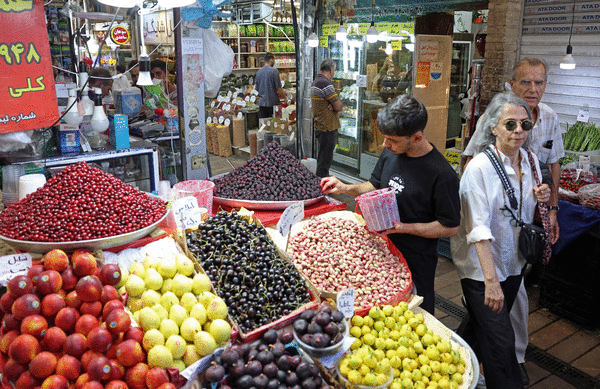
Iranians woke up to yet another sharp fall in the value of their currency, with the U.S. dollar reaching roughly 2 million Iranian rials on the open market. For ordinary families, a currency collapse is not an abstract economic indicator. Its effects can quickly affect the price of food, medicine and other basic necessities.
When I speak with family and friends in Iran, I hear a new anxiety in their voices. The fear of another war has not disappeared, but it is now accompanied by the fear of soaring prices and economic collapse. They tell me that they are already feeling the effects in the cost of basic food.
The burden is especially harsh for retirees on fixed incomes, many of whom depend on medications. When the currency falls and prices rise, food and medicine become competing necessities. Ordinary people are absorbing the most immediate consequences of economic pressure.
Food and medicine are not generally the stated targets of U.S. sanctions. But humanitarian exemptions on paper do not necessarily translate into accessible goods in Tehran, Shiraz or Isfahan. When banks fear processing Iranian transactions, shipping becomes difficult, suppliers withdraw and payment channels disappear, ordinary commerce can become more expensive.
Indian exporters have warned that the combination of new U.S. sanctions and the United Arab Emirates’ suspension of trade and financial transactions with Iran could severely disrupt Indian exports of rice, tea and pharmaceuticals, much of which has been routed through Dubai. Trade between India and Iran has already fallen by more than 90%.
Fundamentally speaking, in regard to sanctions, what is the measure of success? If success means making Iran poorer, economic pressure can accomplish that. If success means making international commerce more difficult for Tehran, sanctions can accomplish that too. But if the objective is to fundamentally change the behavior of the Islamic Republic, the record is considerably more complicated.
The Iranian government has spent decades learning how to survive sanctions. It relies on intermediaries, shadow banking networks, front companies and unconventional payment mechanisms to maintain access to the international financial system. Indeed, the Treasury Department continues to announce new sanctions precisely because these networks continue to operate. In recent months, the Treasury Department has described Iranian shadow banking networks that process tens of billions of dollars in trade each year.
Just days before announcing this latest campaign, the Treasury Department sanctioned another network that it says was moving as much as hundreds of millions of dollars to Hezbollah outside the formal financial system. That should prompt reflection.
After years of “maximum pressure,” Iran and its allies are still developing methods to move money. Tehran still possesses military capabilities. Its government remains authoritarian and repressive. And Washington continues searching for new ways to cut off the same networks that previous sanctions were supposed to disable.
None of this means sanctions have accomplished nothing. Nor does it mean the United States should ignore Iran’s nuclear ambitions, missile program, support for armed groups or repression of its own citizens. But it does mean we should distinguish between targeting a government and impoverishing the society living under it.
There is a legitimate case for targeted sanctions against government officials, Revolutionary Guard commanders, weapons procurement networks and individuals responsible for repression. Freezing the overseas assets of an official responsible for human rights abuses is fundamentally different from policies that contribute to the collapse of an entire country’s purchasing power.
Authoritarian governments also possess something ordinary citizens do not: the ability to decide who absorbs economic pain. When foreign currency becomes scarce, the government can prioritize its security institutions. When international banking channels disappear, politically connected networks develop alternatives. When inflation destroys household savings, however, a teacher, pensioner or shopkeeper has no shadow banking network.
Iran has nearly 90 million people. Those people are not interchangeable with the government ruling them. Many have protested that government, demanded political change and paid an extraordinary price for doing so. American policy should not make their lives increasingly unbearable and then point to their suffering as evidence that pressure on Tehran is succeeding.
The United States is entitled to defend its interests and confront genuine security threats from the Islamic Republic. But every foreign policy instrument should ultimately be judged by what it accomplishes — not merely by how much pain it can inflict. After decades of sanctions, Washington should therefore ask a question more difficult than whether it can make Iran’s economy hurt.
Does making ordinary Iranians poorer actually make the Islamic Republic less dangerous? If the answer is still uncertain after decades of trying, another round of ever-harsher economic isolation deserves scrutiny, not celebration.
____
Pegah Banihashemi, a native of Iran, is a legal scholar and journalist in Chicago whose work focuses on human rights, constitutional and international law, and Middle East politics.
___
©2026 Chicago Tribune. Visit at chicagotribune.com. Distributed by Tribune Content Agency, LLC.














































Comments