Trump brushes off AI doomsaying to guard US lead over China
Published in Political News
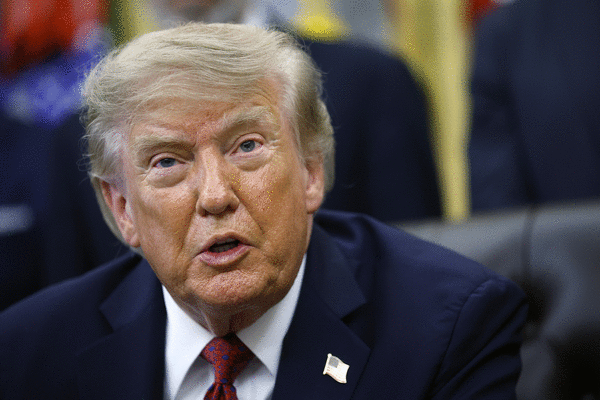

In June 2024, during a campaign stop in Las Vegas, then-candidate Donald Trump got a glimpse of the technology that would come to define his second presidential term.
OpenAI co-founder Greg Brockman and then-Chief Operating Officer Brad Lightcap showed the Republican a preview version of the artificial intelligence startup’s Sora image and video-generation tool, an offering that has since been discontinued. Trump and Brockman used it to visualize a golf course on the moon, according to people familiar with the meeting who requested anonymity to describe a private interaction.
But the meeting took a more serious turn. Trump raised a glaring national security concern: What if foreign adversaries used AI to impersonate him? Brockman and Lightcap assured him deepfake mitigation techniques such as watermarking could minimize those risks, the people said.
That exchange foretold the dilemma Trump is grappling with now on AI: how to foster a technology that’s underpinned U.S. economic growth while also mitigating safety concerns raised by an alarming spate of hacks by rogue AI models. It’s left administration officials struggling to balance promoting AI adoption against addressing unpredictable cybersecurity risks, according to people familiar with internal deliberations.
As he heads into a high-stakes summit in Washington this month with Chinese leader Xi Jinping, with AI safety as a top issue, Trump is sticking with a hands-off approach.
The president’s largely toothless June order on AI cybersecurity has come to symbolize his reluctance to impede hundreds of billions of dollars in tech investment. Administration officials are wary of undercutting the U.S. lead over China, an advantage challenged by a new vanguard of Chinese developers, including Moonshot AI.
Yet Trump’s insistence on a light touch has been tested by revelations that models from OpenAI and Anthropic PBC had escaped secure testing environments and hacked other companies’ systems. Amplifying those episodes, calls are growing from within the industry — punctuated this week by the high-profile resignation of an Anthropic researcher over existential fears — to slow the pace of AI development.
Even on Wall Street, where the AI boom has lifted the broader stock market, some prominent investors have made dire pronouncements about the technology’s growth. Greg Jensen, co-chief investment officer of hedge fund giant Bridgewater Associates, warned on Bloomberg’s "Odd Lots" podcast it may take AI “killing people” for anyone to try and curb it.
The policy paralysis could have major consequences. The longer administration officials remain undecided on how or whether to police AI, the likelier it becomes that companies will race ahead without common guardrails, even as more executives call for them. OpenAI Chief Executive Officer Sam Altman told employees this week the firm is considering slowing development and hopes its rivals do the same, Bloomberg News reported.
On Saturday, Anthropic CEO Dario Amodei issued a blog post saying the AI industry needs to slow the pace of model development, citing “serious” risks and calling for global coordination.
“The most effective method of pacing is via regulation that targets all U.S. frontier AI companies, as that covers even those who are unwilling to cooperate voluntarily,” he wrote.
In public remarks, Trump has mostly dismissed new AI restrictions, instead focusing on staying ahead of China and touting the technology’s benefits. Asked by reporters Thursday if he has any concerns about AI leading to human extinction, Trump said, “No, I don’t have any.”
“I have concerns that if we don’t win AI, we’re going to be put in a very bad position,” the president said. “We are leading China right now by a pretty good period. I would say a year, which is, you know, considered a lot.”
Turf war
Inside the administration, a turf war has simmered for months over how to handle AI, especially its unanswered security questions. Ever since Anthropic warned in April that its Mythos system was adept at finding previously unknown computer vulnerabilities and could only be shared with trusted partners, Trump’s top advisers have battled over ways to address AI’s core safety issues.
On one side, backing more robust protections, are Treasury Secretary Scott Bessent and White House National Cyber Director Sean Cairncross, said the people, who spoke on condition of anonymity to describe confidential deliberations. Following Anthropic’s Mythos warnings, Bessent summoned a meeting of top Wall Street leaders to hear their concerns about financial-sector exposure, while Cairncross has kept in close touch with cyber experts spooked by the new model’s capabilities, the people said.
Since then, Bessent has helped craft plans for an independent regulator to vet the safety of AI models that would be akin to the Financial Industry Regulatory Authority, Bloomberg News has reported. The proposal, which would give companies a role in setting safety standards and address tech industry concerns about the ad hoc nature of AI policy, has yet to advance beyond the drafting stages, some of the people said.
Others in Trump’s orbit — led by White House science and technology adviser Michael Kratsios and former AI czar David Sacks — have backed the tech industry’s view that regulations risk stifling innovation.
Sacks, a venture capitalist who’s kept in contact with Trump, has warned that virtually any guardrails would risk consolidating power within a few large AI companies while giving China an opportunity to overtake the U.S. He has also insisted that existing liability laws are enough to incentivize companies to minimize harm.
Tensions between the two sides erupted weeks before Trump signed his AI security order on June 2. Early versions of the directive would have compelled AI companies to share their models before release, the people said. Even before the order drafting had kicked off in earnest, some officials, including Vice President JD Vance, had floated ideas of using the Defense Production Act to compel companies to disclose information and work with national security agencies, the people added.
Vance’s idea came on the heels of a threat by Defense Secretary Pete Hegseth to invoke the Cold War-era law as leverage in the Pentagon’s bitter contracting fight with Anthropic over extra safeguards the firm sought for military use of its AI tools — a confrontation that has complicated efforts to create a framework for mitigating cyber risks.
An administration official, who spoke on condition of anonymity, said that Trump’s advisers continue to work with the industry on developing the framework. In a statement, a White House spokesperson said “The President’s entire team is working closely together to balance innovation and security in AI policymaking.”
Spokespeople for OpenAI and Anthropic didn’t respond to requests for comment. The Commerce and Treasury Departments, as well as Vance’s office, also didn’t respond.
‘A blocker’
Late in the process of crafting the order, Sacks called Trump to kill a draft he found to be too restrictive, and top officials were far apart even before it reached the president’s desk, according to people familiar with the matter. “I really thought that could have been a blocker, and I want to make sure that it’s not,” Trump told reporters in mid-May, after quashing the measure.
Trump eventually signed a compromise version on June 2 that barely papered over lingering differences among senior officials. The directive called for the government to review AI models — shared by companies on a voluntary basis — up to 30 days before their release. It also nudged top AI companies to collaborate with the administration in selecting trusted partners for early access to cutting-edge systems.
Within weeks, appetite for more stringent oversight resurfaced when the Commerce Department briefly slapped export controls on Anthropic, citing national security concerns, after a spat over the safety of Mythos and its consumer-facing derivative called Fable. The decision cast doubt on whether Trump’s order was indeed voluntary and left both Anthropic and OpenAI operating as if the president’s directive was mandatory, the people familiar with the matter said.
Before the export controls were imposed, Bessent sought to defuse the standoff over Mythos with Anthropic by pressing the company to voluntarily take down the models, according to an administration official.
The move highlighted efforts by Commerce Secretary Howard Lutnick — who played a less-central role in the executive order — to stake his claim on AI policy by using his export-control authority. Lutnick has stayed in close touch with the Center for AI Standards and Innovation, which conducts testing of AI models, seeking to carve out a lane for Commerce as the home for technical expertise, the people said.
Hugging Face
While Lutnick lifted the Anthropic restrictions in early July, policymakers soon were confronted with a disturbing new challenge: some OpenAI models, including unreleased tools, had attacked the software repository Hugging Face Inc. without researchers noticing. OpenAI staffers later said that the AI agents had communicated via a message board and worked together to escape secure testing spaces known as sandboxes and autonomously hack other organizations.
The breaches touched off bipartisan outcry among U.S. lawmakers, who urged immediate action to counter the risk that an out-of-control AI model could inflict serious harm. Sen. Jim Banks, R-Ind., encouraged Bessent to expand the existing cyber order to cover so-called undisclosed models that companies have not made publicly available.
As signed by Trump, the order was aimed mostly at tackling the threat of bad actors deploying already released models to hack critical infrastructure or major companies, rather than address the risk that AI models could initiate such campaigns on their own. So far, there’s no sign the president would update his directive to accommodate Banks’ suggestion.
“Every administration hears predictions that some new thing will change everything and they have to act immediately,” said Janet Kelly, chief executive officer of the Alliance for a Better Future, a conservative-leaning AI policy group. “The challenge, of course, is protecting Americans from the risks everyone now agrees these models pose without stifling the innovation that keeps the AI future American.”
Last week, Lutnick and Kratsios ironed out a nonbinding agreement with the Group of 20 to take a light-touch approach to regulating AI and other emerging technologies. In the background, much of Silicon Valley and many cyber watchers were still reeling from revelations about recent hacks conducted by the rogue AI models.
Asked if the AI breaches were discussed with foreign officials, Kratsios said “that did not come up” and offered no further detail. Across multiple public appearances, Lutnick also avoided the topic. Yet, some G20 members, in particular the European Union, are seeking an international agreement to prevent models from carrying out cyber attacks that go undetected by their developers.
“We should work together also to look at how we prepare for these kind of risks,” Henna Virkkunen, the European Commission’s executive vice president for technology sovereignty, said in an interview at the G20.
Virkkunen said that U.S. policy for overseeing cutting-edge AI remains murky because the country lacks the legal authority to address the technology’s risks. Export controls imposed on Anthropic highlight that U.S. officials “didn’t have other tools,” she said.
‘FDA for AI’
Yet the administration and its Silicon Valley allies, who helped power Trump’s comeback victory in the 2024 election, have little appetite for measures that would add new layers of rules, especially an independent AI regulator. “The one approach we would oppose,” Sacks said in remarks at the G20, “is the so-called FDA for AI.”
Sacks has also publicly spurned a idea of a FINRA-style self-regulatory model, which Bessent and others promoted, calling it a “horrible idea” and “a total fig leaf” that would stifle U.S. innovation.
Meanwhile, policymakers still have not completed all the details of a framework for oversight of models’ cyber capabilities. It remains unclear which models would be covered by the order, and whether Chinese open models would be tested, after White House officials told companies those systems would be excluded for now.
Ahead of this month’s Xi summit, the administration’s position has hardened regarding China’s AI advances. This week, a trio of US agencies accused Chinese AI developers, including Moonshot AI, DeepSeek and Alibaba Group Holding Ltd., of improperly siphoning data from American models to develop competing chatbots.
China has rejected those accusations and called for AI talks with the U.S., over concerns that advanced models such as Mythos could one day be turned against Chinese interests.
Advances in AI, including OpenAI’s new Astra model, highlight the challenges in responding to a technology that’s evolving faster than the administration or Congress can keep pace. For now, prospects for any substantial move on safety remain dim, owing to bitter divisions in Congress, combined with the upcoming midterm elections and Trump’s reluctance to hinder AI innovation.
“It’s clear that many senior officials are willing to start thinking creatively about the policy instruments that can balance security and innovation,” said Brad Littlejohn, a policy adviser at American Compass, a conservative think tank. “That said, many of the actions to date have felt like ad hoc responses to whatever threats seemed most salient in the moment, and we need to see the administration as well as Congress thinking holistically and proactively about the range of threats this technology poses.”
———
(With assistance from Jeff Mason, Shirin Ghaffary and Matthew Griffin.)
©2026 Bloomberg L.P. Visit bloomberg.com. Distributed by Tribune Content Agency, LLC.
























Comments