Election groups, Democrats dig in on midterm prep
Published in Political News
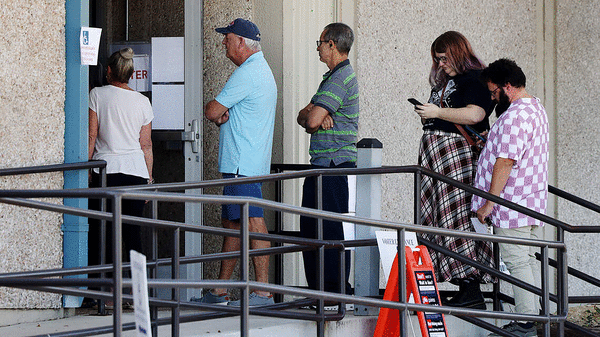
WASHINGTON — Amid concerns about President Donald Trump interfering in the midterm elections, a number of groups have stepped up their preparations, including setting up poll observers and preparing a range of legal responses.
After spending months trying to assert greater control over federal elections, the first attempt by the Trump administration to directly stop the counting of votes came earlier this month, with a federal lawsuit arguing California should set aside the ballots of more than 20,000 voters the federal government suspects are not citizens. A judge rejected the DOJ’s claims this week. It follows years of evidence-free claims by Trump that he lost the 2020 election thanks to fraud — and many experts expect that pattern could continue.
“We have never had a federal government that has taken the actions that this federal government has,” said Marc Elias, a prominent Democratic elections attorney, on a call with voting rights groups this month.
Elias said he was currently dealing with 90 election-related cases in 41 states. Within the Capitol complex itself, House Administration ranking member Joseph D. Morelle said he has been tasked with spearheading election security efforts for House Democrats, calling his party’s efforts this year “unprecedented.”
“Our work to protect free and fair elections has really moved from assessing the threats before us to engaging to meet and surmount these threats,” Morelle said at a briefing earlier this week.
“People shouldn’t have to be expected to have a master’s degree in election administration to vote, but they do need good information. They need trusted information. They need to be able to discount misinformation and disinformation, often which comes from the White House and the Department of Justice,” Morelle said.
Some of it comes down to hoping for the best but preparing for the worst, he said.
“We started with about 150 different threats when we began this exercise eight or nine months ago. We have identified mitigation strategies and response strategies to all 150,” Morelle said.
Among those were Trump’s effort to curtail mail-in voting and his push to pass legislation that would overhaul federal elections and add sweeping voter ID requirements, Morelle said.
The final stretch before the election has seen some other unusual moves. In Alaska, the Justice Department sued in federal court to preemptively prevent a loss by Republican Sen. Dan S. Sullivan if he comes up short in his reelection bid. The lawsuit filed last week in an Alaska federal court argues the presence of Daniel J. Sullivan Jr., a third contender in the race, has the potential to “confuse or mislead voters” and that the state’s certification should be paused if the incumbent loses by less than the number of votes for the other Sullivan.
President Donald Trump said the Democratic nominee, former Rep. Mary Peltola, should be removed from the ballot over her campaign’s reported involvement in recruiting the second Sullivan, detailed in The New York Times this week. Trump called the effort a “FRAUD ON THE AMERICAN PUBLIC” in a Truth Social post on Wednesday.
Morelle said he started his assessments a year ago and has been working with state election officials and civil society groups to prepare and plan.
Part of that includes beefing up existing efforts. A 2024 law codified the authority of official congressional election observers, but Morelle said Democrats have intensified their efforts this year. More than 300 Democratic congressional staff have signed up to be trained as observers, according to an Oct. 27 dear colleague letter from Morelle. He’s also participated in tabletop exercises with local election officials while traveling the country.
A spokesperson for Republicans on the committee said staff who have volunteered to be observers will be deployed to around 50 different congressional districts, but declined to share how many staff have signed up. In the past such observers have been sent in bipartisan pairs.
Republicans and the administration have said they are concerned about voter fraud and the possibility of noncitizens voting in elections. Rep. Bryan Steil, R-Wis., the chair of the House Administration panel, told Fox News this week that the Republican portion of the election monitoring program would be the most “robust” the chamber has ever done.
“The balance of power in the United States House of Representatives is at stake, and we wanna make sure that we have eyes and ears on the ground in close races across the country,” Steil said, noting that the observers may help build evidence for challenges.
The administration itself has its own election monitoring efforts, piggybacking on Trump’s claims that America’s elections are vulnerable to fraud. Trump has argued that the country should “nationalize” its voting systems and launched wide-ranging efforts to have the presidency take a greater role in state election efforts.
On Election Day itself, the administration has said it intends to deploy 1,000 officials nationwide as election monitors. Those monitors will not include any FBI or Immigration and Customs Enforcement personnel or other armed law enforcement, the administration said in court papers this week, but would include officials from the Bureau of Prisons, Drug Enforcement Administration and Bureau of Alcohol, Tobacco, Firearms and Explosives.
‘A moment’s notice’
Outside groups have also stepped up election monitoring efforts. Leah Wong, the voting rights director of the Asian American Legal Defense and Education Fund, told reporters on a call this month her organization and others have established a network of volunteers and attorneys ready to respond to problems on Election Day. Wong said many of the problems voters face on Election Day are likely more mundane — mistranslated ballots, polling place changes and the like.
“These are very everyday, run-of-the-mill access issues that are more likely to happen than, you know, ICE at the polls or whatever it is,” Wong said. “The point is, we’re prepared for the entire range.”
Camille Wimbish, national director of campaigns and field programs for the Lawyers’ Committee for Civil Rights Under Law, said the group will have its usual election hotline staffed with volunteers to provide information to help “identify and actually remove any barriers to voting.”
Wimbish said her organization has dealt with challenges ranging from intimidation at the polls to equipment issues in the ballot box.
Sophia Lin Lakin, director of the ACLU’s Voting Rights Project, said the ACLU has put together the “biggest election safeguarding program that the organization has run in its history,” including signing up 100,000 volunteers, setting up networks along with its 54 state organizations and preparing for last-second efforts by the Trump administration.
Every election, some problems crop up in every state; lightning could strike a polling place and knock out power, for example, requiring a court order to make sure voters can still cast a ballot. Lakin said the big difference this year has been the Trump administration; in his first term, she said, they were involved in fewer than 10 election cases. Now it’s over 40.
“Layered on top of that is what we’re seeing from the administration, this weaponization of the federal government against voters in unprecedented ways,” Lakin said.
She said they have worked with state and local elected officials nationwide along with a network of organizations who can serve as local advocates to emphasize problems on Election Day. All of that work comes to a head in a compressed time frame for Tuesday. After all, once the ballot box closes, “it’s done, and there’s no chance for a do over,” Lakin said.
“If you want to have an impact, you have to be ready to go in a moment’s notice of an issue to be able to provide real results for votes and make sure their vote is cast,” Lakin said.
‘Tune out the noise’
Justin Levitt, a law professor specializing in election law at Loyola Law School, said there’s been an “electric anxiety” of election preparations, but that doesn’t mean people should be afraid to go to the polls.
“If people can manage to tune out the noise, and I know that is asking a lot, I think what they’ll find when they walk out the door is wonderfully, relentlessly, spectacularly mundane,” Levitt said.
But Levitt also said some of that noise has been intentional.
“The headlines are reflecting an attempt to project power the federal government doesn’t have, and an attempt to market disruption and a response to that marketing of disruption that just breeds more disruption that doesn’t exist on the ground,” Levitt said.
Levitt said it would be illegal for any armed federal official to be present at polling places, and has been for more than 100 years. However, he didn’t discount the possibility of some appearing outside the polls on Election Day — or reports of the same, whether they are true or not.
“As a practical matter, I am not going to be at all surprised by seeing a viral clip of ICE at the polls somewhere. That could be new. It could be fake, or it could be just an old clip that somebody says is ICE at the polls.”
©2026 CQ-Roll Call, Inc., All Rights Reserved. Visit cqrollcall.com. Distributed by Tribune Content Agency, LLC.












Comments