Foster bill would bolster tech use to monitor AI financial risks
Published in Political News
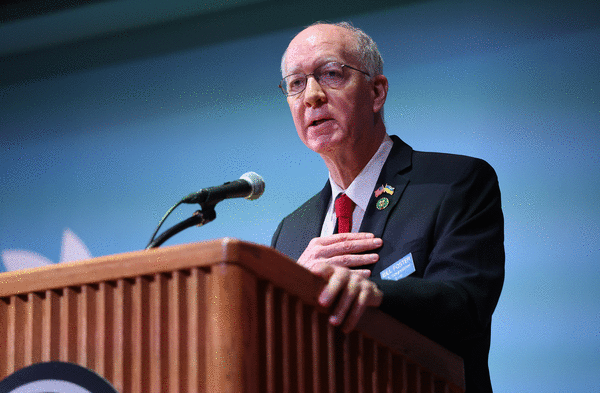
WASHINGTON — A leading Democrat on the House Financial Services Committee introduced legislation Thursday aimed at helping regulators use technology to better spot financial stress turbocharged by artificial intelligence and around-the-clock payment systems.
The draft bill, from Rep. Bill Foster, D-Ill., would require the Federal Reserve to work with other regulators to develop, test and publicly release model software that would improve the ability to assess market conditions in real time and respond quickly to cybersecurity and other threats.
The bill is designed to help regulators keep pace with new risks “driven largely by the development of state-of-the-art AI models,” according to a summary.
The legislation is intended to help regulators provide financing to banks during crises and wind down failing banks. The model software would reduce the amount of manual compliance work that smaller financial institutions would have to do by providing standard data formats for regulatory reporting and tools to manage and transmit the information to regulators, according to a Foster spokesperson.
“With advances in AI creating new cybersecurity threats and financial risks, it’s more important than ever that we modernize the way we monitor the health of our financial institutions,” Foster said in a statement. “We cannot afford to rely on outdated systems to oversee an increasingly complex financial sector.”
Foster, who has a Ph.D. in physics and has been a leader on AI issues on the Financial Services panel, is in line to become chair of the Financial Institutions Subcommittee next year.
He has been mulling a challenge to ranking member Maxine Waters, D-Calif., to chair the full committee in the new Congress. But Foster is now “leaning toward not running,” a person familiar with his thinking said.
Casten makes it official
Waters already has a confirmed challenger in Rep. Sean Casten, D-Ill., who on Thursday circulated a “Dear Colleague” letter seeking the support of House Democrats for his bid.
Casten touted his “career at the intersection of business, science and public policy.” Before entering Congress, he worked in clean energy and co-founded a company that converted industrial waste energy into usable power.
In his letter, Casten cited the need to lower housing and insurance costs, protect consumers from fraud, address risks posed by cryptocurrency and prediction markets and guard against the next financial crisis. He also promised to hold the Trump administration accountable for ethical lapses.
He’s got a tough road ahead of him, however. Every Financial Services Democrat except Casten, Foster and Rep. Sam Liccardo of California signed an Oct. 21 letter to House Democrats in support of Waters. That show of support came after Casten made it known he was interested and it was clear that Foster had been considering his own bid.
Although Foster may not compete for the chairmanship, he has recently talked to Waters about changing how the committee operates.
“He wants a variety of members to play a role in legislation brought up in committee,” the source familiar with his thinking said. He’s also seeking more input on witnesses who testify at subcommittee hearings.
The draft bill he released on Thursday covers a topic that Foster is likely to pursue throughout the 120th Congress. He often asks the most questions about the use of AI in financial services at hearings and offers the most amendments related to the issue at markups.
Under the bill, model software would be developed for banking records and operations, regulatory reporting, stress testing, anti-money laundering and fraud screening, AI risk monitoring and other activities.
The software must be open source, publicly available and tested for reliability and accuracy, according to the summary. It would be tested using synthetic or legally permitted historical data rather than actual customer accounts. Regulators would not take financial or supervisory actions during the study.
The software developed during the study would not have to be adopted; rather, it “should be viewed as a starting point for further modernization,” the summary says.
All software models would have to be published within one year of enactment of the bill and a final report assessing feasibility, costs and savings, competition and other criteria, would be due to Congress within two years.
©2026 CQ-Roll Call, Inc., All Rights Reserved. Visit cqrollcall.com. Distributed by Tribune Content Agency, LLC.






































Comments