Historic Trump-Xi-Putin summit fails to deliver on substance
Published in Political News
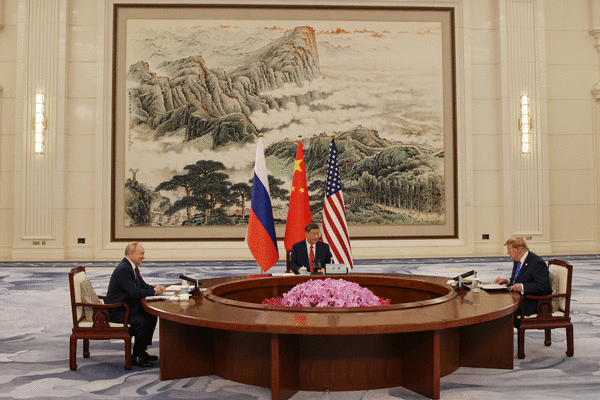
It was a sitdown that had officials in Europe, Asia and other parts of the globe imagining the worst: Donald Trump, Xi Jinping and Vladimir Putin bargaining over the likes of Ukraine and Taiwan as they carved the world into spheres of influence.
But for now, at least, there’s no actionable grand strategic plan. Against a backdrop of conflicting national interests, even the most tangible takeaway — a pledge to boost the global supply of fuels — fell flat in energy markets Thursday.
The other outcomes included calls to reform the United Nations, gut the International Criminal Court and avoid destroying the world with nuclear weapons — all things the three were either already doing or are so vague as to be effectively meaningless.
Yet the symbolism of the U.S., Chinese and Russian presidents meeting on the sidelines of the Asia-Pacific Economic Cooperation summit in Shenzhen was still powerful. Russia is a pariah in the West due to its war on Ukraine, but here Putin was honored with a seat at the top table — as an economic partner, the head of a key nuclear power, and in Trump’s words, “my friend.”
As the three sat around a circular table in a government villa in China’s futuristic high-tech city of Shenzhen, the introductory remarks betrayed a shared great-power attitude more suited to the mid-20th century.
Xi said the three powers “bear a special responsibility” in the world, and should set an example for other nations. Putin echoed that sentiment, evoking their shared experience of victory in World War II and the subsequent founding of the U.N. to suggest they hold a duty for “maintaining international peace and security.”
Trump included the International Criminal Court among “rogue, globalist organizations” that had to be brought to heel, adding that the trilateral talks were necessary because “no problems were ever solved under the old school, refusing to talk about them.”
Key tension
“These non-major powers don’t have to make choices — the major powers will decide for them,” said Ja Ian Chong, an associate professor in political science at the National University of Singapore, describing the sentiment among the three leaders. “Middle and smaller powers just have to live with these decisions, for better or worse.”
The trilateral lay at the heart of the central tension at this year’s APEC, between the optics of great-power politics and those middle powers pitching a rival vision of the world that detests the idea of being pushed around. As if on cue, Taiwan reported two Russian aircraft entering its defensive zone on Thursday immediately before the trilateral summit, the second incursion this week.
The imagery over the past 48 hours has been hard to escape: Xi greeted Trump at the airport with a rare embrace; the Chinese leader standing center stage in the APEC family photo flanked by Trump and Putin; and then the three men together at an unprecedented trilateral.
But speeches from a host of other leaders have offered an alternative vision of how countries should navigate a more fragmented world.
In the wider plenum earlier on Thursday with representatives of all 21 APEC economies, Australian Prime Minister Anthony Albanese cited the Ukraine and Iran conflicts — one caused by Russia, the other begun by the U.S. and Israel — as two of the biggest causes of disruption to trade. He called on Putin to “end your war, end it now.”
Canada’s Mark Carney, the most eloquent advocate of middle powers, argued that greater sovereignty comes from building strength at home while cultivating diverse partnerships abroad. He pointed to new trade agreements, critical-minerals partnerships and growing ties across Asia.
Fragmentation warning
South Korea’s Lee Jae Myung similarly called for collective action to secure critical minerals and energy while warning against economic fragmentation. Thailand’s Anutin Charnvirakul argued that resilience should come from widening connections while preserving openness.
It amounted to a coordinated pushback to the risks facing smaller economies in a world increasingly shaped by great-power rivalry — and already exposed to the reverberations of volatile U.S.-China relations.
But the reality remains that the week’s defining image will be of three great powers sitting down together.
The Shenzhen talks have drawn parallels with Yalta in 1945, when the heads of the three dominant military powers of the day — the U.S., U.K. and Soviet Union — met to discuss the end of World War II and the postwar future.
Yalta history
The wartime allies Franklin Roosevelt, Winston Churchill and Joseph Stalin met as their armies closed in on Nazi Germany to negotiate elements of the postwar settlement, producing the enduring image of a “Big Three” with extraordinary influence over the world that followed.
But unlike that conference, Xi, Trump and Putin have no common enemy or comparable shared project. Power is also more dispersed: Ukraine and other states have far greater agency. As if to make that point, Kyiv again hit Russia’s bridge to occupied Crimea early Thursday.
Yalta and its follow-up, the Potsdam conference, failed to produce the lasting great-power cooperation its architects hoped for as the Cold War took root and the allies faced off on opposing sides. The idea of a “new Yalta” has still circulated in Moscow for years, appealing to those who want Russia restored to a place on the world stage alongside the other major powers.
“The three leaders generated enormous media attention but did not reach any substantial agreements or produce any concrete deliverables likely to alter global geopolitics,” said Adam Farrar, a senior analyst at Bloomberg Economics who was formerly a director on the US National Security Council in both the Trump and Biden administrations. “Yalta this was not.”
Today’s Russia is very much the junior partner, with an economy less than one-seventh China’s size and an even smaller fraction of America’s. It is also increasingly dependent upon Beijing’s favor as sanctions and the collapse of much of its trade with Europe force it to turn east.
Putin emboldened
Putin appeared emboldened by his inclusion in the talks regardless, using a speech to APEC business leaders on Wednesday to rail against “failed attempts” to isolate Russia and claiming that his nation was emerging stronger.
Xi, meanwhile, has his own economic challenges that mean he’ll have little time to bask in the warm glow of his moment hosting his fellow world leaders. Sweeping new U.S. restrictions on China’s access to high-end AI chips are a fresh challenge to tackle, even as he played nice with Trump throughout the gathering.
Trump pronounced himself pleased with the meeting, yet it’s not without risk for the U.S. president. Sitting down with traditional U.S. adversaries at a time of national outages that have driven some Americans to stockpile basic goods may not go down well with a public that overwhelmingly rejected his Republican party in this month’s midterm elections, pushing him closer to lame-duck status.
Still, each leader is betting they have more to gain than lose over the long run. And Xi made it clear that they should make the trilateral major-power gatherings a regular feature.
The countries can work on global solutions, build consensus and “get other countries on board in due time,” according to Wu Xinbo, the Shanghai-based director of Fudan University’s Center for American Studies and a former adviser to China’s Foreign Ministry.
“No matter who is going to be the U.S. president or Russian president, the national interests would require this kind of interactions among the three countries,” he said. “This will not be the last one.”
_____
(With assistance from Nectar Gan, Ilya Arkhipov, Jeff Mason, Courtney Subramanian, Annmarie Hordern and Colum Murphy.)
_____
©2026 Bloomberg L.P. Visit bloomberg.com. Distributed by Tribune Content Agency, LLC.














Comments