How Ford's 'skunkworks' team is designing a more efficient EV
Published in Business News
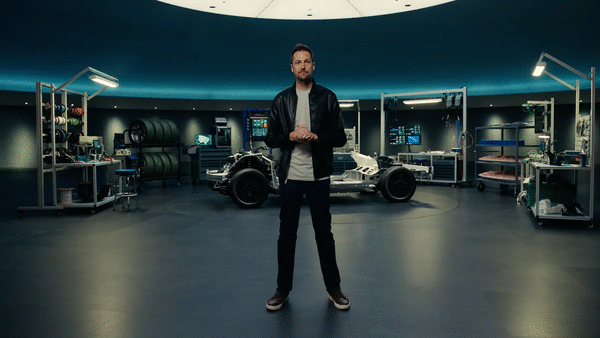
Ford Motor Co. engineers assigned to work on the Dearborn, Michigan, automaker's new electric vehicle platform often take several months to transition to the group's different approach to vehicle development, the team's executive director said.
Ford a few years ago broke off a small team of engineers and designers it called "skunkworks" in California to develop an affordable EV that could compete against Tesla Inc. and low-cost, subsidized and technologically advanced Chinese competitors threatening global market shares. The resulting Universal EV Platform, which will launch next year with a midsize pickup starting at $30,000, represents cost savings through 20% fewer parts, 50 miles of longer range through aerodynamic improvements alone and internet-connected technology that stays up to date.
Culturally, it was a transformation from the way Ford has done vehicle development for decades, with checks, processes and bureaucratic steps ingrained into the structure over time. Skunkworks freed workers from those historic constraints with the goal of innovation and efficiencies.
But it raised question about whether employees in Dearborn could be left behind. Alan Clarke, advanced EV development's executive director, said the group is working on bringing its learning to the overall company over time.
"There's not going to be any sort of light switch where it's like suddenly you see all the impacts to Ford," he said during a virtual briefing with reporters. "Over a multi-year period, as proof points come out, as relationships are built, you'll see a lot of cross-collaboration that ultimately impacts and benefits both models."
The advanced EV team benefits from Ford's history of vehicle dynamics and industrialization, while it seeks to bring to the greater Ford a more agile and innovative way of thinking. Parts for the EVs will be reused on hybrids and internal combustion engine vehicles, Clarke said.
There are employees in Dearborn working on the advanced EVs. The UEV group uses the same industrialization team as any other product. But they've been "pulled out of the mothership," Clarke said, emphasizing the importance of environment and working in an open collaboration space, which was a core part of the design of Ford's new global headquarters in Dearborn. It creates a rotation that over time will result in diffused learnings throughout departments.
"We just culturally have to separate it, especially during specific phases of the projects, because even in the architectural phase, some naivety breeds that innovation, and innovation ultimately is what is going to help us win," Clarke said. "Curious first principles engineers ultimately are the ones that are most likely to find those innovative new solutions."
First principles, Clarke said, refers to rethinking the approach and asking questions like: What is the best way to do this, or what's the function I'm trying to provide? It's not working within an existing structure, but potentially creating new processes or tools to accomplish the work in the best way, he said.
"Culturally, it's a really big shift," Clarke said, "and it takes even the people that we pull out of Ford to be part of this team, it takes them three to six months to transition and to free their mind from, 'OK, there's this thing I want you to do. OK, what's the process and tool that I should use in order to do that?'"
The result has been removing "silos" of functions, with different departments instead working side by side to find solutions. Clarke describes a "democratization" of information that gives employees greater access to a wider swath of data from 3D computer-aided designs to test results.
A key example is how the group approaches tradeoffs, which it calls bounties. Traditionally, engineers or teams have ownership of a particular component or system. They advocate for it and improve it to decrease the cost, but often without the context of how it affects the customer's experience or vehicle performance. As a result, the best of what each person or group oversees can come into conflict with another, like the aerodynamics team wanting a lower roof to decrease drag, while the occupant package group wants more headroom, and interior designers say a smaller cabin size reduces costs.
Bounties change the goal by connecting it to yielding the best vehicle range and battery cost. All teams have the same goal, knowing that adding 1 millimeter in height to the roof is $1.30 in battery cost and 0.055 miles of range, Clarke explained.
Engineers described how detailed this became. Shrinking the side view mirror body by more than 20% added 1.5 miles of range. Positioning the front tire wake directly toward the rear tires to hide them from wind gained another 4.5 miles.
"It doesn’t sound a lot, but these marginal gains add up," Saleem Merkt, advanced EV aerodynamics senior manager, said in a blog post.
They have added up to a 15% range improvement over the 2025 Ford Maverick truck and the 2022 Hyundai Santa Cruz, and a 30% gain at highway speeds. Half of the aerodynamics team come from Formula 1, and borrowing strategies from racing, the group 3D-printed parts to test and understand how each component would affect the end result.
Inside the vehicle, Ford developed in-house a zonal electrical architecture. To put it simply, it reduces the number of computers in the vehicle that control seats, infotainment, windshield wipes, power conversion and anything else that uses electricity to five main modules. It means less reliance on suppliers to update the vehicle, and shorter wires. The UEV's wire harness is 4,000 feet shorter and 22 pounds lighter than Ford's first-generation products.
"How do you compete with the Chinese?" Clarke said. "First of all, you understand your customer really well. You understand what they want. ... They want a software-defined vehicle that continues to improve over time, with more featured content and more capabilities. Our focus has been on giving them everything they would get in a nice vehicle and more, and we think that that'll allow us to ultimately not just make an affordable vehicle, but make one that's extremely desirable."
Whether or not what Ford has accomplished on the UEV will convince customers, especially after the federal plug-in vehicle tax credits have been abandoned and carbon emissions and fuel economy regulations have been pulled back, remains to be seen, said Peter Richardson, vice president of research at industry analysis firm Counterpoint Research, in a note.
"Ford has recognized that a radical shift is needed — in design, manufacturing, and it is taking steps to make that transition," he said. "But rather than following, for example, German manufacturers’ approach that leads to relatively high-priced cars, Ford has gone back to first principles in an effort to rekindle the ideas that made the Model-T such a transformative product for ICE era automobiles — not only in terms of affordability, but also production process innovation."
The zonal architecture also contributed to 25% fewer fasteners alongside the two unibody castings that make up the body of the vehicle. They represent two parts to Maverick's 146 parts. Others have used a similar approach to manufacture vehicles, but Ford highlights its model as being 27% lighter than the Tesla Model Y crossover, using less aluminum.
In 2023, Ford also acquired Auto Motive Power, bringing high voltage power electronics architecture and design in-house for the platform. It developed the "ebox," which converts the battery's 400 volts to the 48-volt system — Ford's first over the traditional 12-volt battery that operates in-vehicle electronics — and shares components with the vehicle's fast-charging infrastructure. A single module also manages power distribution, battery management and bidirectional charging for powering a home during an outage. The system consolidates sensors and auxiliary supplies.
"China might have some supply chain advantages, but ingenuity will win in the long run," Anil Paryani, Ford's executive director of engineering and former CEO of AMP, said in the briefing.
The work translates to faster charging speeds, longer battery life and improvements in cost of ownership, he said.
The only other vehicle selling in the United States with a 48-volt system is the Tesla Cybertruck, though it's been discussed in the industry for years. The system reduces the thickness of copper wires, and Clarke said its' the future of the industry, despite parts not yet being widely available.
"This vehicle is not just a great EV, it's going to compete with the best on the gas vehicle side," Clarke said. "We expect that we'll see a lot of customers coming from outside of pickup trucks and really attracted by the price, but also the utility of having a place to put really big stuff."
©2026 www.detroitnews.com. Visit at detroitnews.com. Distributed by Tribune Content Agency, LLC.









Comments