Kentucky AG reflects on death penalty, lawsuits and police collaboration
Published in News & Features
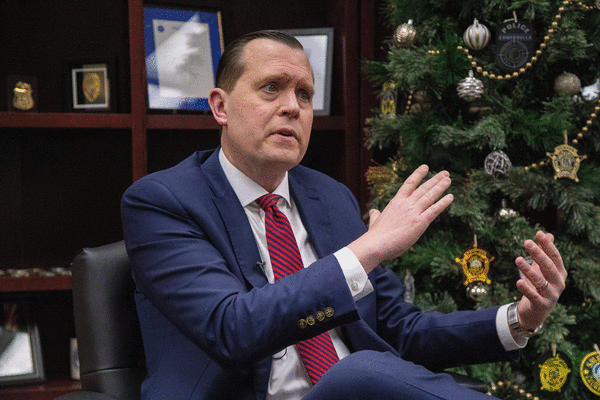
Kentucky Attorney General Russell Coleman sat down with the Lexington Herald-Leader last week to discuss several topics, including the death penalty, collaboration with law enforcement and the lawsuits his office has filed — and settled — over the past year.
In a 25-minute interview, Coleman reflected on his proudest moments of the year and his approach to the job as the top law enforcement official in the commonwealth.
Here’s what he said:
The death penalty
Since his 2023 election, Coleman has pushed hard to reinstate the death penalty in Kentucky.
This year, he urged the Franklin County courts system to rule Gov. Andy Beshear can sign a death warrant for Ralph Baze, a Kentucky man who killed two sheriff’s deputies in the 1990s. Coleman also urged Beshear directly to sign the warrant.
Coleman insists the governor can sign Baze’s death warrant but refuses to do so because it’s “politically inconvenient” for Beshear, who is widely expected to seek the Democratic nomination for president in 2028.
Beshear has cited several roadblocks that keep him from signing the warrant, including a lack of access to lethal drugs and unfinished Department of Corrections protocols that protect prisoners with intellectual disabilities.
But Coleman argues those claims don’t apply to Baze.
“Meanwhile, the family of these two sworn law enforcement officers who gave their lives for this Commonwealth have been calling for justice,” Coleman said. “They feel that they’re re-victimized every time they go through another proceeding, and we’re talking 1992. The governor could sign that death warrant today, but he’s throwing up these distractions as reasons not to. The governor’s looking for another job.”
The attorney general’s office is awaiting a decision from Franklin County Circuit Judge Phillip Shepherd that would clarify a previous ruling on whether Beshear can sign the warrant.
Prominent lawsuits
The attorney general’s office filed several lawsuits this year that Coleman says aim to protecy vulnerable populations in Kentucky.
In October, Coleman filed a lawsuit against Roblox, a popular gaming platform, saying it created a playground for predators to distribute child abuse material and groom juvenile victims.
He accused Roblox of violating the state’s Consumer Protection Act through deceptive and unfair practices by misrepresenting the platform’s safety and concealing risks.
The Kentucky lawsuit was the second of its kind, after Louisiana, whose attorney general filed a civil action against the company in August.
“In this job, you go to where the threats are, and whether that threat is the increasing amounts of fraud in this space, or whether that is platforms like Roblox and TikTok and the social media space, or whether it’s violence in Louisville, you go to where the threats are,” Coleman said.
Two other lawsuits filed by Coleman’s office helped Kentucky secure settlement funds related to businesses’s roles in the opioid epidemic.
In January, Coleman announced Kroger Pharmacies agreed to pay $110 million to Kentucky.
The settlement came after Coleman filed the suit in February 2024, just one month into his tenure as attorney general. He alleged that between 2006 and 2019, more than 100 Kentucky Kroger pharmacies were responsible for more than 11% of all opioid pills dispensed in the state.
And in June, Coleman announced an additional $73 million settlement from Purdue Pharma, for their part in the opioid epidemic.
The settlement was the result of a national lawsuit against the pharmaceutical company that created OxyContin. It’s the second-largest sum of settlement money secured under Coleman.
At that time, the total amount secured by Kentucky in opioid lawsuit settlement money was $1.07 billion.
Collaboration with law enforcement
In January, Steven Sheangshang, 47, was sentenced to life in prison for the May 2023 fatal shooting of Scott County Deputy Caleb Conley during a traffic stop.
Coleman said the decision of his office to not pursue the death penalty came after consultation with prosecution, law enforcement and the Conley family, who did not want to drag out legal proceedings.
“At the beginning of this year, I sat in a courtroom in Georgetown as we prosecuted the killer of Caleb Conley, a young deputy that gave his life on the side of I-75; we prosecuted that case,” Coleman said. “We were able to achieve life without possibility of parole, plus 70 years.”
And in the final weeks of 2025, Coleman received a text message from Scott County Sheriff Jeremy Nettles, that contained a photo of a shield with two scuff marks on it.
Nettles told Coleman body shields the AG’s office helped secure saved the lives of two deputies in a stand-off.
It was a full-circle moment for Kentucky’s top law enforcement official, who said it showed how his office can collaborate with law enforcement.
The armor was supplied when a deputy told Coleman 20% of law enforcement do not possess proper equipment.
Coleman went before the Kentucky legislature, which approved $15 million in funding for a body armor program that supplied 2,400 Kevlar vests and 14,000 pieces of equipment such as shields, plates and helmets.
“One of those shields saved the life of a couple of sheriff’s deputies, in the same sheriff’s office that lost a deputy,” Coleman said. “That’s what I’m most proud about. This job is about supporting the men and women of law enforcement as the chief law enforcement officer, and zealously collaborating and being focused on the mission.”
©2025 Lexington Herald-Leader. Visit at kentucky.com. Distributed by Tribune Content Agency, LLC.




Comments