DeSantis pushes ahead on Florida redistricting, despite opposition
Published in News & Features
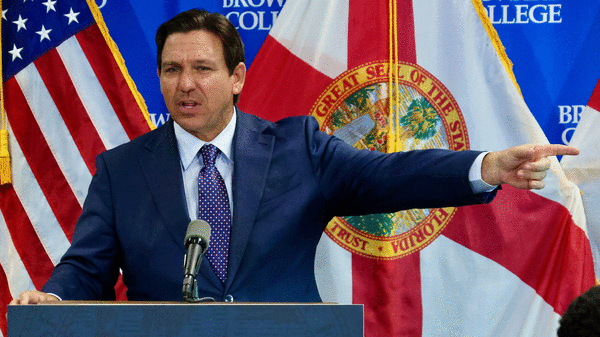
TALLAHASSEE, Fla. — The tide seems to be turning against a gambit by Gov. Ron DeSantis to redraw Florida’s congressional districts, a move made at the behest of President Donald Trump to help Republicans maintain control of Congress.
Nonetheless, DeSantis is pushing forward, having called the Florida Legislature back to Tallahassee for a special redistricting session starting April 20, though neither his office nor legislative leaders have released plans on how they want to redraw the state’s congressional maps.
DeSantis claims the state’s population growth means those maps need to be redone in a rare mid-decade move, but there is plenty of opposition.
Recent polling by Emerson College show 56% of Florida voters don’t want congressional districts redrawn, and key Florida congressional Republicans are warning that redistricting could have the unintended consequences of turning red seats blue at the same time Trump’s approval ratings are plummeting.
Democrats also recently flipped two solidly Republican state legislative seats that went for Trump in 2024 — winning a House seat that includes Trump’s Mar-a-Lago resort and a Tampa-based Senate seat previously occupied by Lt. Gov. Jay Collins. Election watchers viewed the outcomes as a sign GOP support might be waning.
Also, time is running out for the U.S. Supreme Court to issue an opinion in a Voting Rights Act case out of Louisiana, which DeSantis had said was key to his redistricting plans. The next batch of opinions are scheduled to be released the Thursday before Florida’s special one-week session starts. No other opinions are expected until May and June.
“Florida Republicans have to be careful with how they approach redistricting now,” said Kyle Kondik, managing editor of Sabato’s Crystal Ball at the University of Virginia Center for Politics, a nonpartisan political handicapper that forecasts elections, analyzes polling data and electoral history and predicts outcomes in presidential, congressional and gubernatorial races.
Despite the risks, Kondik said he still expects Florida to redraw. “The president is going to demand it, and Florida seems likelier to accede to the president’s demand as compared to, say, Indiana. But it’s a tricky proposition.”
Normally, state political boundaries are redrawn every 10 years based on the latest U.S. Census, which is used to determine whether states gain or lose seats in Congress. The states then must redraw the district boundaries to take the population changes and any new congressional seats into account.
But last year Trump — facing potential Republican losses in Congress during the 2026 elections — urged Republican-controlled states to conduct a mid-decade redistricting to try to gain more Republican-leaning seats. DeSantis was one of several governors who answered the call, along with GOP leaders in Ohio, North Carolina and Texas.
Florida’s efforts looked to be targeting several seats now held by Democrats, including that of Rep. Darren Soto in Central Florida, Rep. Jared Moskowitz’s in Broward County and Rep. Lois Frankel in Palm Beach County.
Some Democratic-led states have fought back. On April 21, Virginians will go to the polls to vote on a map that could potentially give Democrats an extra congressional seat.
And that could also impact what Florida leaders do, Kondik said.
If the referendum succeeds, Florida Republicans will be under pressure to make up for the potential seat loss in Virginia, he said. “If Virginia acts and Florida doesn’t, Democrats will basically be ahead in the redistricting fight.”
For several months, DeSantis had said he wanted to wait for the high court’s ruling — which could weaken or nullify protections against diluting the voting power of minorities — to help ensure the legality of any new Florida districts. But now he now seems confident that the Legislature can draw a legally sound map without the opinion.
“We know how that Supreme Court case is going to come out at this point. I don’t think there’s much of a dispute about that,” DeSantis said Monday. “So, us looking at our map, understanding the issues in that case and fixing it, I think that’s appropriate whether the decision comes before we do it, or after.”
DeSantis issued an executive order for the special session in January, at the start of the Legislature’s regular session, but Senate President Ben Albritton said no work has been done by the Senate on redistricting during those 60 days. And the House has not produced any maps despite holding two committee hearings on redistricting.
“As for the Special Session called by the Governor for the week of April 20th, we will be in touch next week with further details,” Perez said.
That doesn’t mean legislative staff aren’t working in secret on maps for lawmakers to consider when they return to Tallahassee. But that would be highly unusual, given the amount of transparency required by state law and the Fair Districts amendment approved by voters in 2010.
The current congressional district map was approved in 2022 after several months of hearings and public input. DeSantis vetoed the map originally approved by the Legislature and forced lawmakers back in special session to approve a map drawn up by his staff that eliminated a congressional district with a majority of Black residents.
The new map gave Republicans a 20-8 advantage compared to the 18-10 break the Legislative map would have provided.
The governor’s map was challenged in court, with several lower court rulings against it, but it was ultimately upheld by the Florida Supreme Court in July 2025. The court also threw out a legal challenge this year to the governor’s call for a special session on mid-decade redistricting.
DeSantis said the current map is already outdated due to the state’s explosive growth of the previous years and used that to justify mid-decade redistricting.
“Florida experienced 10 years of population growth in three,” DeSantis said at a recent news conference in Tampa. “Districts are not apportioned properly.”
But a recent report on census data shows the flow of people into Florida, which spiked during the last five years, has collapsed, with several major urban counties showing population losses.
There also seems to be less support for MAGA in the once-reliably red Florida. The two special elections that flipped blue in March with the help of independent voters quickly served as a rallying cry for Democrats hoping to build momentum leading up to the November mid-term elections.
“Florida voters just sent a message in Palm Beach that no partisan map can erase: They are done with the MAGA agenda,” Florida Democratic Party Chair Nikki Fried said of the March special elections. She said the redistricting effort is a “desperate attempt to rig the rules to favor the voters that he wants.”
U.S. House Minority Leader Hakeem Jeffries estimated there are at least a half dozen Florida Republicans who are vulnerable and said Democrats plan to campaign aggressively in those districts. He named Reps. Mario Diaz-Balart, Carlos Gimenez, Maria Elvira Salazar, and Brian Mast as likely targets.
Meanwhile, congressional Republicans have expressed misgivings about redistricting.
“Don’t do it,” said veteran lawmaker Rep. Daniel Webster of Clermont.
Diaz-Balart of Miami is among the Republicans now doubting redistricting is wise. Creating two new GOP seats, as some have suggested, could come at the risk of a “very large overreach, which I think is in the Democrats’ best interest.”
Evan Power, chair of the Republican Party of Florida, said he understands that incumbents don’t want their districts changed, forcing them to acquaint themselves with new voters and new communities. But he was confident that a redrawn map would benefit Republicans.
Even if change doesn’t happen now, Power said, the mid-decade redistricting battle could be a prelude to the regular redistricting cycle that will kick off after the 2030 census results are finalized.
“It goes into the next regular redistricting cycle, where we’ll get two to three more seats and those will likely go Republican,” Power said.
Even if the Supreme Court soon outlaws the use of race in shaping congressional districts, state lawmakers still have to work within Florida’s Fair Districts amendment. It prohibits drawing legislative and congressional districts with the intent to favor one political party over another or to reduce the voting power of minorities. It also requires districts to be contiguous and, where possible, follow compact and existing geographical boundaries.
That means any new map agreed on this month could face legal challenges.
“If the governor and Legislature go through with this without a court ruling or new census data, it would be illegal, if it creates an advantage for one party or an incumbent,” said Jonathan Webber, spokesman for the Southern Policy Law Center, a racial justice nonprofit that also litigates civil rights cases.
©2026 Orlando Sentinel. Visit orlandosentinel.com. Distributed by Tribune Content Agency, LLC.





Comments