Orban's birthplace turns into a battleground for his survival
Published in News & Features
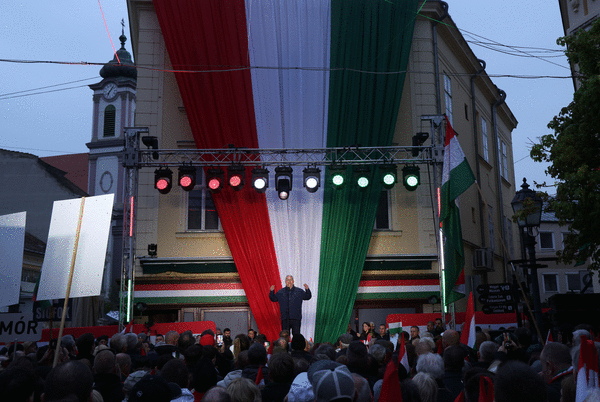
Szekesfehervar is Viktor Orban’s kind of place. It’s where he was born, where he attended high school and a city that encapsulates his domination of Hungarian politics since returning to power 16 years ago.
Sixty kilometers (37 miles) southwest of Budapest, it’s also now the kind of place that Orban desperately needs to keep hold of in Hungary’s election this weekend. Polling shows Szekesfehervar, where the first kings of Hungary were crowned, is a bellwether for the outcome of Sunday’s vote.
The prime minister is facing the biggest ever challenge to his nationalist rule, while his relationship with Russia and opposition to aiding Ukraine are under scrutiny. Inside and outside the country, the election is being framed as a now-or-never moment for Hungary to shift back toward the European mainstream.
While the vote might have outsized geopolitical significance, as ever it’s places like Szekesfehervar that will decide. A handful of voters in the quiet city willing to speak in the run-up to the election all said the same thing: Hungary needs change.
Nationwide, polls have consistently shown a double-digit lead for opposition leader Peter Magyar’s Tisza party over Orban’s Fidesz. In one of the two Szekesfehervar districts, which Fidesz has held since 1998 and which is seen as a must-win for Orban’s party, the margin was about 13 percentage points in favor of Tisza, according to 21 Research Center, an independent think tank in Budapest.
The district is a key indicator. The result there is likely to reflect the national vote share, according to electoral analyst Matyas Bodi. In 2022, just weeks after Russia’s full-scale invasion of Ukraine, Fidesz was reelected by a whopping 26-point margin.
“People are just tired and unhappy, there’s this sense that we’re stuck in a hamster wheel,” said Peter, a café owner in the town. He declined to be identified by his full name when speaking about politics. “It’s not about enthusiasm for Tisza, it’s about having had enough of Fidesz.”
Magyar is tapping into popular discontentment over the cost of living and cronyism as the European Union continues to freeze much of Hungary’s funding because of corruption allegations.
During Orban’s tenure, the country has become the most corrupt in the EU, based on Transparency International’s annual index. Instead of a “flying start” Orban promised four years ago, the economy has been in and out of recession since the pandemic. He’s overseen new investment the electric vehicle industry, though that’s not providing the boost the government expected.
At a rally in Szekesfehervar on Friday, Orban blamed meager economic gains over the past fours years on the war in Ukraine. He depicted Magyar as a puppet of Brussels and the stooge of Ukrainian President Volodymyr Zelenskyy. His main message: he was the only leader to keep Hungary out of harm’s way and things could only get worse with someone else in charge.
“The real choice is who should form the next government: Zelenskyy or me?”’ Orban told supporters as he wrapped up his campaign in his home city.
That sort of rhetoric goes a long way to explain how Orban, 62, has turned Hungary into the EU’s black sheep. He’s taken control of everything from the courts to the media, opposing immigration and allying with Donald Trump and Vladimir Putin and cozying up to China.
What Fidesz retains, though, is an ability to mobilize its supporters at the right moment, according to Szekesfehervar Mayor Andras Cser-Palkovics, who represents the party in the city. That’s why he reckons Fidesz will win again, even if the optics in the capital are different.
“Tisza is dominant in Budapest just as we are in the provinces, so it’s in the in-between places, in cities like Szekesfehervar, where this election will be decided,” Cser-Palkovics, a Fidesz moderate who called out the “excessive political polarization” of the country, said in an interview at his office. “To use the language of sports, it’s game on.”
Orban was born in Szekesfehervar in 1963, spent a lot of his childhood in the nearby village of Felcsut. Then his family moved to the city for his education. At the Blanka Teleki high school, above a wood-paneled wall, there’s a tableau photograph of Orban’s class that graduated in 1986, including the future premier. He’s the city’s most famous living son, albeit now sharing that title with Liverpool football star Dominik Szoboszlai.
By the fall of communism in 1989, Orban was a prominent pro-European anti-regime activist, a founding member of Fidesz, an acronym for Alliance of Young Democrats. He ran as a parliamentary candidate for Szekesfehervar in 1994, placing third with 27% of the vote. Four years later, he was prime minister for the first time, at age 34.
Now it’s Magyar who says he represent the new face of Hungary. In Szekesfehervar’s packed square on March 28, he addressed corruption, the cost-of-living crisis and political scandals — from one involving child abuse at state homes to the latest one depicting Hungary’s government allegedly serving the Kremlin’s interests in the EU.
“I’d like to make it known from this magnificent city that has crowned kings that Hungarians are a freedom-loving people,” Magyar said. “It’s no accident that Tisza is not only surging but flooding all across Hungary, it’s no accident that the countryside rose up again Viktor Orban.”
If Szekesfehervar reflects where Hungarian politics might end up, it also reflects the state of the country.
The city became prosperous magnet for foreign investment in the automotive and electronics industry. But a stroll from its historic center with classic central European cobbled squares and grand late 19th century pastel-colored public buildings leads to newly paved streets and yet dilapidated discount stores. Many along the road from the railway station are shuttered.
It also feels the pain of having EU funds put on ice, according to Cser-Palkovics, who won office in 2010 as Fidesz returned to power nationwide. Hungary is being punished for its politics, including its anti-immigration focus, he said.
“We cities and towns are collateral damage in this, we have nothing to do with it so we’re asking for more direct funds,” said Cser-Palkovics, citing a planned transportation hub.
The EU is watching the outcome of the election and the expectation among officials is that, should he win, Magyar will look to quickly unfreeze some of the more than $20 billion currently withheld from Hungary.
Many Hungarians now in their 50s and 60s have grown up politically with Orban as the dominant force. Some young people have known no other leader than him. To keep Hungary on the path he wants, Orban must get the vote out in the regions that form the bedrock of his support.
Fidesz has won one of the Szekesfehervar districts every time since 1998, even when the party was in opposition. It’s held the other one since 2010.
In the European Parliament election in 2024, just weeks after Tisza was formed, the opposition party already received more votes than Fidesz in one of the two Szekesfehervar districts and narrowly lost in the other, the Fidesz stronghold.
If Tisza takes both on Sunday, it would all but certainly signal the end of the Orban era.
———
(With assistance from Thomas Escritt.)
©2026 Bloomberg L.P. Visit bloomberg.com. Distributed by Tribune Content Agency, LLC.




Comments