In LA County, many homeless people enter shelters, only to end up back on the streets
Published in News & Features
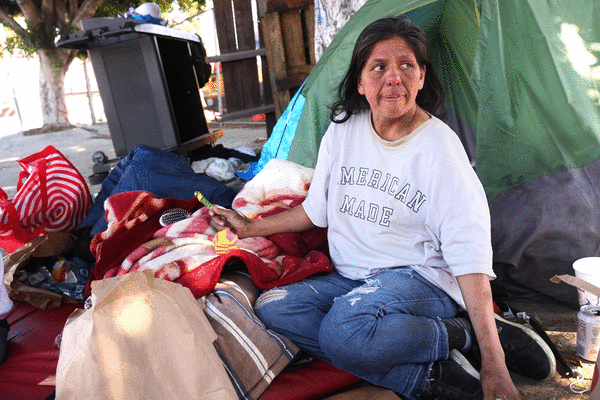

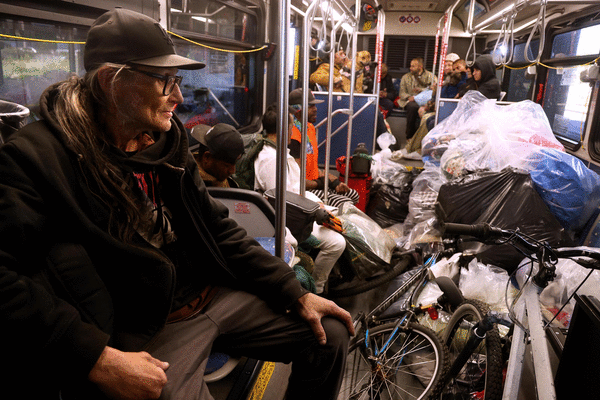

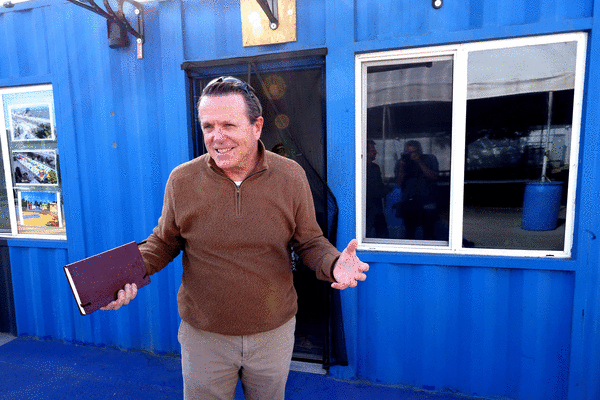





LOS ANGELES — It's not clear who was the instigator when, several months ago, Amanda Ponce got into an altercation with a fellow resident at a Boyle Heights homeless housing site. What the two parties agreed upon was this: In frustration, Ponce tapped the man over the head — and it wasn't a big deal.
But according to Ponce, it was enough to land her on the streets.
This was a common refrain from many homeless people who say they were evicted from short-term shelter at a time taxpayers are spending hundreds of millions of dollars to get them into shelter, stabilize them and move them to permanent housing.
Across Los Angeles County, interim housing sites are struggling to fulfill a basic mission.
On average, in recent years, of the people who exit interim housing, nearly 59% left for the streets or destinations unknown, according to data from the Los Angeles Homeless Services Authority, almost double an agency target of no more than 30%.
Justin Szlasa, who sits on the LAHSA Commission oversight board, said the agency's exit numbers show "we aren't doing something right" and LAHSA should rewrite contracts with providers so there's more emphasis on outcomes.
"There needs to be a major reset," he said.
Ponce was evicted from a Boyle Heights tiny home village run by Volunteers of America Los Angeles, which has 1,300 interim beds across 14 sites in the county.
The 41-year-old mother of four said she struggles with chronic seizures and uses meth, crack and PCP. She now lives in a tent near the 5 Freeway.
If she forgets to take her seizure medication, Ponce said, she can have several episodes a day.
"They should have given me a second chance," Ponce said. "I don't want to be on the streets."
Los Angeles County's interim housing system is primarily managed by LAHSA, which receives money from the city of L.A. and the county and then pays nonprofit operators to run congregate shelters with dozens of people in one room, as well as tiny home villages and motels with one or two residents per unit.
In all, there are more than 12,000 LAHSA interim beds within the city of L.A. and other parts of the county.
LAHSA, with the help of a city-hired consultant, has been investigating why people end up back on the streets.
Sometimes they are removed for threats or acts of violence. Other times, providers are too quick to expel people for behavior that although disruptive, doesn't pose an immediate danger, said Kelsey Madigan, LAHSA's director of interim housing.
And people of course leave on their own. They may want more privacy, a location closer to friends or their doctor, or fewer rules — such as quiet hours, no drugs on-site and no guests.
Tiffany Crear said she walked out from a South L.A. congregate shelter about nine months ago.
"I am not good around other people," she said, peeking out of a gray tent underneath the 110 Freeway. "I need a space to myself."
One man who used to live in a tiny home village told The Times he moved back onto the streets after he got popped on a probation violation and spent a short stint in jail, causing the provider to give up his bed.
Many providers lack the funding to hire a critical person who can help reduce incidents and a resident's individual misery: on-site mental health specialists.
Ken Craft, chief executive of Hope the Mission, said some people with severe mental health problems need more help than staff can provide, and leave.
Other times, the long wait for permanent housing proves demoralizing. "Some people just get tired and say, 'I'm done. I'm leaving,'" Craft said.
LAHSA's Madigan said a physical altercation, such as the one Ponce described, shouldn't automatically result in removal, because it might not present an imminent risk to the safety of residents or staff. She said it's important for providers to remember that many residents "have experienced trauma most people could not fathom going through."
Before removing someone for negative behavior, Madigan said, providers should ask whether a mental health episode or drugs played a role, whether there was a real safety threat and whether the behavior is likely to continue.
From L.A. Mayor Karen Bass' Inside Safe program to tiny home villages, many types of interim shelter have high rates of exits to the streets and unknown locations.
During the first five months of this fiscal year, LAHSA said that 66% of exits from shelters run by Volunteers of America were to unknown or uninhabitable locations, compared with 59% for all providers who serve a similar population.
Orlando Ward, director of community affairs for VOA, said he wasn't sure why the organization's numbers were so high, but that helping people change detrimental behaviors "doesn't happen overnight."
Citing privacy laws, Ward said he couldn't comment on individual situations. But when someone is told they must leave, he said, VOA refers them to other locations that have open beds, and, when possible, confirms that the operator will take them.
"We don't move people to the streets," he said.
"That's B.S.," Ponce countered, when told of Ward's comments. "They do."
She said that after she was informed she was being kicked out, a VOA caseworker gave her a list of other places where she could find housing. Ponce said she gave the list to a different VOA caseworker, who promised to help her find a bed at one of the places.
She said she never heard back and had to leave with no list and move onto the streets.
Two other former VOA residents now on the street said they received no information about other housing after being removed.
Margot Kushel, director of UC San Francisco's Benioff Homelessness and Housing Initiative, said the number of people in L.A. County going to unknown locations or returning to the streets is "marginally worse" than statewide. To improve, she said, more investment in permanent housing is needed so people have a place to go and don't get stuck in interim beds where they eventually get fed up or kicked out.
There could be better outcomes "if you just had more options for people," she said.
LAHSA said it has long tracked exits by destination, but it wasn't until last fiscal year that the agency set a goal of no more than 30% to unknown and uninhabitable locations. The agency has been criticized over the years for lack of oversight, and the county government is pulling funding and transitioning programs, including the thousands of interim beds it funds through LAHSA, to an internal department.
The city of L.A. is debating similar measures but for now remains fully in LAHSA.
Los Angeles City Councilmember Nithya Raman, who is running for mayor against Bass, said there are some signs of progress, after she and other members of the city's Homeless Strategy Committee pushed LAHSA to better use its data to improve outcomes.
Across the entire interim system funded by the city, 51% of exits in January were to unknown and uninhabitable locations, down from 56% two months earlier, according to the latest data available.
Contributing to that drop was a corrective action plan LAHSA issued against one of its largest providers in late November.
The nonprofit was VOA.
Under the plan, which Madigan characterized as a pilot that could extend to other providers, LAHSA required VOA to receive the agency's approval prior to kicking out residents. LAHSA also mandated that VOA increase staff training and made unannounced visits to the nonprofit's 14 sites.
In an interview, Madigan said VOA had too broad a definition of what was a "direct threat" to safety that would allow for immediate removal.
One example? LAHSA said VOA wrongly removed residents for recording its staff, arguing it was a threat.
After the discovery, LAHSA notified VOA that people must receive opportunities to correct bothersome but non-threatening behavior.
Ward said changes are underway. Prior to LAHSA's intervention, he said, a hit, grab or tap would result in swift removal.
Now, Ward said VOA is factoring in more context following an incident, and executives, rather than just lower-level staff, must sign off on any exit. People may no longer be removed for a tap.
"I think we learned that [in such a situation] maybe, you know, they were irritated for a second, but they're at peace and there's no further threat of violence," Ward said.
Some providers are doing better, and city consultant HR&A Advisors told the Homeless Strategy Committee that these operators tend to create a welcoming community, rather than a "triage center" with "punitive signs up everywhere."
At VOA, whether the impact of LAHSA's intervention holds remains to be seen. During the action, the exits at issue dropped from an average of 200 a month to 100 a month.
At the end of January, the agency allowed the organization to once again remove residents on its own, and those exits rose to 140, according to LAHSA.
LAHSA said it doesn't have the resources to put one provider under such oversight permanently, or to conduct it for multiple nonprofits at the same time.
LAHSA data show that some who exited interim housing to the streets or unknown locations in recent years have since found permanent housing or are back in an interim bed. But most are still unsheltered or their whereabouts are unknown.
Dana Kanu, 63, is among that majority.
She said she was kicked out of a VOA shelter for "disrespecting one of the staff" but received no insight on where to go next. Through a friend, she said she found a place run by another operator, only to be thrown out again when she threw a meth pipe at a staff member who told her to move off the steps of the facility.
The grandmother, who has trouble walking, said she again wasn't given any information on where to go. She's now living in a tent on Avalon Boulevard with her dog, Zara.
---------
—Times staff writers David Zahniser and Doug Smith contributed to this report.
©2026 Los Angeles Times. Visit at latimes.com. Distributed by Tribune Content Agency, LLC.






Comments