Colorado Supreme Court tells judges they can stop livestreaming their hearings despite state law requiring it
Published in News & Features
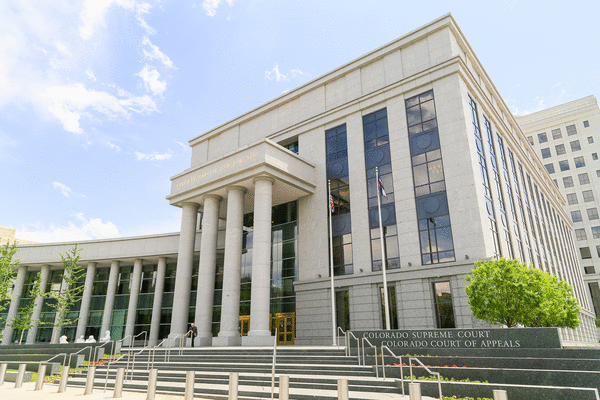
DENVER — The Colorado Supreme Court on Tuesday told judges they can stop livestreaming court proceedings for the next 90 days — a move that directly contradicts state law and escalates an ongoing power struggle between the state’s highest court and its lawmakers, who have repeatedly mandated that most criminal court proceedings be streamed online for public viewing.
Chief Justice Monica Márquez wrote in a four-page directive that she believes the state constitution gives the Colorado Supreme Court the authority to set aside the 2023 law that requires Colorado judges to livestream most criminal court proceedings except under particular circumstances.
Márquez on Tuesday aimed to undo that law for the next 90 days, issuing guidance to judges that ends the presumption that court hearings must be livestreamed and instead makes such livestreams the exception rather than the rule.
The three-month pause is necessary, she wrote, because livestreamed court proceedings were being rebroadcast on monetized social media platforms.
“Rather than the serious business of justice, viewers are treating this content as entertainment,” Márquez wrote. “Posters are editing and manipulating the recordings to distort their content. Viewers are leaving comments that denigrate the appearance and intelligence of court participants, challenge the innocence or truthfulness of defendants, victims and witnesses, threaten court personnel, and expose vulnerable litigants to public ridicule — behavior that would never be tolerated in a physical courtroom.”
She described one situation in which a sexual assault survivor testified in court — a public proceeding that required the survivor to enter their name into the public record — and video of that testimony was publicized with the survivor’s name, though the survivor’s face was blurred.
People should be able to testify in court without fear of “intimidation, harassment or abuse,” Márquez wrote. Social media platforms have been unwilling to remove such broadcasts, she wrote.
Colorado lawmakers first required judges to livestream most criminal proceedings in 2023. That law allows judges to turn off the public video if they find livestreaming compromised anyone’s safety, a defendant’s right to a fair trial or a victim’s rights — as long as the judge also found that there is no “less restrictive alternative” to let the public continue to watch remotely while preserving those rights.
Under the statute, judges are required to make case-specific findings.
After pushback from the Colorado Supreme Court to the 2023 law, legislators this year doubled down, amending the statute to explicitly say that the law “supersede(s) any statute, judicial guidance or chief justice directive limiting remote public observation of criminal courts.”
“The legislature has been pretty clear that we think these proceedings should be livestreamed, that we believe the livestreaming of these proceedings serves the public in terms of transparency,” said Rep. Javier Mabrey, a Denver Democrat who sponsored both bills. “…I understand the court has concern about people making a mockery of the process and people uploading recordings of court proceedings to TikTok or YouTube and sort of making it a joke, but I don’t know — ultimately I view that as freedom of speech.”
Márquez wrote in her directive that the legislative amendments to the law “purport to supersede” the chief justice’s authority.
Whether the legislature or the Colorado Supreme Court has the ultimate authority to govern livestreaming is not a cut-and-dry legal issue, and any challenge to the new chief justice directive would ultimately go before the Colorado Supreme Court, said First Amendment attorney Steve Zansberg, who also represents The Denver Post.
“There is the sort of legal minutia in the weeds about separation of powers and who ultimately has the final word here, and then there is the realpolitik that the only way you are going to enforce this is in this court system with these justices,” he said.
Practically, Márquez’s temporary order is not reviewable by any court, Zansberg said.
The courts previously exempted themselves from the Colorado Open Records Act, another transparency effort passed by lawmakers, said Jeff Roberts, executive director of the Colorado Freedom of Information Coalition.
“It’s a real shame that it has come to this, because the livestreaming of criminal court proceedings is an important way for people to get more eyes on the judicial system in Colorado,” Roberts said. “It helps journalists cover the courts, especially at a time when there are a lot fewer journalists and they can’t make it to every court proceeding, this helps them cover the courts and report on the courts for a much broader audience. And of course it helps the public in general know what is going on in the courts.”
Colorado’s judiciary embraced virtual court to keep functioning during the COVID-19 pandemic. One-way livestreaming followed that abrupt transition to remote court, but the Colorado Supreme Court, which issues guidance and rules for the state’s judges, never embraced livestreaming as fully as legislators, for years keeping in place a chief justice directive that contradicted state law even as the majority of judges followed the law and livestreamed proceedings.
By mid-morning Tuesday, about a dozen courtrooms across the state had active livestreams — significantly fewer than usual.
Márquez wrote in Tuesday’s directive that virtual courtrooms have faced disruptions from bad actors who share violent, sexual or racist material. She acknowledged that is a problem with the court’s two-way virtual courts, which function like video conferencing and allow online users to participate in court, rather than with the one-way livestreaming, which functions like TV and allows only observation.
The Colorado Judicial Department hopes to stop those two-way disruptions by switching to a new virtual court system on a different online platform; a pilot is underway. Such disruptions are not possible with one-way livestreaming.
The pause on livestreaming does not change two-way virtual courts, and the two-way video conferencing system will now be the only way for members of the public to view court proceedings online unless judges opt to livestream, according to the directive, which notes such public access is at the discretion of judges.
Physical courtrooms remain open to the public.
The 90-day stoppage — set to expire Dec. 15 — will give the Colorado Judicial Department “time to explore more effective ways of striking a proper balance between preserving public access to our court and upholding the dignity and integrity of our justice system,” Márquez wrote.
In an additional statement, spokeswoman Suzanne Karrer said the court system will use the three-month pause to train judges and staff, examine technical solutions, simplify the procedure to turn off livestreaming, and consider better enforcement mechanisms for people who violate court rules by rebroadcasting livestreamed proceedings, among other considerations.
_____
©2026 MediaNews Group, Inc. Visit at denverpost.com. Distributed by Tribune Content Agency, LLC.






Comments