Nightmares, flashbacks, addiction: What human trafficking survivors face
Published in Health & Fitness




PONTIAC, Mich. — By the time women arrive at the doorstep of Hope Against Trafficking, a nonprofit long-term recovery program for victims of human trafficking in Oakland County, their needs are extreme.
Some have not seen doctors for years and suffer from internal injuries, dental neglect and physical ailments, including sexually transmitted diseases and HIV.
Many want their name changed to ensure their trafficker cannot find them. Others need help obtaining physical identification, such as a state ID or driver's license, because their previous cards have long been destroyed.
The most challenging aspect for many of the women who enter the two-year residential program in Pontiac might be starting the emotional work of recovering from a life of sexual abuse, torment and trauma, as victims begin meeting with psychiatrists and mental health experts who are trained to help trafficked women rebuild their lives.
"It's scary to let go of this trauma," said Michele Isbister, the program's executive director. "The first phase is just being comfortable around people again."
Human trafficking is the exploitation of another person for commercial sexual activity or labor by force, fraud, or coercion. In the last five years, Michigan has ranked in the top 10 in the nation in the number of human trafficking cases, alongside states such as California, Texas, Florida, and New York, according to Polaris, an anti-trafficking organization that operates the National Human Trafficking Hotline; the FBI, State Department and Homeland Security; and the Human Trafficking Institute.
Safe housing is the foundation of the Pontiac program, Isbister said, because survivors have been under the control of someone else, trafficked for sex, living in places they cannot leave, with little to no personal property, no direct access to food or people outside their world.
The program, which is faith-based and supported with donations, is organized around four phases.
Survivors initially undergo a comprehensive medical exam and have their documents and identification restored. Phase two focuses on full-scale therapy for medical, dental and mental health needs with options for art therapy, equine therapy, financial literacy courses and job skills training. Completing a GED or attending college courses are also offered.
Phase three allows women to work outside the program and participate in a graduation ceremony, while phase four is an after-care program in which women transition from services offered by the program to services and programs in the community.
Sixty women have participated in the program, which opened its first house in 2018, and graduated through different phases of it. Today, the program has 21 beds across three furnished houses in Pontiac.
Women ages 18 and older are typically referred by law enforcement, shelters, rescue organizations or social service agencies. They sign a contract and agree to conditions such as not using alcohol or drugs and not reaching out to their trafficker, which is something many victims struggle with.
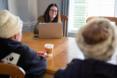
The Detroit News recently sat down with three women in the recovery program who agreed to speak about life after trafficking. They asked that their full names not be used or their faces shown in photographs out of fear of their trafficker finding them and for their own privacy.
Feeling safe to talk
A.P. said she was part of a nationwide, high-profile human trafficking ring that operated outside of Michigan, but she was able to escape her traffickers ― a man and a woman ― a few times.
"He always found me, or she always found me, and I was snatched back up again," she said during an interview at a Hope house.
The last time she got away in 2023, A.P. entered a 14-day safe house in Tennessee, then a recovery center in Seattle, before coming to Michigan and moving into a Hope home in Pontiac in the fall of 2023.
"I've been through a lot. When I got here, I was a horrible mess," said A.P., wearing a Detroit Lions knit cap. "I had been trafficked for many years, and not just human trafficking, but drug trafficking. Due to how long I had been trafficking and the damage, I had trauma. It was horrible, and I was unhealthy."
Officials with Hope provided A.P. with access to medical care and insurance for regular check-ups to address multiple medical needs. But she could not stop worrying and living in fear, she said.
"My mental state was completely out of this, out of this world," said A.P., 41. "You couldn't speak to me. I didn't want to go outside. ... I mean, even when going to a doctor's appointment, it was watching both ways and worrying. When you get out of the car, it was out of the car and basically running, sprinting to the door."
Suffering from nightmares and flashbacks during the first year of her stay at the house, A.P. could not sleep, even with medication.
A medical coordinator and a residential coordinator at Hope helped A.P. get to appointments and attend support programs and therapies for addiction recovery and anger management. She worked with multiple therapists, understanding her triggers and how to cope with them.
Along with the right medication, A.P. started to feel a change — "actually feeling safe to be able to express yourself because I didn't want to talk" — and experiencing peace for the first time.
Once she felt ready to speak, A.P. wanted to tell her story and get her experience out of her head, out of her body and out for the world to know.
"I had to get it off my chest," she said. "And I have what they call survivor's guilt, because I was in a very large nationwide, high-profile trafficking ring. And it was from all ages. It was all races, all genders, involving children as well."
A.P. said she does not want to go too far from the house yet. She hopes one day to be an advocate for trafficking education and help other survivors recover.
"Can I handle being out all day?" A.P. asked herself. "I don't know until it's time."
'I have a say'
C.D. grew up in a good family, was educated in a private school and had access to resources in an affluent part of Michigan.
"And it still happened to me … it doesn't just happen to people on the other side of the tracks," C.D. told The News of her human trafficking experience.
Wearing a bandanna to cover her light brown and blond hair, C.D., now 31, came to a Hope house in August 2025. It was not her first time: she came in 2020, after being trafficked, and left before finishing the program. She struggled with drug addiction before she was trafficked and continued to struggle after.
"I've been out of it (trafficking) for years, but the tumultuous life that I was living as a result of that, it wasn't pretty: bad, abusive relationships … addiction," C.D. said in a soft voice. "My trafficking experience was heavily reliant on addiction. They went hand in hand. So even though I was no longer being trafficked, I was still living that lifestyle. I was stuck in it. I'd go to rehab. I'd get out of it for a month or two, and then I just fall right back into it."
Clean from drugs today, C.D. remains in phase one of the program, where she has a series of medical and gynecological appointments to address her health, as well as dental work.
"Dental is a huge thing for me right now. I'm undergoing a lot of dental care. It's very stressful, and it's not comfortable, but it's long overdue," she said.
C.D. has immersed herself in Hope's social enterprise program, which makes soaps, lotions, and scrubs, and sells them online and at events. The funds are deposited into the women's bank accounts, program officials said.
The work gives her the opportunity to be a decision-maker again, something C.D. says is helping her regain her life.
"I enjoy the productivity part of it," she said. "I like seeing stuff get finished, that sense of accomplishment. Like, yeah, I did that. The fruits of your labor or whatever. I also like being able to be a part of something that I have a say in."
C.D. has a child and says she has stayed in touch with her parents, who have always stood by her side. She experienced trauma bonding with her abuser, she says. The child does not stay with her.
"You see a lot of people who come in and out of like programs, and sometimes they go back to their abuser because that's what's comfortable or, you know, just like that false sense of, like, loving someone who hurts you," she said.
Women in the program are not allowed to have or use smartphones for the first few months as part of a probationary period, for their own safety, program officials said. Some want to contact their traffickers or tell the trafficker where they are living, which would put all the women at risk.
C.D. said her trafficker does cross her mind, and she wonders where he is or what he is doing. But she knows she is not making that phone call to her past.
"I know where it takes me, and it's nowhere good," C.D. said. "And in the past handful of months that I've been at Hope, I've made more progress than I have in the last 15 years of my life. And I will not allow anyone to take that from me."
As she moves into phase two of the program, C.D. plans to take an online certification course to be a dental hygienist or medical assistant.
'Learning how to become ourselves'
N.S. was raised Baptist, and her family owns and operates a church. She owned a debt collection company before she was trafficked.
The 33-year-old is the newest member of the Hope home, arriving in October. She is not from Michigan and did not want to disclose her home state.
N.S. told The News that she has found safety and stability in the program and medicine to address her physical and mental health needs. She also found a therapist and psychiatrist for individual therapy and participates in group therapy with some of the other women.
"This group therapist, she's there with us at church when I'm crying, and she's there at the program with us when I need her," N.S. said. "We're kind of learning how to become ourselves again. … When I came here, I was stripped of who I was, and I'm slowly just becoming back who I am."
N.S. says she wants to stay for the entire two-year program, after which she can get help finding housing and employment. She works in the social enterprise program, making products for sale such as soaps, body oils, and scrubs, and participating in Bible study and a relapse-prevention program.
"My path forward is to just have this very intimate relationship with Christ and just know that I could wake up and he's got me, and I'm not in fear," she said.
The women leave the house for errands, doctor appointments and other necessities. Sometimes they go to the movies or a restaurant. Each day has a structure and a plan to keep the women on track.
At the end of the two years, N.S. said she hopes to re-enter the world with a different name, a place to live and work, and stable mental health.
"I know that I am in a safe place," she said. "What makes me feel safe is no one really knows where we are, and no one can really, I guess, find us, even if they tried, because we're very well hidden."
Asked if she had found friendship at the house with other women or staff, N.S. said she found something more.
"I wouldn't say friends. I'd say sisters. We're sisters," she said. "So yeah, we may not be blood, but yeah, we're sisters, and we can rely on each other."
©2026 www.detroitnews.com. Visit at detroitnews.com. Distributed by Tribune Content Agency, LLC.








Comments