House passes second spending package with more bills in pipeline
Published in Political News
WASHINGTON — The House easily passed a package of two fiscal 2026 appropriations bills with broad bipartisan support Wednesday, teeing up a second set of long-delayed spending bills for the Senate to consider.
The $76.6 billion package bundles the final negotiated versions of the Financial Services and National Security-State bills for the fiscal year that began last October, providing funding for the Treasury Department, IRS, State Department and more.
The 341-79 vote marked the second time this month the House passed a multi-bill spending package as lawmakers race to complete appropriations by Jan. 30, when current funding for most federal agencies is set to expire.
The latest package will next move to the Senate, which isn’t expected to take it up until the final week of January, when senators return from a scheduled weeklong recess.
Senators are aiming this week to clear the first package the House passed this month, which features the Commerce-Justice-Science, Energy-Water and Interior-Environment bills, clocking in at $181 billion according to Congressional Budget Office estimates.
Senate Majority Leader John Thune, R-S.D., has been trying to get a unanimous consent agreement on amendment votes to speed up the process, but has not yet been able to secure one. The bill is eligible for a cloture vote as early as Wednesday night to limit debate without such agreement, though that vote could slip to Thursday.
Sen. John Hoeven, R-N.D., a senior appropriator, said Wednesday that members of both parties are seeking votes on amendments, although any adopted changes to the measure would require the Senate to send the legislation back to the House for another vote and are unlikely.
“There are amendments on both sides and I hope people will decide to minimize that and we can vote on the bill and not drag it out, but that’s a work in progress,” he said. However, Hoeven predicted the chamber would clear the package before Friday.
With Wednesday’s vote, the House has now passed final versions of eight of the 12 annual spending measures.
But some of the biggest and most controversial of the bills remain on deck: the Defense, Homeland Security, Labor-HHS-Education and Transportation-HUD bills, which together account for the majority of the roughly $1.7 trillion in total discretionary spending that Congress is expected to approve this year.
Negotiations on the Labor-HHS-Education bill appeared to suffer a setback after the Trump administration quietly rolled back about $2 billion in mental health and substance use funding late Tuesday, blindsiding about 2,000 grantees who rely on these funds to operate.
The frozen grants from the Substance Abuse and Mental Health Services Administration “obviously doesn’t help the negotiations,” said Rep. Robert B. Aderholt, R-Ala., chairman of the House Labor-HHS-Education Appropriations Subcommittee.
But Sen. Tammy Baldwin of Wisconsin, the ranking Democrat on the corresponding panel, downplayed that concern.
“My understanding is that there has been an intervention at the White House, and that there may well be a retracting of those grant cancellations,” she said. “It might be a one-day issue.”
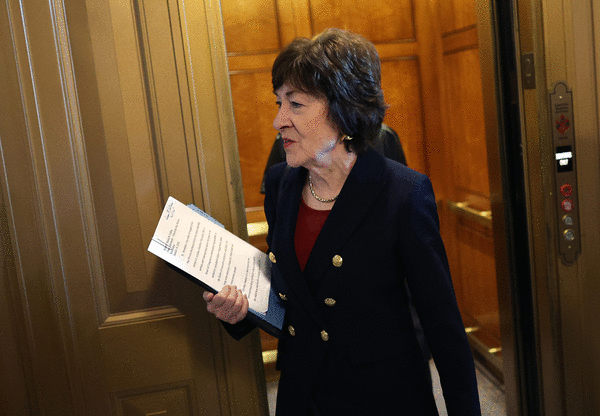
Senate Appropriations Chair Susan Collins, R-Maine, said Wednesday that the lawmakers were aiming to release a three-bill package of the Defense, Labor-HHS-Education and Transportation-HUD bills on Sunday night.
“The negotiations are still going on, but we’re down to a limited number of issues, so that’s a good sign,” she said.
The path forward for the Homeland Security bill remains more murky, however. That bill had been expected to move in the package the House passed Wednesday but had to be dropped after tensions rose following the shooting death of a Minnesota woman by an Immigrations and Customs Enforcement agent last week.
Negotiators were still trying to reach an agreement on a full-year Homeland Security bill, but it’s not clear if a breakthrough will happen in time to get the measure included in a final package or if funding for the Homeland Security Department would require another stopgap extension.
“We still don’t have a bipartisan bill,” Sen. Christopher S. Murphy, top Democrat on the Senate Homeland Security Appropriations Subcommittee, said Wednesday.
Bipartisan satisfaction
The two-bill package features relatively flat funding in the Financial Services bill and a major reduction to the National Security-State measure, compared to what Congress appropriated for fiscal 2025.
House National Security-State Appropriations Subcommittee Chairman Mario Diaz-Balart, R-Fla., said the bill would restore “fiscal sanity” to the agencies covered under it.
“Within these really, I think, dramatic but necessary reductions, the bill makes sure the secretary has the resources necessary to counter our adversaries,” Diaz-Balart said, mentioning China, Iran, drug cartels and Cuba.
Diaz-Balart said the bill confronts Cuba and includes language that limits funding to countries and organizations “that participate in the human trafficking of Cuban medical professionals.” Cuba is personal for Diaz-Balart, whose family fled the island nation during the 1959 revolution that brought the Castro regime to power.
House Appropriations ranking member Rosa DeLauro, D-Conn., heralded the Financial Services portion of the bill for increased funding for entrepreneurship programs at the Small Business Administration.
“At a time when so many families are feeling the weight of the affordability crisis, and job prospects feel few and far between, we must do everything in our power to increase economic opportunities in the communities that need it most,” she said.
President Donald Trump intends to sign the bill if it reaches his desk, the administration said in its statement of administration policy released Wednesday.
The statement says that spending covered by the package is $10 billion below current levels, while it “acknowledges the closure” of the U.S. Agency for International Development and supports the administration’s deportation efforts.
The Financial Services portion provides necessary security funding for the District of Columbia ahead of the nation’s 250th anniversary celebrations this year, the SAP says. The White House budget office also said the bill would provide the IRS “the funding necessary to ensure an efficient tax filing season, while significantly reducing spending on unnecessary and previously-weaponized IRS enforcement.”
Amendment votes
The Republicans’ slim majority and attendance issues raised concerns that an earlier vote for the rule needed to take up the bill could tank, but it was adopted easily after Speaker Mike Johnson, R-La., kept his conference in line.
To secure that partisan support, GOP leaders had promised two amendment votes to hard-line conservatives, both of which came up short.
One amendment, offered by Rep. Eli Crane, R-Ariz., would have prohibited funding in the bill from being used for the National Endowment for Democracy, a nonprofit group promoting democratic values that gets most of its funding from the federal government. The group has long been a target of some conservatives who say it promotes left-wing causes, but the amendment was defeated on a 127-291 vote.
The other amendment, offered by Rep. Chip Roy, R-Texas, would have cut funding for the U.S. Court of Appeals for the District of Columbia Circuit, as well as the U.S. District Court for the District of Columbia, by 20%, while striking salary and expense funding for the staffs of two U.S. District Court judges targeted recently by conservatives: James Boasberg of D.C. and Deborah Boardman of Maryland.
That amendment was defeated on a 163-257 vote.
_____
©2026 CQ-Roll Call, Inc., All Rights Reserved. Visit cqrollcall.com. Distributed by Tribune Content Agency, LLC.


















































Comments