A cacophony of presidential words, but few policy changes from Trump
Published in Political News
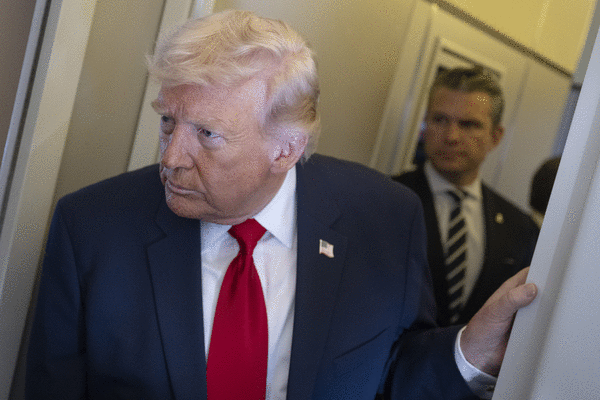
WASHINGTON — A tidal wave of presidential words does not policy make.
That was the lesson this past week at the White House, the Capitol and on board Air Force Once, where President Donald Trump got out 35,615 words publicly between Sunday and Thursday, according to CQ Roll Call’s Factba.se. His remarks generated dramatic headlines, heartburn for other world leaders and countless social media posts. But how much did they change all the many things his administration is doing?
Not very much.
In fact, Trump’s own words — at a singular event or media availability — contradicted something he had said moments, or even seconds before, in the same setting.
The talker in chief had a prolific Monday, when he was seen speaking 17,220 words in public settings for 1 hour and 41 minutes across a handful of events, according to Factba.se. Tuesday featured another presidential talk-a-thon, with 11,371 words spoken over 1 hour and 6 minutes during several St. Patrick’s Day events.
Those days were sandwiched between his 3,303 words during an 18-minute gaggle Sunday evening with reporters on Air Force One and a publicly silent Wednesday. Trump spoke 3,721 words over two events Thursday with Japanese Prime Minister Sanae Takaichi that collectively lasted nearly 30 minutes — including an awkward reference to that country’s attack on Pearl Harbor during World War II.
An example of Trump’s weeklong coyness came Thursday when a reporter asked if he would send more U.S. troops to the Persian Gulf region. “No. I’m not putting troops anywhere,” he replied, but with some wiggle room: “If I were, I certainly wouldn’t tell you.”
On Tuesday, Trump was seated alongside Irish Taoiseach Micheál Martin in the Oval Office when he declared, referring to U.S. allies who had rebuffed his requests for help opening the Strait of Hormuz: “We don’t need too much help and we don’t need any help, actually.”
But about 22 minutes later during the same media availability, the U.S. commander in chief signaled British Prime Minister Keir Starmer should have sent minesweeping ships to Hormuz.
“You would have thought they would have said, we’d love to send a couple of minesweepers. It’s not a big deal. It doesn’t cost very much money,” he said in a misleading statement about any costly naval deployment. “But they didn’t do that. … I think it’s very unfair to the United States, not to me, but to the United States.”
But two minutes after that — around the Oval session’s 29-minute mark — Trump appeared to reveal a U.S. intelligence assessment of what might, or might not, be awaiting oil tankers, shipping vessels and military ships.
“We’d like to have minesweepers because, just in case, we don’t know that there are any mines down (there) because we wiped out I think … 24 boats that do nothing but put mines in the water.”
Trump calls his long-form speaking style “the weave.” The next thought was a version of “the weave” in miniature as he used the alleged destruction of the Iranian ships that might — or might not — have laid mines like carpet on the Hormuz floor to boast about the military operation he greenlit.
“This doesn’t sound like a great country. This doesn’t sound like a friendly country, but we killed all of those boats. They’re at the bottom of the sea,” he said. “But, so, we don’t even know if there are any mines there. But if there are, we’d like to have a little help in finding them.”
That new ask for the minesweepers came just minutes after he wrote on Truth Social that he did not want help.
”Because of the fact that we have had such Military Success, we no longer ’need,’ or desire, the NATO Countries’ assistance — WE NEVER DID!” he wrote Tuesday morning. “In fact, speaking as President of the United States of America, by far the Most Powerful Country Anywhere in the World, WE DO NOT NEED THE HELP OF ANYONE!”
Only that the president claimed he did not need the ships after the leaders of several countries had publicly denied his request.
“For Europe, this war offers nothing: no security benefit, no economic benefit, and no political justification,” Democratic strategist Mike Nellis wrote this week. “Why would anyone lift a finger for a man who has attacked them, hurt their economies, and threatened their sovereignty?”
The U.S. communicator in chief’s torrent of contradictory words with little policy effect was not limited to his Iran war.
Trump was asked Monday to clarify statements he and his team have made warning Cuba that it could follow Venezuela and Iran as a target of U.S. military strikes.
“I do believe I’ll be the honor of having, the honor of taking Cuba,” Trump said. “That’d be good. That’s a big honor.”
A reporter from typically friendly Fox News asked in a surprised tone: “Taking Cuba?”
What followed was another miniature “weave” — but, again, no firm change nor any clarity on his administration’s possible plans for the Caribbean island.
“Taking Cuba in some form, yeah. Taking Cuba. I mean, whether I free it, take it, I think I could do anything I want with it,” Trump said. “You want to know the truth? They’re very weakened nation right now.”
Another example came Tuesday, during the same Oval Office availability with Ireland’s Martin. Trump was asked about Iranian officials’ warnings earlier that day that American boots on the ground in their country would lead to another Vietnam War.
“No, I’m not afraid,” said the former critic of prolonged U.S. military ground operations in the region. “I’m really not afraid of anything.”
There was one policy declaration that was clear.
“If (the war) were to be extended, it wouldn’t really disrupt the U.S. economy very much at all,” White House National Economic Council Director Kevin Hassett said Tuesday. “It would hurt consumers, and we’d have to think about, if that continued, what we’d have to do about that — but that’s really the last of our concerns right now. … We’re very confident that this thing is going ahead of schedule.”
Yet, by week’s end, the government of the Islamic Republic remained intact, the Strait of Hormuz remained closed and oil prices remained well above where they’d stood before the joint U.S.-Israeli attack on Iran on Feb. 28.
In many ways, Hassett’s 45 words were more telling and definitive than the ten of thousands Trump uttered.
©2026 CQ-Roll Call, Inc., All Rights Reserved. Visit cqrollcall.com. Distributed by Tribune Content Agency, LLC.








































Comments