Minnesota House GOP effort to launch Tim Walz, Keith Ellison impeachment fails
Published in Political News
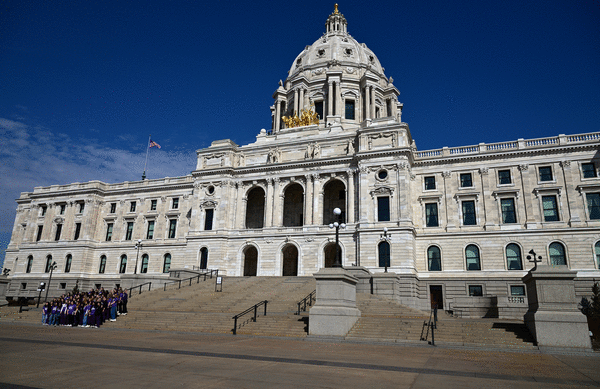
ST. PAUL, Minn. — A Republican-backed proposal that would have set up the framework for impeachment proceedings for Democratic Gov. Tim Walz and Attorney General Keith Ellison over fraud concerns failed to pass in a House committee on Wednesday.
There was little chance of the resolution passing in the tied House, where it was defeated on an 8-8 vote of the House Rules Committee after Democratic Farmer Labor and GOP lawmakers debated for a little more than an hour. DFLers called the discussion a waste of time as it was bound to fail.
The resolution would have set up a structure for an investigation in the House, though it would not have formally initiated proceedings against Walz or Ellison. With allegations of significant fraud in state government programs in recent years, Republicans said the House should use its powers to answer questions about the top state leaders’ handling of the scandals.
“Minnesotans are rightfully demanding answers regarding the theft of billions of dollars of our state money in multiple overlapping fraud schemes,” said Rules Committee Chair Harry Niska, R-Ramsey, referencing speculation at the overall amount of Medicaid fraud from the state’s former U.S. Attorney. “Minnesotans demand answers, and they are asking for accountability.”
Niska said an impeachment investigation would help answer questions about how Walz handled funding for programs while the Feeding Our Future scheme was still active at the beginning of the decade, as well as whether Ellison knew people he received campaign contributions from were involved in fraud.
A tied House
If the resolution had passed, the House Committee on Fraud Prevention and State Agency Oversight would be tasked with an impeachment investigation and presenting a report no later than May 1. The House is tied 67-67 between the parties, but Republicans have control of the fraud committee as part of a power-sharing agreement from 2025.
Even if articles of impeachment are officially filed, it’s unlikely they’d pass in the tied House, where 68 votes would be needed to advance the process to a Senate trial where members would determine whether to remove Walz and Ellison from office.
The Legislature has pursued an active impeachment inquiry since the 19th century, according to Matt Gehring, director of House Research, and they generally involved actions against judges.
In Wednesday’s hearing, Democratic lawmakers pressed their GOP colleagues on whether they supported the impeachment of Republican President Donald Trump, who has already been impeached twice by the U.S. House when the chamber was under control by Democrats, and will likely face impeachment again if Democrats take back control of the chamber.
Rep. Michael Howard, DFL-Richfield, pointed to the president’s 34 felonies, attempts to overturn the results of the 2020 election, and numerous sexual assault allegations as just a few examples of reasons he should be removed from office.
“At every turn, you’re having complete silence on a president who basically has an impeachable offense on any day that ends in ‘Y’. And so it’s tough to take this serious,” Howard said. ”I think what Minnesotans want us to do with the last remaining bit of session is to focus on the issues they care about. Let’s help make lives more affordable, let’s actually get stuff done.”
Rep. Jim Nash, R-Waconia, shot back that lawmakers have no power to act on the president and called DFLers’ arguments a distraction.
“We can’t impeach anybody in Washington. We don’t have that privilege of voting in that chamber of Congress or the Senate,” he said. “So the question remains, where does accountability begin here in the state of Minnesota? And what I’ve heard from my colleagues on the DFL side of the aisle today is a deflection away from the things that we’ve heard.”
Walz: GOP lawmakers ‘putting on a little play’
Speaking to reporters at an event in Rochester on Wednesday, Walz said GOP lawmakers were “putting on a little play” and called on them to act on bills that actually had a chance of passing in the Legislature by the end of session in May.
“They know, and I know it’s more likely the sun will rise in the west than that will happen and go anywhere,” said Walz, who ended his campaign for a third term as governor in January as public pressure mounted on his record with fraud. “I get it, they don’t like me, but they were not elected to like me; they were elected to serve their constituents … I’m gone in eight months, just get over it and do some work for your constituents.”
The attorney general’s office had no comment on Wednesday’s proceedings. Ellison is seeking a third term in this year’s election.
Proven fraud in Minnesota is in the hundreds of millions, despite former federal estimates that it could top $9 billion since 2018. The state lost about $250 million alone in the Feeding Our Future meal fraud scheme, according to federal prosecutors, who have convicted dozens since the first charges were filed in 2022. The money involved was federal funding for state administered programs.
Federal officials say 2025 charges in Medicaid-funded state programs in services like housing assistance and autism support are likely only the surface of more extensive fraud in programs lacking proper oversight. Fraud in those alleged schemes so far has only reached the tens of millions, according to charges.
_____
©2026 MediaNews Group, Inc. Visit at twincities.com. Distributed by Tribune Content Agency, LLC.









































Comments