Mariners slugger Cal Raleigh is catching fire at the right time. Is a swing change to thank?
Published in Baseball
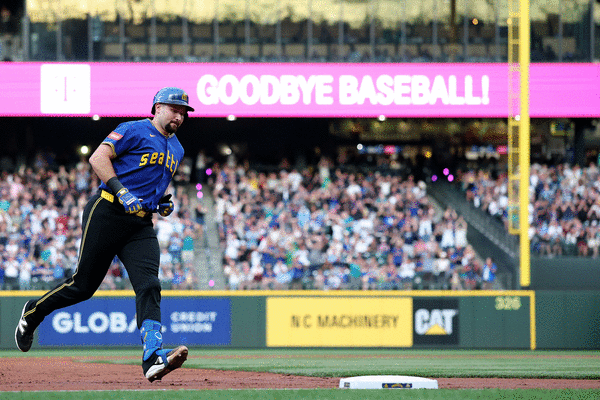
SEATTLE — Cal Raleigh fidgeted with his hands and looked at his feet. He rocked back and forth a little, weighing his answer and how much he really wanted to share.
It was like a dentist asking him how regularly he flossed.
Raleigh wasn’t being asked about anything negative in a season filled with plenty to be pessimistic about.
No, he was being asked about his recent success and a small but somewhat noticeable tweak to his setup/stance at the plate following his most productive stretch of plate appearances since either mid-April or last season.
Coming into Wednesday’s homestand finale, Raleigh had produced a .348/.531/1.130 slash line over his last nine games, including six homers, nine RBIs, nine walks and only five strikeouts. That, of course, included Raleigh's career-best three-home run game Monday night, which he followed up with another on Tuesday.
Never one who enjoys talking about himself and his accomplishments, this seemed even more uncomfortable.
The hesitation to share the changes made to stance or swings isn’t uncommon. Some players, specifically Julio Rodríguez, refuse to discuss them.
There is a fear opening up about what they are changing or trying to work on will allow opponents to make adjustments. And, of course, baseball players are quite superstitious, with worries that talking about changes that lead to success could somehow make them not effective or the success might dissipate.
You never talk about it," said a former Mariners player. "Never."
But Raleigh, who believes consistent work matters more than luck, slowly opened up about the changes.
“I’m just trying to get into a good spot where it doesn’t take as long to get to my fire position,” he said.
This is where it gets a little hitting-coach nerdy.
The fire or launch position is where the swing starts to “fire” forward with the hitter's hips first, then eventually followed by his hands. For Raleigh, it usually comes the moment when the heel of the front foot is firm into the ground after a small leg kick and step forward. Ideally, his hands are stacked in a strong position near his back shoulder with his bat knob pointed toward the catcher and barrel with a slight tilt. It’s the position that allows his hips to separate from his hands, creating a stretch before coming through.
Think of pulling back a sling shot and building up that energy before releasing with force and speed.
During his struggles this season, Raleigh hasn't found consistency in getting to the proper firing position; either his front foot wasn't getting down soon enough or his hands weren't in the right spot.
Normally, Raleigh's stance starts with his hands just above his shoulder, about ear level and closer to his neck. As the pitch is being delivered, his hands would slide back into position as he loaded his body to swing. But this season, the timing and placement on that movement has been inconsistent for a variety of reasons. He has struggled to put himself into a good firing, or hitting, position with regularity. It's almost impossible to hit MLB pitching in that situation.
On the previous road trip, he brainstormed with coaches Edgar Martinez and Kevin Seitzer about ways to get into that position quicker. It wouldn't just help him make more contact, but also help with his swing decisions.
"Ultimately that's what it's all about is being able to recognize pitches, lay off bad ones, see the good ones and execute on the good ones," Raleigh said.
Martinez suggested that Raleigh has started putting his hands up higher and back farther, closer to the preferred spot for his firing position, similar to the hall of fame DH's stance during his playing days.
Mariners fans can easily imitate the high hands of Edgar waving the bat.
But what they may not remember is how Martinez’s hands worked down into the firing position with metronomic consistency.
“Edgar is a big proponent of it,” Raleigh said. “He always has been. He’s been big on getting your hands back early and getting that separation beforehand so you don't have to worry about it. You are basically taking the chance of not getting them back there or not being on time with them.”
Admittedly, Raleigh wasn’t in a spot where he could be resistant to suggestions. With the Mariners fighting to make the postseason over the final month of the season, he knew something needed to change.
“I was trying to simplify it,” he said. “That was a very simple thing to do. There's less room for error just by having them a little higher, a little more back. I'm a little more in that position from where I fire from, and I don't really have to go searching for that spot or have perfect timing every time. By getting there early, I have more room for error for being on time to hit the fastball and staying back a little more on the breaking ball.”
The changes didn't provide immediate results in Milwaukee as he tried to get used to a new feel in his stance. And even with his success during the homestand, including the four homers in five plate appearances, results are still fleeting.
Raleigh went 0 for 4 with four strikeouts a few hours after talking with the media about the swing changes. To be fair, Jesus Luzardo was also dominant and struck out nine, giving him 203 punchouts on the season.
But it’s likely Raleigh won’t be talking about that subject again any time soon either.
The thinking behind the changes mattered. The impetus for change was obvious, but changes are not as easy to implement as fans might expect. They aren’t a magic fix. But if they can lead to incremental improvements that result in better production, that's what is needed.
“To me in a typical season, it’s like 10 percent of the time you're hot, super hot, you can't get out,” he said, “And another 10 percent of time, you're awful, can't do anything right. And then there’s that remaining 80 percent where you're kind of fighting and battling. Maybe you’re not good, but maybe you’re not bad. You’re sort of right in the middle. ”
This season, the ratios have felt uneven. The awful has felt more than 10% and the hot has been much less. The rest has been a battle.
"The first however many months are what they are, and (you) can't live in the past," he said. "You've got to move on, look to the future, Obviously, it stinks. But at the same time, there's still a great opportunity in front of us, and there's a lot of optimism, a lot of things to look forward to and things to play for. It's not been exactly how we wanted to go, but at the same time, there's so much in front of us."
© 2026 The Seattle Times. Visit www.seattletimes.com. Distributed by Tribune Content Agency, LLC.





Comments