They went hunting for deer. They shot elk instead.
Published in Outdoors
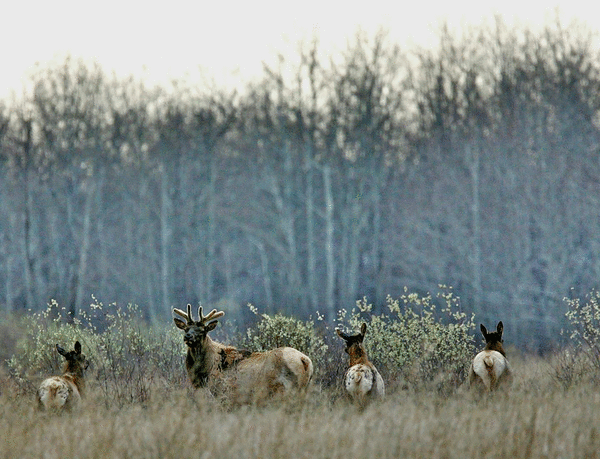
MINNEAPOLIS — Wildlife officials in Minnesota and Wisconsin have reported four wrongful killings of elk in recent weeks.
In northern Minnesota, hunters illegally shot three bull elk during the firearms deer season, according to the Law Enforcement Division of the Department of Natural Resources. Two of the elk were taken in wilderness management areas, Skull Lake near Lancaster and Twin Valley, northwest of Detroit Lakes. The third was shot near Greenbush in the northwest corner of the state.
In at least two cases, the hunters told conservation officers they mistook the elk for whitetails, said division spokesperson Joe Albert. Two hunters self-reported, and officials issued citations to all three, he added.
“These instances certainly underscore some of the key tenets of firearms safety — namely that it’s imperative to properly identify your target,” Albert said.
Confusing a much larger ungulate for a deer is uncommon, though not unheard of. Last year, a Duluth man said he mistook a partly obscured bull moose for a deer in the rising sun of opening morning and shot it about 20 miles south of Eveleth.
The Wisconsin case isn’t so clear. On Nov. 17, a bull elk was found shot to death on public land in Jackson County in west-central Wisconsin.
“The elk’s head was removed, and the entire carcass was left to rot,” according to a DNR statement on the incident. The agency is seeking tips on what happened.
The elk would have been part of Wisconsin’s central elk herd around Black River State Forest, estimated in July to be about 225 animals. A hunting season for those elk is underway, but licensed hunters must register their kills, and leaving an animal to waste is illegal.
Redemption in the Wisconsin woods
It took this weekend’s Wisconsin deer opener to redeem our family’s deer season. At least that’s how my son sees it.
At 16 and comfortable with his rifle, he had high hopes he’d shoot his first deer this year.
The moment presented itself in the waning light of the last day of Minnesota’s regular firearms season earlier this month. A doe appeared in my firing range, and I quickly shot it. As it ran before dropping, a smaller deer, likely its fawn, chased after and then stopped. My son shot it.
My deer was dead, but his was not, and after following the blood trail well into the night — and the next morning — an ugly truth of deer hunting settled upon him: Sometimes you shoot a deer but it doesn’t die, and you never know its fate.
He studied diagrams of deer anatomy and aiming points, vowing to do right by the next deer, whenever that might be.
And so, it was amid a steady drizzle that we climbed into a ladder stand in northwest Wisconsin for that state’s rifle opener on Saturday. As usual, Wisconsin’s later season was throwing harsher elements at us than Minnesota had.
Around 8:30 a.m. — during a lull in the precipitation — a deer walked into his firing line. This time, his .243 found its mark. We watched the deer bound through the forest and crash to a halt behind a pair of leafless maples. It was only when he knelt down that he discovered two nubs atop the deer’s skull: a “button buck,” likely born this year.
At the meat processor and then the diner in town, he welcomed the congratulations that inevitably followed when anyone learned the news.
“Now I can live with that other one,” he said later.
He and I each had more tags. So on Sunday, we returned to the stand. Once again at 8:30 a.m., three deer walked onto my son’s side. He fired at the biggest, a well-shouldered doe, and fired well. We watched it run briefly and fall amid the maple pillars.
This one was twice as big as his first.
Pepin County gets its first CWD case
On the eve of the state’s rifle season, wildlife officials confirmed the first case of chronic wasting disease in a wild deer in Pepin County in western Wisconsin.
CWD has been detected in all but 15 counties in Wisconsin, but it’s most widespread in the southern part of the state, where more than 5% of the deer tested were positive in 2024 and 2025.
Pepin County, on the other hand, is in bluff country, overlooking the Mississippi River across from Lake City, Minn. The area is renowned for producing large bucks with record antlers, likely a result of quality habitat and minerals in the soil.
A smattering of positive cases have shown up in neighboring Buffalo County in recent years, but this is the first in a wild deer in Pepin, where a baiting and feeding ban will now be extended for three years.
©2026 The Minnesota Star Tribune. Visit startribune.com. Distributed by Tribune Content Agency, LLC






Comments